
Rüstem Pasha Mosque
To find the Rüstem Pasha Mosque, you have to earn it. There is no grand approach, no wide boulevard announcing its presence. You thread through the Hasırcılar Çarşısı — the Strawmat Weavers Market — past stalls selling saffron and dried figs, then climb a narrow staircase tucked into a corner, and suddenly, without warning, you step into a courtyard of extraordinary calm. What fills the mosque beyond is unlike anything else Mimar Sinan built: every vertical surface, from floor to gallery, covered in İznik tilework so dense and so varied that scholars still argue over who ordered all of it, and why.
A Grand Vizier's Complicated Legacy
Rüstem Pasha served Sultan Suleiman the Magnificent as Grand Vizier twice — from 1544 to 1553, and again from 1555 until his death in 1561. He was also Suleiman's son-in-law, married to Mihrimah Sultan, the emperor's beloved daughter by Hurrem Sultan. Power and family connection combined in a man who was widely viewed with suspicion by his contemporaries. He accumulated wealth on a scale that drew resentment, and his political maneuvering — including a role in the execution of Suleiman's son Şehzade Mustafa — left him a figure of controversy even within the court.
Before he died, Rüstem Pasha expressed the wish to build a mosque in Istanbul. Whether this was genuine piety, a calculated attempt to burnish his reputation, or both, the historical record does not make clear. Sultan Suleiman authorized the project in 1562, the year after Rüstem's death. Land deeds date to that year; a water deed suggests the mosque was still incomplete in December 1562. It was almost certainly operational by late 1563.
Sinan Builds on a Market
Mimar Sinan — the Ottoman Empire's chief architect, responsible for hundreds of structures across the realm — faced an unusual constraint at this site: there was very little room. The Tahtakale neighborhood of Fatih, near the Spice Bazaar, was already dense with commerce. Sinan's solution was characteristically practical and elegant. He raised the mosque on a high terrace over a complex of vaulted shops, whose rents were designed to financially support the mosque complex in perpetuity. The elevation gave the building visibility in the Istanbul skyline despite its modest footprint.
Access from the street comes through narrow, twisting interior staircases in the corners of the terrace, which open onto a spacious courtyard. The mosque has a double porch with five domed bays, sheltered by a deep, low roof on columns. Because the terrace left no room for a standard ablution kiosk, that structure was relocated to street level — a small but telling sign of how creatively Sinan worked within this site's limitations.
The İznik Tide
Inside, the effect is immediate and overwhelming. The mosque's interior plan is an octagon inscribed within a rectangle, the main dome resting on four semi-domes set in the diagonals rather than along the building's axes — a structural arrangement that opens the interior to light. But what visitors remember is the tile.
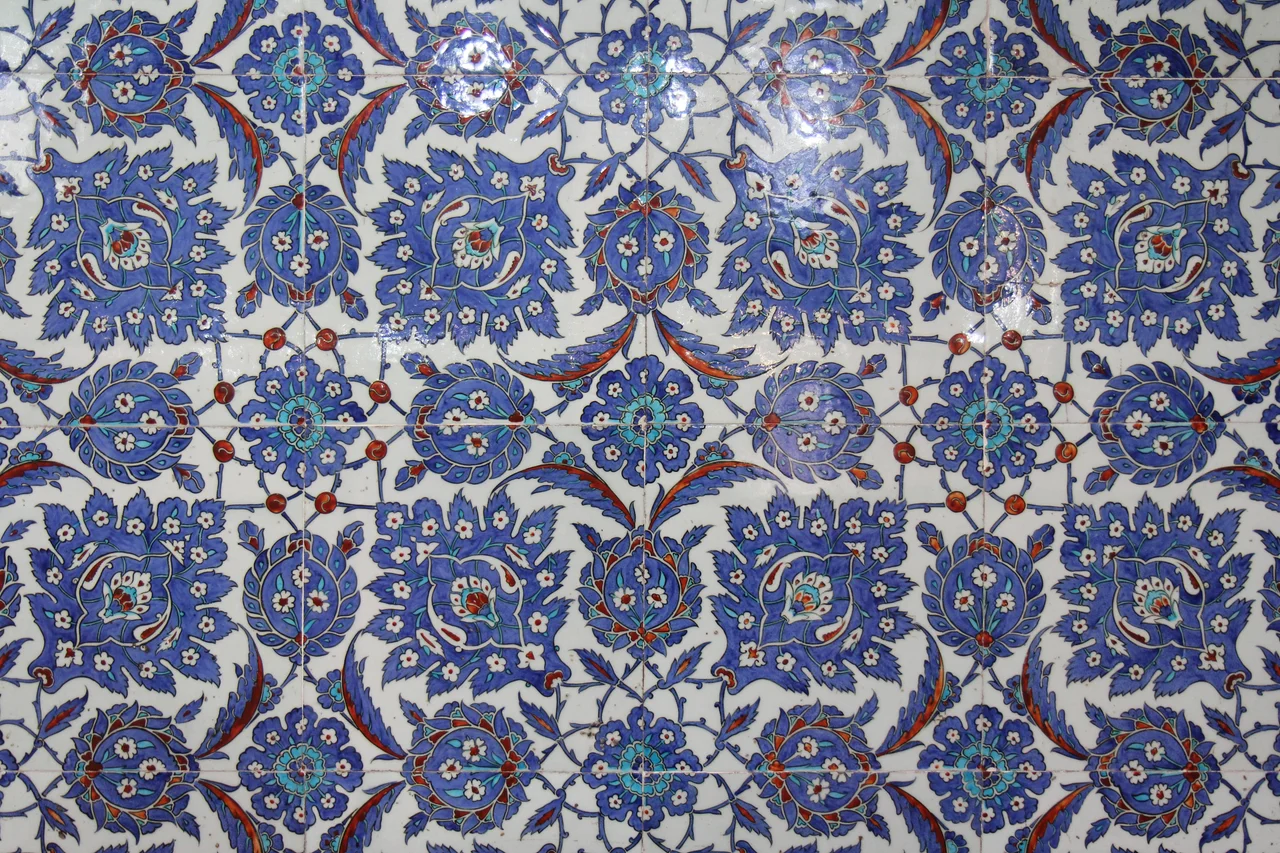
No other mosque uses İznik tilework this lavishly. The walls, the arches, the galleries, the porch — all are covered in repeating panels of cobalt, turquoise, and white, punctuated by rose buds, lotus palmettes, and carnations. The characteristic pattern known as the Rüstem Pasha Border — cobalt tiles, a white rosace, turquoise accents — recurs throughout, giving the interior a visual rhythm beneath its apparent riot of decoration. The tiles were produced in İznik, the Anatolian town whose kilns had reached the height of their art in the sixteenth century. Some scholars believe Rüstem Pasha commissioned the tiles specifically to support the court designer Kara Memi, known for his floral compositions. Others suggest some tiles were added after Rüstem's death. A few panels, notably near the main entrance, show the sage green and dark manganese purple of an earlier 'Damascus ware' palette. The bright emerald green found in one exterior panel was added later still — because that vivid hue was not available to the mosque's original builders.
The Qibla Wall's Quiet Complexity
The wall oriented toward Mecca — the qibla wall — is the most studied surface in the mosque. Mostly blue in its tiling, it uses two shades of paint in what scholars call 'two-blue' painting: a relatively restrained technique that produces a calm, slightly repetitive field. Inset into this field is a mihrab — the prayer niche — shaped like a half-dodecagon. Between its frames, a panel of calligraphy in the thuluth script is framed by white tile borders with blue guard stripes. Wedged into the space between the mihrab frame and niche is a section of cambered tile in a vivid red found nowhere else in the mosque, startling against the surrounding blues.
Scholars note that the qibla tiling looks as if several hands worked on it at different moments. The art historian Walter B. Denny has suggested the project may have been deemed too large for one designer, with multiple contributors adding to Sinan's underlying vision. After extensive restoration, the mosque reopened for worship in 2021.
A Hidden Place in a Busy City
What makes the Rüstem Pasha Mosque singular is the combination: the modest exterior, the unexpected elevation, and then that interior. Istanbul has grander mosques — the Blue Mosque's six minarets, the Süleymaniye's commanding hilltop position. But none hides its splendor quite like this one, folded into the fabric of a commercial district, reached through a working market. The tiles were made at the peak of İznik ceramic production, in a moment when Ottoman craftsmen had mastered a red so vivid it seemed to glow. That red — the so-called 'tomato red' of mid-sixteenth century İznik ware — faded from production in later decades. The Rüstem Pasha Mosque preserves it, along with hundreds of other patterns and palettes, in a space small enough that you could count the tiles if you had a month to spare.
From the Air
The Rüstem Pasha Mosque sits at 41.0176°N, 28.9687°E in the Eminönü/Tahtakale district of Istanbul's historic peninsula, roughly 150 meters north of the Spice Bazaar and 400 meters from the Galata Bridge over the Golden Horn. At cruising altitude above Istanbul, the mosque is not individually visible, but its neighborhood — a dense grid of market streets between the Golden Horn waterfront and the hillside above — is clearly identifiable. The nearest major airport is Istanbul Airport (LTFM) on the European side of the city, approximately 35 kilometers to the northwest. Approach the city from the west to see the historic peninsula's skyline: the Blue Mosque's six minarets, Hagia Sophia's dome, and the Süleymaniye complex on its hill are the dominant landmarks. The Eminönü waterfront and the Galata Bridge crossing the Golden Horn sit at the base of the peninsula. Visibility is best in the morning before summer haze develops.
Nearby Stories
- Kocaeli Peninsula 7.6 km away
- Second Battle of Çatalca 11 km away
- Istanbul's Rural Outskirts 14 km away
- MV Struma 20 km away
- HMAS AE2 36 km away
- Bursa 66 km away
- Sangarius Bridge 71 km away
- Januarius MacGahan 101 km away