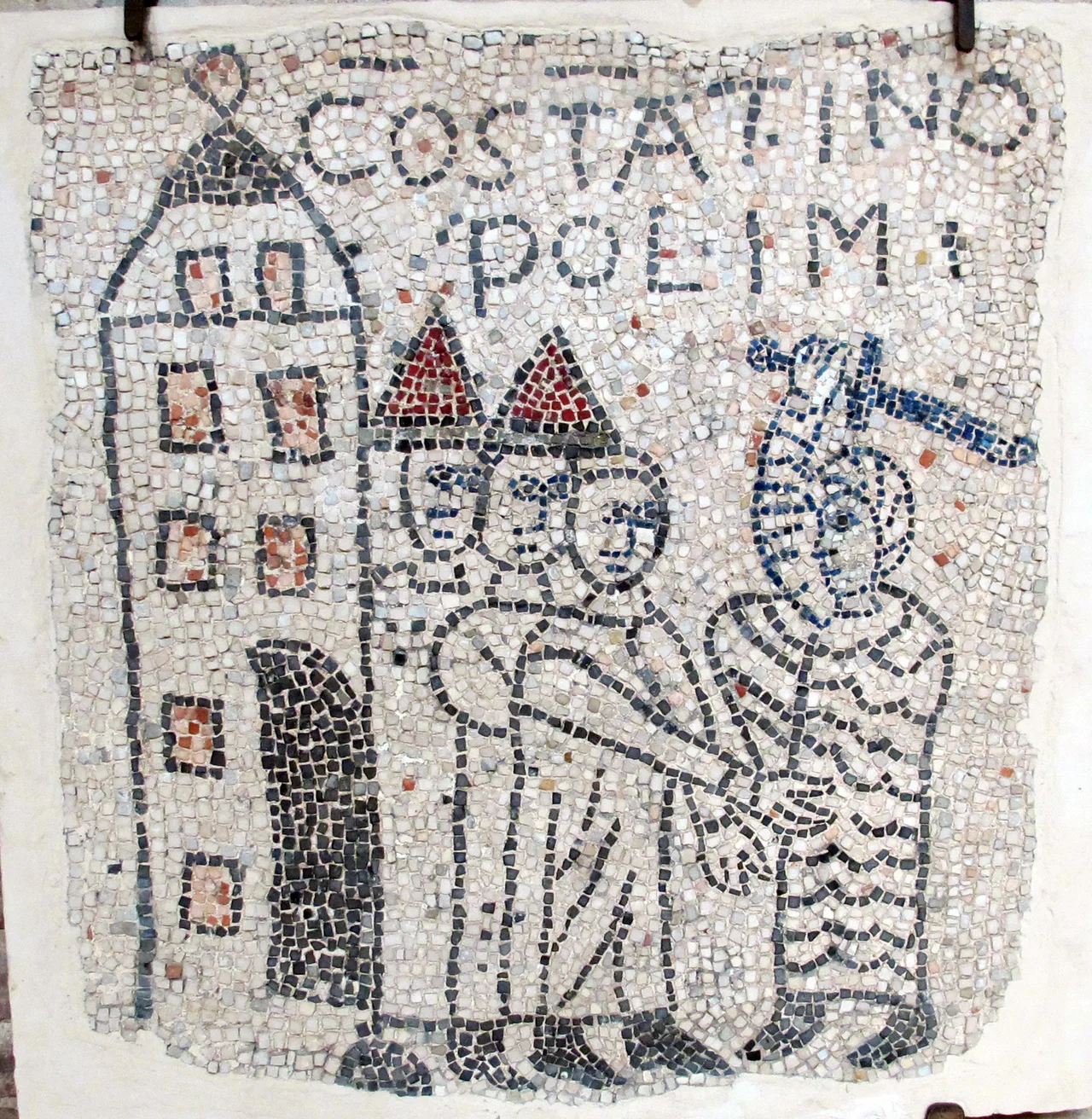

Sack of Constantinople
The soldiers who sacked Constantinople in April 1204 had taken the cross. They had sworn oaths before God to fight for the recovery of Jerusalem. Instead they spent three days killing, raping, enslaving, and looting the inhabitants of the greatest Christian city in the world — a city that had sheltered Eastern Orthodox civilization for nearly nine centuries. The men and women who lived through those days were not the enemies of Christendom. They were its eastern half, speaking Greek rather than Latin, worshipping in a different rite but praying to the same God. What the Fourth Crusade did to Constantinople was, by any reasonable measure, a catastrophe visited by Christians upon Christians — and its consequences stretched across centuries.
How a Crusade Turned on Itself
The Fourth Crusade did not begin with Constantinople as its destination. It began, like earlier crusades, with the intention of reaching the Holy Land. But the enterprise was from the start entangled in debts, politics, and competing interests. The Venetians, who had contracted to transport the Crusader army by sea, found themselves owed money the Crusaders could not pay. Alexios IV Angelos, the son of a deposed Byzantine emperor, offered a way out: if the Crusaders would help restore his father to the throne in Constantinople, he would provide 200,000 marks of silver, submit the Orthodox Church to Rome, and join the crusade against the Saracens.
The diversion to Constantinople seemed to offer something for everyone. For the Venetians, whose merchants had carefully mapped the city's harbors years earlier and who had long resented Byzantine trade advantages, the proposition held obvious appeal. For the Crusader leadership, it was a way to resolve their debts and regain momentum. In August 1203, the pro-Crusader Alexios Angelos was crowned Emperor Alexios IV. He tried to honor his promises. He could not. The financial demands were beyond the empire's means, and his association with the Crusaders made him deeply unpopular among his own people.
By January 1204, Alexios IV was deposed. By February, he had been strangled. The new emperor, Alexios V Doukas, offered the Crusaders nothing. They had lost their client and their promised payment. The siege that followed was no longer about restoring an emperor — it was about taking what they had come to collect.
Three Days in April
The first assault on the city, on April 9, 1204, was driven back. Bad weather compounded the difficulties; troops who landed on the shore came under heavy fire and retreated. A second assault succeeded. On April 13, Crusader and Venetian forces breached Constantinople's walls.
What followed, over three days, was a systematic sacking of a city that held some of the most significant art, relics, and wealth of the medieval world. The Crusaders had taken oaths not to harm Christian inhabitants. Those oaths were broken. Civilians were killed. Women were raped. Residents were enslaved or held for ransom. Churches were looted — priests beaten and altars stripped. Even the tombs of Byzantine emperors in the Church of the Holy Apostles were pillaged. The historian Nicetas Choniates, who was present in the city, wrote in anguish: the Crusaders, he said, were less merciful than the Saracens who had taken Jerusalem a century before. Hagia Sophia itself — the great church that had stood at the center of Orthodox Christian worship for nearly seven hundred years — was desecrated; a prostitute was placed upon the patriarchal throne. The estimate of civilian dead is approximately 2,000 people, though the total human cost, accounting for enslavement and those who fled, was far greater. The Venetians received 150,000 silver marks as their share; the Crusaders took 50,000 silver marks from the agreed division, plus additional sums. An estimated 500,000 silver marks were stolen outright by Crusader knights outside any formal arrangement.
A City Divided, an Empire Diminished
According to a prearranged treaty, the Byzantine Empire's territories were divided between Venice and the Crusaders' leaders. A Latin Empire of Constantinople was proclaimed. Baldwin IX of Flanders was crowned emperor in Hagia Sophia as Baldwin I. The Venetians secured key ports and islands; Boniface of Montferrat went on to found the Kingdom of Thessalonica. The Venetians also established the Duchy of the Archipelago in the Aegean.
Most of the Byzantine aristocracy fled. Among ordinary people, there was little sympathy for the elite who had governed them with increasing incompetence. But the Latin Empire they had been handed was fragile from the start. Byzantine exiles established successor states, among them the Empire of Nicaea. In 1261, the Empire of Nicaea recaptured Constantinople and restored Byzantine rule. But the empire that came back was not the one that had been taken. It never regained its former territory. It never recovered its economic strength. Over the following two centuries, it fell piece by piece to the rising Ottoman Empire, which completed its conquest in 1453.
The sack had weakened Byzantine defenses not just militarily but economically and psychologically. The walls that had protected the city for a millennium were allowed to fall into disrepair. The treasury that might have financed resistance was gone. The population was smaller. The empire was poorer.
The Wound That Remained
The Orthodox world did not forget what happened in April 1204. The image of Latin soldiers desecrating the altars of Constantinople — breaking open reliquaries, melting down sacred vessels, loading mules with chalices and vestments — entered the memory of Eastern Christianity as an act of violence whose perpetrators could never quite be forgiven.
Relations between the Catholic and Orthodox churches, already strained, were broken in ways that proved nearly permanent. Formal dialogue and occasional negotiations over reunion continued for centuries, but the emotional reality of 1204 made genuine reconciliation enormously difficult. In May 2001, Pope John Paul II expressed sorrow to the Orthodox Patriarch Bartholomew I for the sacking of Constantinople, acknowledging the events of eight hundred years earlier as a cause of ongoing pain; Bartholomew formally accepted the apology in April 2004.
Walking through Istanbul today — through the neighborhoods that were Constantinople, past the surviving walls, near Hagia Sophia — it is possible to sense the layering of history: Byzantine, Latin, Ottoman, Turkish. The sack of 1204 is a seam in that history, a place where something broke that was never quite repaired. The people who suffered through those three days in April — the residents of Constantinople who had done nothing to invite this attack beyond being Greek and Orthodox — deserve to be remembered as what they were: not symbols of ecclesiastical rupture, but human beings whose city was taken from them by soldiers who had promised to protect Christendom.
From the Air
The events of April 1204 centered on Constantinople — today's Istanbul — at approximately 41.0375°N, 28.9450°E on the historic peninsula where Europe and Asia approach each other across the Bosphorus strait. The walls breached by the Crusaders in 1204 ran along the Golden Horn waterfront on the city's northern side. From the air, approaching Istanbul from the west, the historic peninsula is clearly visible as a triangle of land bounded by the Sea of Marmara to the south, the Golden Horn estuary to the north, and the Bosphorus to the east. Hagia Sophia's dome and the Blue Mosque's six minarets dominate the skyline of the peninsula's eastern end. The nearest major airport is Istanbul Airport (LTFM), approximately 35 kilometers to the northwest on the European side of the city. The old Theodosian walls, parts of which still stand on the peninsula's western land side, are also visible from low altitude.
Nearby Stories
- Kocaeli Peninsula 7.6 km away
- Second Battle of Çatalca 11 km away
- Istanbul's Rural Outskirts 14 km away
- MV Struma 20 km away
- HMAS AE2 36 km away
- Bursa 66 km away
- Sangarius Bridge 71 km away
- Januarius MacGahan 101 km away