
Sakıp Sabancı Museum
The mansion at Emirgan has been many things in its life: the property of pasha families and Egyptian governors, a royal residence and embassy for the Kingdom of Montenegro, a summer home for one of Turkey's great industrial dynasties, and eventually a museum that brought Picasso, Rodin, and Genghis Khan to the Bosphorus shore. A bronze horse still stands at the entrance — the same sculpture that gave the property its popular name, Atlı Köşk, the Equestrian Villa, after industrialist Hacı Ömer Sabancı placed it there in 1951. That horse, and the Bosphorus glittering beyond the garden, frame a place that has quietly become one of Istanbul's most significant cultural destinations.
A Mansion That Changed Hands
The history of the building at Emirgan is a compressed version of Istanbul's own layered past. From 1848 to 1884, it belonged to various pasha families and khedives — Egyptian governors of the Ottoman era. In 1884, Sultan Abdülhamid II purchased it through the Ottoman Treasury and presented it as a gift to King Nicola I of Montenegro. For the next thirty years the mansion served as both a royal residence and the embassy of Montenegro in Istanbul.
In 1913, the Ottoman government repossessed the property. It passed to the granddaughter of Sultan Mehmed V Reşad, and after the founding of the Turkish Republic it fell into the hands of Prince Mehmed Ali Hasan, grandson of Khedive İsmail Paşa. The prince commissioned the architect Edoardo De Nari to rebuild the structure, but the mansion remained unused for years until the prince's elder sister made it her home in 1944.
In 1951 came the purchase that defined the property's modern identity. Hacı Ömer Sabancı, founder of Sabancı Holding, bought the mansion as a summer residence. His son Sakıp Sabancı lived there from 1969 until 1999, by which point the building and its collections had become something larger than a family home.
The Collection Takes Shape
Hacı Ömer Sabancı began collecting decorative art in 1940 — figurines, metalwork, porcelain, furniture, objects of art. His son Sakıp expanded the collection from 1970 onward with a more focused intention. What emerged over decades was an extraordinary breadth: 18th and 19th century Chinese porcelain in the Famille noire and Famille verte traditions; large numbers of Sèvres vases and German porcelain from Berlin and Vienna; more than 320 paintings by Ottoman and Turkish artists including Osman Hamdi Bey, İbrahim Çallı, and Fikret Mualla, alongside European artists who lived and worked in the Ottoman world such as Fausto Zonaro and Ivan Ayvazovsky.
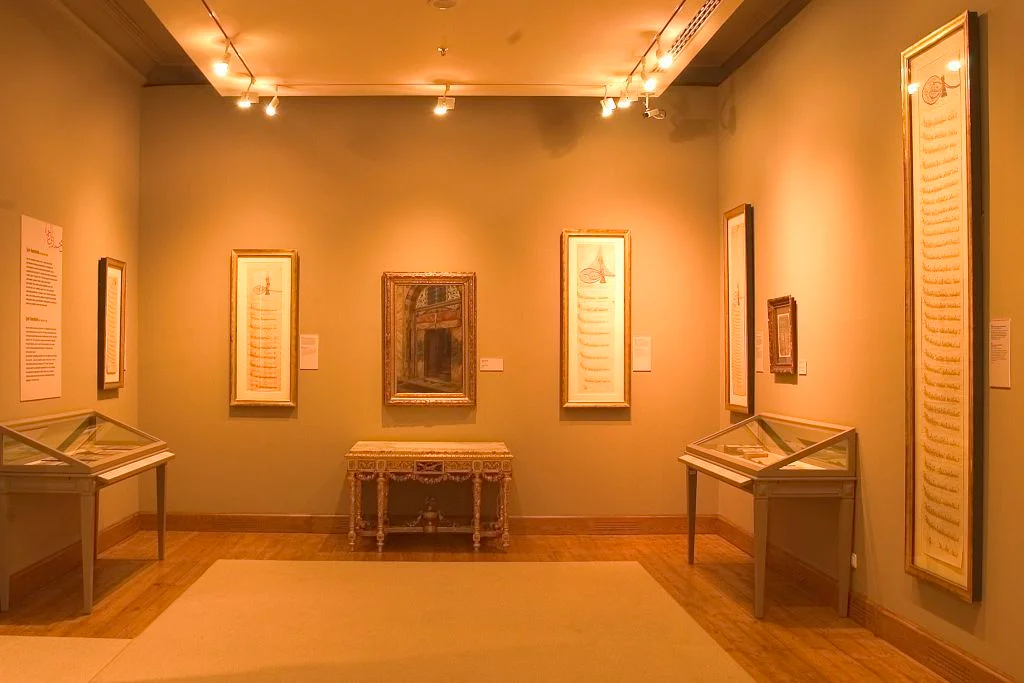
At the core of the museum's permanent collection — and its deepest scholarly significance — is the calligraphy. Nearly 400 pieces document Ottoman calligraphic art across 500 years: manuscript Korans and prayer books, imperial decrees and documents, calligraphic panels, seals, poetry books, and the tools of the craft itself. Among the Koran editions accessible through the museum's digital archive are a volume reflecting the style of the court gilder Kara Memi from the Suleiman I era, the sole edition inscribed by Bayezid II's heir Şehzade Korkud, and a Koran written by the celebrated calligrapher Hafız Osman in 1682. These are not curiosities — they are primary documents of Ottoman civilization.
Picasso, Rodin, and the Bosphorus
The mansion was leased in 1998 for 49 years to Sabancı University, which opened the Sakıp Sabancı Museum in June 2002. A modern gallery annex was added alongside the original mansion to accommodate the institution's growing ambition.
The temporary exhibition program that followed raised the museum to international attention. In late 2005, 'Picasso in Istanbul' brought 135 pieces — including 20 paintings the artist had kept for himself from different periods — to the Bosphorus. The show was the first exhibition anywhere to feature this particular selection of works from the Picasso family's private collection, supplemented by loans from museums in Barcelona, Málaga, and Paris. More than 250,000 people saw it.
The following year, 203 works by Auguste Rodin arrived from the Musée Rodin in Paris, including The Thinker, The Kiss, The Burghers of Calais, and The Gates of Hell. The Rodin exhibition made a specific accommodation: visually impaired visitors were permitted to touch 14 of the sculptures, with Braille labels attached. Later exhibitions brought the Aga Khan Museum collection, Louvre holdings on Istanbul, Isfahan, and Delhi, Golden Age Dutch paintings from the Rijksmuseum including a Vermeer, and a Genghis Khan retrospective that showed 600 objects from major museums across Germany, Austria, Mongolia, and Turkey — some exhibited publicly for the first time.
Where the Bosphorus Meets the Collection
The Sakıp Sabancı Museum sits at Emirgan on the European shore of the Bosphorus, in the Sarıyer district at approximately 41.099°N, 29.054°E. The view from the gardens takes in the strait directly — the same waterway that has defined Istanbul's geography for millennia, connecting the Black Sea to the Sea of Marmara and separating Europe from Asia. The mansion's waterfront position is not incidental to its identity. Istanbul has always been a city where things from different worlds arrive and intermingle, and the museum's programming — Ottoman calligraphy alongside Picasso, Rodin sharing a wall with Monet — enacts that logic deliberately.
The restaurant Müzedechanga, operating at the museum since 2005, won Wallpaper magazine's award for best-designed restaurant in 2007. The digital archive launched in 2013 as one of Turkey's first comprehensive museum digital platforms, providing open access to more than 77,000 high-resolution images from the collection to researchers and the public worldwide.
From the Air
The Sakıp Sabancı Museum stands at 41.0991°N, 29.0537°E on the European shore of the Bosphorus at Emirgan, in the Sarıyer district of Istanbul. From the air, Emirgan is identifiable as a wooded residential area on the European Bosphorus coastline, north of the second bridge (Fatih Sultan Mehmet Bridge) and south of the forest areas approaching the Black Sea. The museum's mansion and garden are set immediately above the shoreline; the water is visible from the property. The nearest major airport is Istanbul Airport (LTFM), approximately 25 kilometers to the northwest. Approaching along the Bosphorus from the north, the strait narrows and then widens as it approaches Istanbul; the European shore's wooded bluffs at Emirgan and Tarabya are visible from low altitude on the right bank. The second Bosphorus bridge is a useful landmark — Emirgan lies just north of it on the European side.
Nearby Stories
- Kocaeli Peninsula 7.6 km away
- Second Battle of Çatalca 11 km away
- Istanbul's Rural Outskirts 14 km away
- MV Struma 20 km away
- HMAS AE2 36 km away
- Bursa 66 km away
- Sangarius Bridge 71 km away
- Januarius MacGahan 101 km away