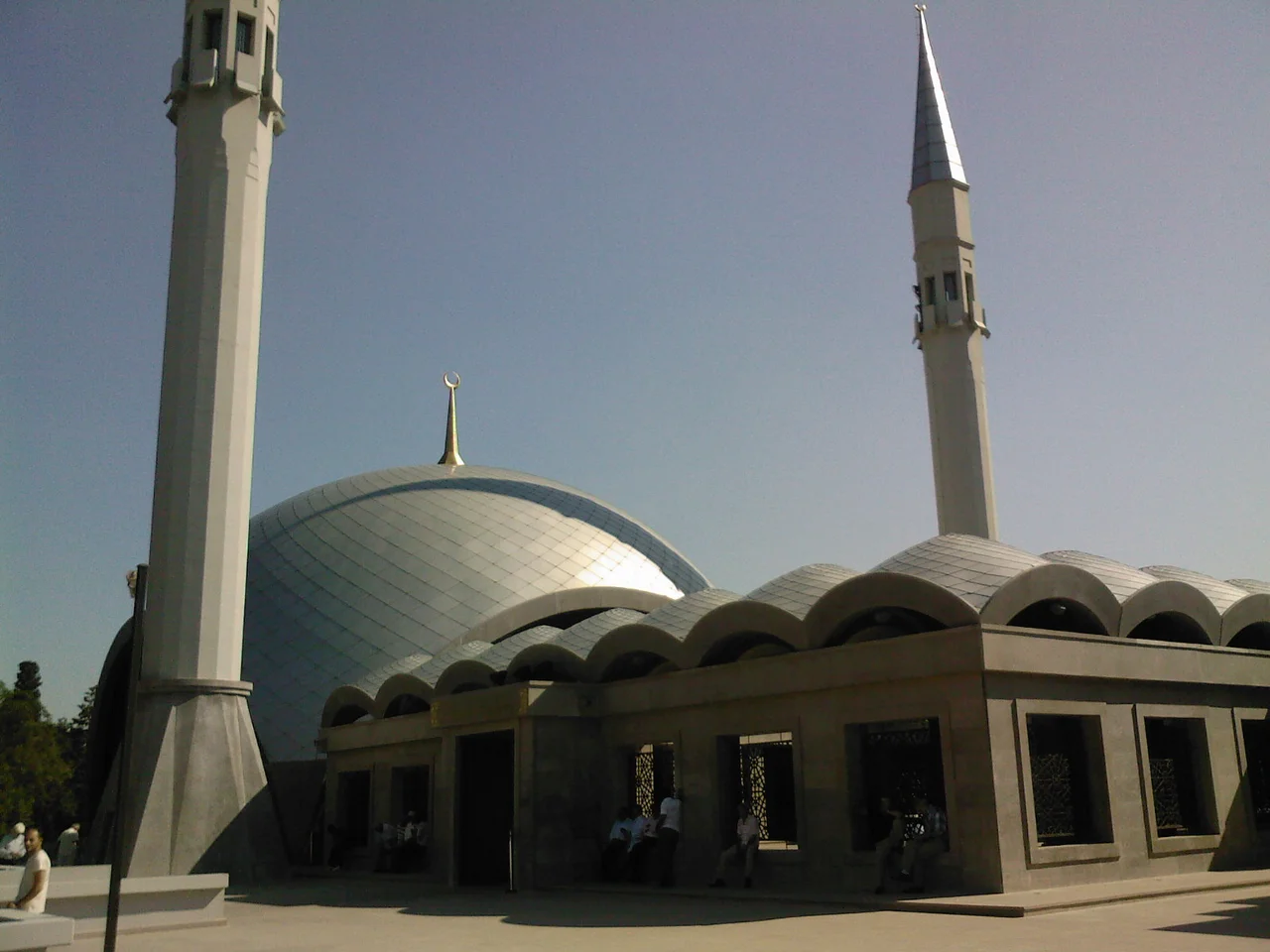

Şakirin Mosque
At the gate of Karacaahmet Cemetery — the oldest cemetery in Istanbul and the largest in Turkey — a mosque opened in 2009 that seemed to arrive from a different century altogether. Its aluminum-composite dome curves like a raindrop caught mid-fall. Inside, an asymmetrical chandelier hangs from the ceiling, its waterdrop-shaped glass globes catching light and scattering it across the prayer hall, fulfilling what the designer described as a prayer that Allah's light should fall on worshipers like rain. The Şakirin Mosque is modern not as a provocation but as a form of devotion — and it was shaped from within by a woman, in a tradition that had almost never allowed one to try.
A Foundation's Gift
The mosque was built by the Semiha Şakir Foundation, established in memory of İbrahim Şakir and Semiha Şakir, and it opened on 7 May 2009. The architect of record was Hüsrev Tayla, a respected figure known for his work on the Kocatepe Mosque in Ankara and for architectural conservation projects across Turkey. Construction took four years. The building covers 10,000 square meters and includes not just the prayer hall but an exhibition area and a parking garage beneath the structure — a design choice that speaks to the practical realities of urban Istanbul. Two minarets, each 35 meters tall, flank the dome and keep the building anchored to its religious context even as the interior departs radically from convention.
The Woman Who Shaped the Space
The person who transformed the Şakirin Mosque into something genuinely remarkable was interior designer Zeynep Fadıllıoğlu, a great-niece of Semiha Şakir. Newspaper accounts from the time of the opening described her as the first woman to design the interior of a mosque in modern Turkey — and in some accounts, in the modern world. That claim is difficult to verify absolutely, but it captures something true about the magnitude of what she was doing. Fadıllıoğlu brought a jeweler's eye to sacred space. She commissioned the chandelier from artist Nahide Büyükkaymakçı, each globe shaped like a falling drop of water. The minbar — the pulpit from which the imam delivers sermons — is made of acrylic, translucent and clean where stone and wood have always been. Decorative motifs throughout draw on Seljuk art, connecting the building to pre-Ottoman Anatolian Islamic tradition.
Light as Architecture
The calligraphy on the interior of the dome was written by Semih İrteş, curling across the aluminum-composite surface in the traditional script that has adorned mosque ceilings for centuries. But where traditional mosque windows are often high and narrow, designed to admit light without distraction, the Şakirin prayer hall opens on three sides through large windows designed by Orhan Koçan — glass panels that let the cemetery gardens and the sky into the room. The women's section was deliberately positioned to offer an unobstructed view of the chandelier, a small but considered gesture in a space where women's sightlines have historically been an afterthought. The fountain in the courtyard was designed by British water sculptor William Pye, whose work sits in public spaces and gardens around the world. The choice of a non-Turkish, non-Muslim designer for that element says something about the collaborative ambition of the project.
A Cemetery's New Companion
Karacaahmet Cemetery, which stretches behind and around the mosque, has been a place of Muslim burial since the 14th century. Its oldest sections contain tombstones that lean at wild angles, the carved stone turbans and cypress trees of Ottoman funerary art weathering slowly in the Üsküdar air. The Şakirin Mosque stands at one of its entrances, which means it was built to serve people arriving for burial rites and mourning visits as much as for daily prayers. That context — grief and memory — gives the building's luminous interior a particular resonance. Light that falls like rain in a place of endings is not incidental. The mosque is also reported to be among the most carbon-neutral mosques in Turkey, its sustainability a quieter ambition running beneath the more visible architectural one.
From the Air
The Şakirin Mosque sits at 41.0131°N, 29.0244°E on the Asian shore of Istanbul, in the Üsküdar district beside the sprawling Karacaahmet Cemetery. From the air at 3,000–5,000 feet, the aluminum-composite dome is distinctive against the dark green of the cemetery's dense tree cover. The Bosphorus strait is visible immediately to the west, with the European skyline — the Blue Mosque and Hagia Sophia domes — across the water. Nearest airport: LTFJ (Istanbul Sabiha Gökçen International), approximately 15 km to the southeast. LTFM (Istanbul Airport) is on the European side, roughly 40 km to the northwest.
Nearby Stories
- Kocaeli Peninsula 7.6 km away
- Second Battle of Çatalca 11 km away
- Istanbul's Rural Outskirts 14 km away
- MV Struma 20 km away
- HMAS AE2 36 km away
- Bursa 66 km away
- Sangarius Bridge 71 km away
- Januarius MacGahan 101 km away