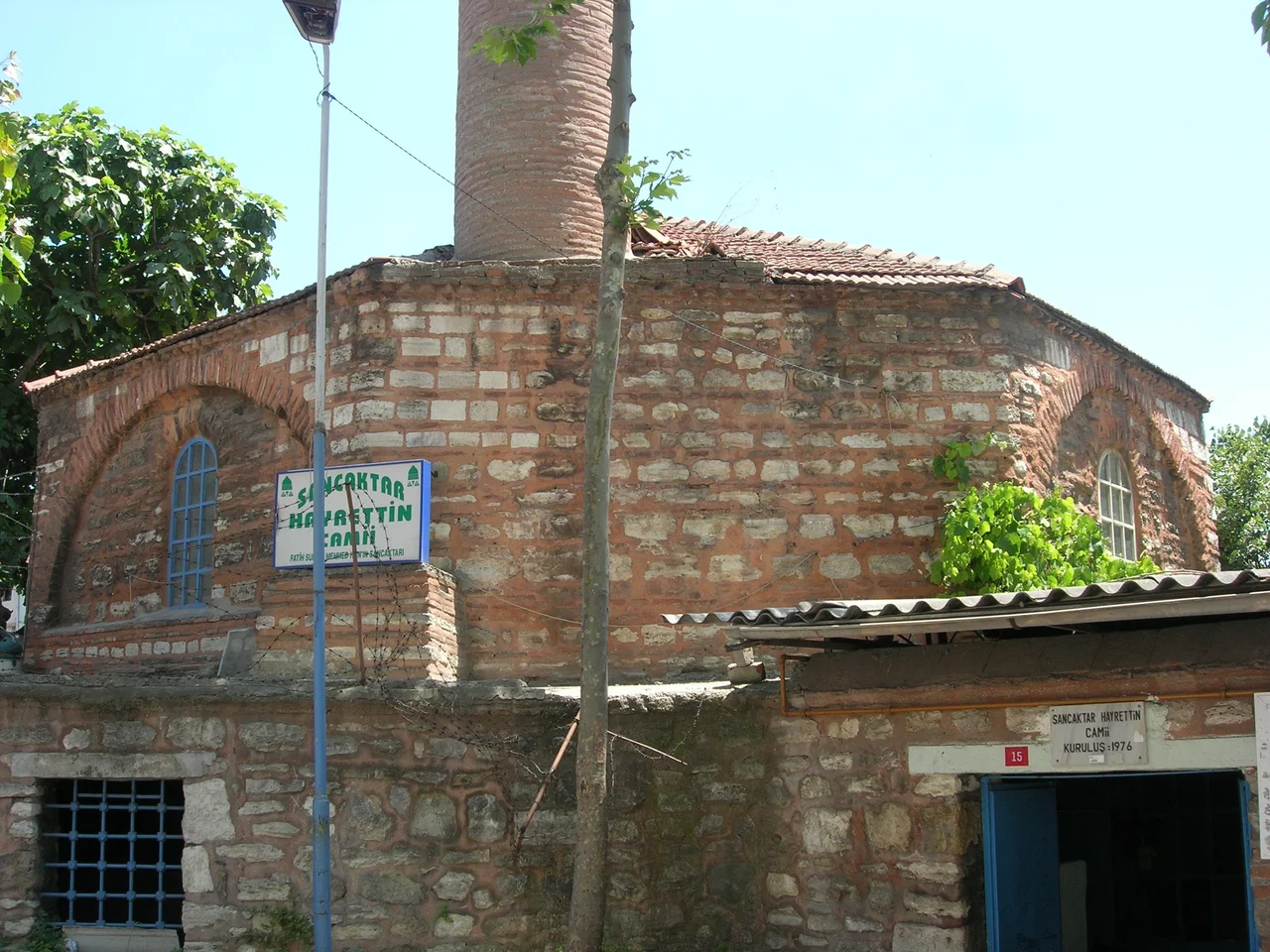

Sancaktar Hayrettin Mosque
Tucked between artisan shops on a street in the old Samatya quarter, a small building carries more history than its modest exterior suggests. The Sancaktar Hayrettin Mosque — also called the Sancaktar Hayrettin Mescidi, the word mescit indicating a small mosque — occupies a structure that was built as part of a Byzantine monastery probably sometime before the tenth century. It is hemmed in on all sides by the city that grew up around it. A minaret was added after the Ottoman conquest, and the building was restored in later centuries, but the core of what stands here is far older than the Ottoman presence in Constantinople. This is one of the minor architectural survivals of Palaiologan Byzantium, which makes its survival — squeezed, modest, overlooked — all the more remarkable.
The Legend of Helena's Vases
The traditional story attached to this site reaches back to around 326–328 AD, when Helena, mother of Emperor Constantine I, was said to have returned from Jerusalem carrying the True Cross. According to legend, she entered Constantinople through the Port of Psamatheus and left here a set of vases — gastria in Greek — containing aromatic herbs she had gathered on Calvary. She then founded a nunnery on the spot. Historians treat this as legend rather than history. No monastery is known to have been established in Constantinople before the last quarter of the fourth century, which places the Helena story about fifty years too early. But legends adhere to places for reasons of their own. The monastery came to be called the Monastery of Gastria — Monē tōn Gastríōn, the Monastery of the Vases — and that name, at least, preserved the story's trace.
Empresses in Exile
The documented history of the Monastery of Gastria is bound up with the Empress Theodora, wife of Emperor Theophilos and a central figure in the restoration of icon veneration in the Byzantine Church. Her mother, Theoktiste, purchased a property in the quarter of Psamathia and established a nunnery there, which passed to Theodora as its foundress. In 856, when Theodora was deposed as regent for her son Michael III, her brother Bardas removed her to the monastery along with her daughters Thekla, Anna, Anastasia, and Pulcheria. All of them were forced to take monastic vows. Her eldest daughter Thekla was later recalled by Michael to serve a different purpose entirely, but the others remained. The Emperor Constantine VII Porphyrogennetos records in his book De Ceremoniis that the monastery's church served as a mausoleum for Theodora's family: the empress, her brother Petronas, her mother, and her daughters were all buried there.
Survival and Conversion
The last written mention of Gastria before the fall of Constantinople in 1453 comes from a Russian pilgrim who visited the city sometime in the second quarter of the fifteenth century. He described a nunnery near the Golden Gate where the relics of Saint Euphemia and Saint Eudokia were venerated — an account that scholars believe refers to this site. After the Ottoman conquest, the monastery was converted into a mosque, as many Byzantine religious buildings were throughout the city. The structure is a minor example of Palaiologan architecture, the final Byzantine period before the fall, which produced refined stonework but fewer grand buildings than earlier centuries. Remnants of walls that connected it to adjacent structures were visible before restoration work. A minaret was added to signal its new identity.
The City Around It
What makes the Sancaktar Hayrettin Mosque unusual today is not its architecture — which is modest — but its location and its survival. It stands on Teberdar Sokak in the Kocamustafapaşa neighborhood, about five hundred meters northeast of the local tram station. Artisan workshops have pressed up against it for decades, and the surrounding fabric of the city has changed many times while the building remained. It overlooks the Sea of Marmara from the southern slope of Constantinople's seventh hill. To walk past it is to encounter one of the city's quiet anachronisms: a building that has been, in turn, an early Byzantine nunnery, a place of imperial confinement, a repository of relics, and a neighborhood mosque. The name Sancaktar Hayrettin — the standard-bearer Hayrettin — refers to whoever converted or administered the building in the Ottoman period, a name now attached to fourteen centuries of earlier history.
From the Air
The Sancaktar Hayrettin Mosque stands at 41.00275°N, 28.93466°E in the Kocamustafapaşa (Samatya) neighborhood of Istanbul's Fatih district, on the European historic peninsula. From the air at 3,000–5,000 feet, the seventh hill of the old city rises gently above the Marmara shoreline; the mosque is embedded in the dense residential grid south of the Fatih district's center. The Theodosian Walls run north-south to the west, and the Sea of Marmara is visible to the south. Nearest airport: LTFM (Istanbul Airport), approximately 25 km to the northwest.
Nearby Stories
- Kocaeli Peninsula 7.6 km away
- Second Battle of Çatalca 11 km away
- Istanbul's Rural Outskirts 14 km away
- MV Struma 20 km away
- HMAS AE2 36 km away
- Bursa 66 km away
- Sangarius Bridge 71 km away
- Januarius MacGahan 101 km away