
Scotney Castle
Father Richard Blount went over the wall and into the moat. It was somewhere between 1591 and 1598 - the records are vague on the exact night - and Elizabeth I's pursuivants had returned to Scotney for the second time to arrest him. Catholicism was illegal in England. The Jesuit had been hiding in the castle for years, ministering to local Recusants, sheltered by the Darrell family who paid the heavy fines that came with refusing Anglican worship. The first raid had failed. The second was thorough. Blount fled across the courtyard, scaled the curtain wall, and dropped into the moat below. He swam to freedom in the wet night. He went on to serve as the Jesuit Superior of England for over twenty years.
Roger Ashburnham's Walls
The earliest record of Scotney comes from 1137, when one Lambert de Scoteni held the estate that would take his name. The castle itself was built around 1378-80 by Roger Ashburnham - a roughly rectangular fortified house with towers at each corner, protected by a moat fed by springs and the River Bewl. The original plan was probably never finished. By 1558 only the southern tower remained intact. The fourteenth-century fortification was always more residence than military stronghold - a moated manor house with pretensions to defence rather than a serious castle. In 1580 the south wing was rebuilt in Elizabethan style. Around 1630 the eastern range was rebuilt again in three-storey Inigo Jones style, the most fashionable architecture of its day. The Darrell family owned the castle for some 350 years.
Building the Picturesque
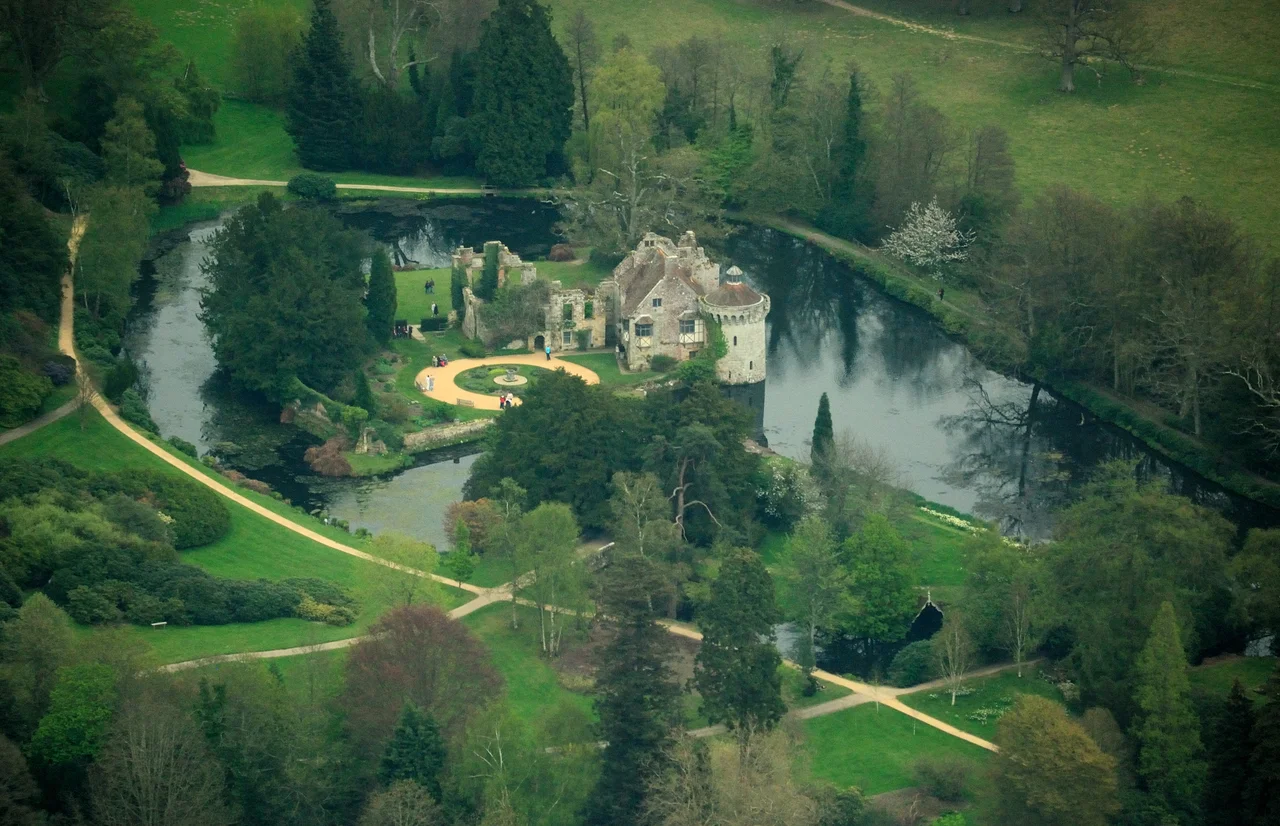
Edward Hussey bought the estate in 1778. It was his grandson, also Edward, who made the decisive aesthetic decision in the 1830s. He commissioned Anthony Salvin to design a new house at the top of the slope, in Tudor Revival style, and then partly dismantled the old castle below - deliberately - leaving its ruins as a garden feature. The sandstone for the new house came from a quarry cut into the hill itself, and the hollow created became the Quarry Garden, complete with a 100-million-year-old dinosaur footprint exposed in the rock face. The result, completed in 1843, became one of the most celebrated examples of the picturesque garden style in England. A new Tudor mansion on the ridge. A moated medieval ruin on an island in the lake below. A wooded valley landscaped to frame both.
Rhododendrons and Reflection
The gardens that surround Old Scotney Castle now constitute a Site of Special Scientific Interest. Sloping wooded grounds descend from the new house to the lake, planted in great drifts of rhododendrons, azaleas, and kalmia for spring colour. Summer brings wisteria climbing the walls and roses through the borders. The autumn colour is what brings serious gardeners from across Britain. The lake itself is small but precisely calculated - the ruin sits on its island like a Romantic painting come to life, mossy stones reflected in still water with the wooded slopes rising behind. Anthony Salvin's new house above is, by his standards, restrained. He had built more flamboyant Tudor Revival piles. At Scotney he held back, letting the ruin be the star.
Margaret Thatcher's Belfry
Christopher Hussey, architectural historian and longtime editor of Country Life, left the estate to the National Trust on his death in 1970. The Trust let out apartments in the house and on the estate. One of the tenants, throughout the 1970s and 1980s, was the Conservative Member of Parliament for Finchley, who rented the Belfry flat as a weekend escape from Westminster. Margaret Thatcher used Scotney as a refuge during her years as Leader of the Opposition and then as Prime Minister - the long drive from London ending in a quiet flat above a garden landscape, far from cabinet rooms and division bells. When Denis Thatcher was created a baronet in 1990, his title was gazetted with the territorial designation of Scotney in the County of Kent. Elizabeth Hussey continued to live in the main house until her death in 2006, after which the house itself was opened to the public for the first time on 6 June 2007.
Shakespeare in the Bushes
The grounds host occasional Shakespeare productions, with actors emerging from the bushes on cue - an arrangement that draws audiences from across the South East on summer evenings. Old Scotney Castle was the location for the Squeeze song Some Fantastic Place, the band drawn to the picturesque combination of ruin and water. The estate sits three and a half miles from Royal Tunbridge Wells, hidden from the busy A21 by a fold in the land. From the New Castle's terrace, the gardens descend in a single composed view: roses, rhododendrons, the still lake, the ruined castle on its island, the wooded valley climbing the other side. Edward Hussey designed it to look exactly like this when he stood here in 1843. It still does.
From the Air
Located at 51.09 degrees N, 0.41 degrees E, in the valley of the River Bewl southeast of Lamberhurst in Kent. The estate appears as a distinct landscape composition: the Tudor Revival house high on the south slope, a lake in the valley below, and the moated ruin on its island visible as a smaller dark feature within the water. Wooded slopes frame the view. Nearest airports: London Gatwick (EGKK) twenty-three miles west, Lydd (EGMD) twenty-six miles southeast. Best viewed at 1,500-3,000 feet on clear days.
Nearby Stories
- Saltwood Castle 2.8 km away
- Jezreel's Tower 5.4 km away
- Bethlem Royal Hospital 6.2 km away
- Herne Bay Pier 6.7 km away
- Royal Sovereign Lighthouse 11 km away
- Plymouth Brethren 15 km away
- Battle of Boulogne 40 km away
- Fratton Park 75 km away