
Şehzade Mosque
Süleyman the Magnificent mourned for forty days. His son Şehzade Mehmed — born 1522, the golden heir whom Süleyman had groomed for the throne, the eldest child of his beloved Hürrem Sultan — died in 1543 at twenty-one in Manisa, where he served as governor, while Süleyman was returning from a victorious campaign in Hungary. The sultan, ruler of the most powerful empire on Earth, could do nothing but grieve. Then he commissioned a monument. He summoned his chief architect, a man named Mimar Sinan, and gave him his first major imperial task: build a mosque complex worthy of the prince. What Sinan designed between 1545 and 1548 on Istanbul's third hill, in the Fatih district, he would later call his 'apprentice work.' The world would call it one of the most beautiful buildings of the sixteenth century.
A Father's Grief Made Stone
The complex rose in stages from loss. Mehmed's mausoleum came first, completed in 1544 — an octagonal structure of polychrome stonework and fluted dome, its walls sheathed in multi-coloured cuerda seca tiles that still glow with an almost jewelled intensity. A Persian foundation inscription over the entrance dates the tomb to 1543–44. Inside, a rectangular wooden throne sits above Mehmed's sarcophagus, a deliberate symbol: he was to have been sultan, and even in death his status was acknowledged. His youngest brother Şehzade Cihangir, who died a decade later, was also laid here. The identity of the fourth person interred in the mausoleum's fourth sarcophagus has never been established.
The mosque and the rest of the külliye — the complex encompassing a medrese, a guesthouse, a caravanserai, a soup kitchen, a primary school, and a cemetery — were completed between 1545 and 1548. It was said that a green column at the edge of the complex's cemetery wall marked the geometric centre of Istanbul itself.
Sinan's Apprentice Masterpiece
Sinan was dissatisfied with the Şehzade Mosque. He never repeated its layout in any subsequent work, calling it merely an exercise. Yet his 'apprentice work' solved problems that had challenged Ottoman builders for a century.
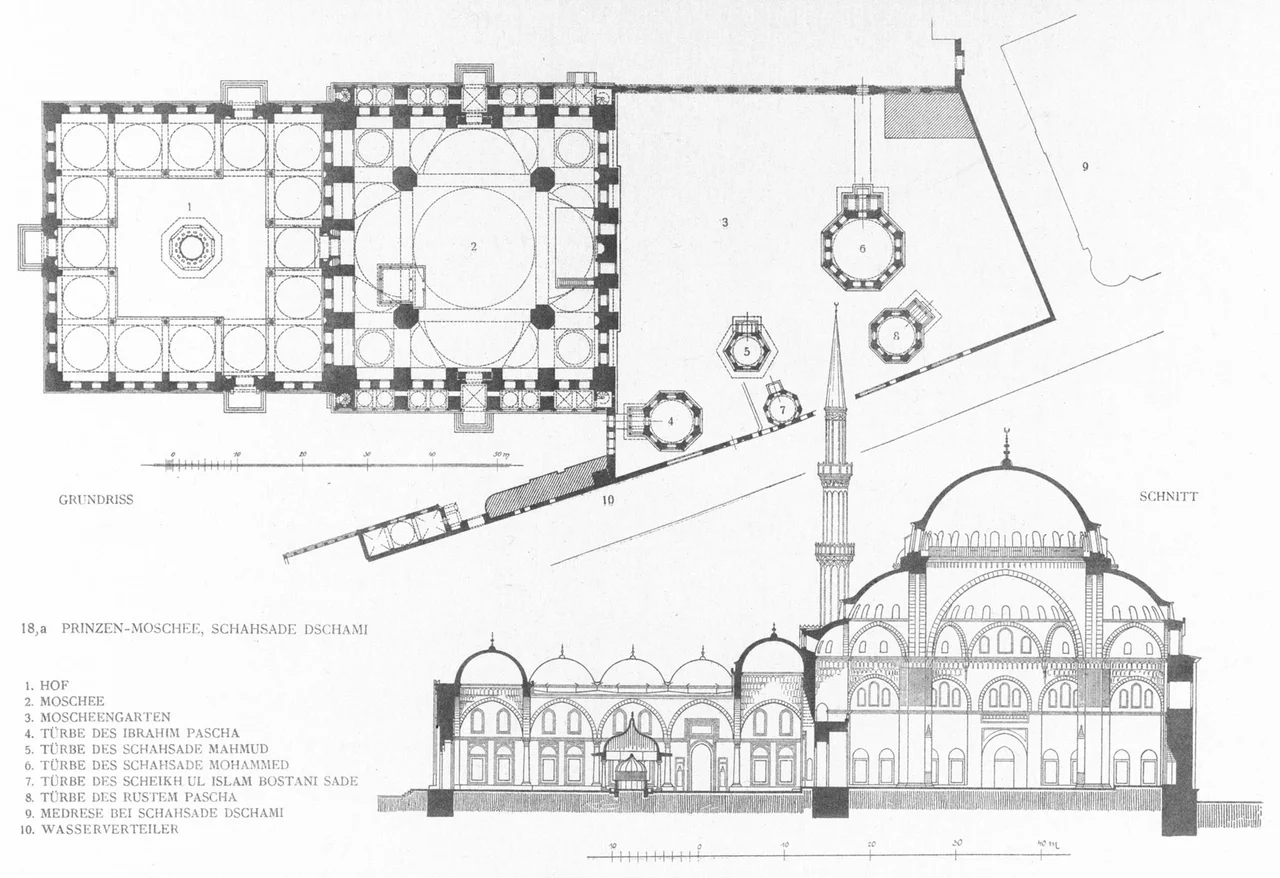
The mosque rests on a square plan, its central dome — 19 metres in diameter, rising to 37 metres — flanked by four half-domes and four smaller corner domes. Complete bilateral symmetry: no earlier Ottoman mosque had achieved it at this scale. To carry the dome's load, Sinan concentrated the structural forces into four interior pillars and a series of exterior buttresses, freeing the walls between them to be thin and window-filled. Light pours in. He then disguised the buttresses with domed porticos along the northeast and southwest façades, so the exterior presents an illusion of effortless mass and volume.
The twin minarets — this mosque, though not built for a sultan, was granted two — bear two balconies each, their shafts carved with muqarnas and interlacing geometric relief. This level of decorative elaboration on minarets was unique to the Şehzade and was rarely attempted again.
The Forecourt and Its Proportions
Visitors enter through a marble-paved colonnaded courtyard equal in area to the prayer hall itself — a proportion that feels deliberate, a kind of breathing room between the bustle of the city and the interior calm. Arches in alternating pink and white marble frame a portico of five domed bays on each side. At the centre stands the şadırvan, the ablution fountain, added later by Sultan Murat IV. The effect is one of measured grandeur: nothing excessive, nothing deficient.
Standing in this forecourt, looking toward the mosque entrance, you understand something about Sinan's method. He was not trying to overwhelm. He was trying to choreograph — to arrange the visitor's experience as precisely as he arranged the loads on a dome.
A Template for Three Centuries
Sinan moved on to other experiments — the Süleymaniye, then the Selimiye in Edirne, which he called his masterwork. But the four-semi-dome plan he tested here at the Şehzade proved irresistible to the architects who came after him. The Blue Mosque (completed 1616), the New Mosque at Eminönü, the eighteenth-century reconstruction of the Fatih Mosque — all repeat the Şehzade's symmetrical arrangement of dome and half-domes. So does the nineteenth-century Mosque of Muhammad Ali in Cairo. Whatever Sinan thought of his own effort, the Ottoman architectural tradition voted with its buildings.
In June 2016, a bombing on a nearby street shattered some of the mosque's windows. They were repaired. The structure that a grieving sultan raised for a dead prince in the sixteenth century still stands on the third hill of Istanbul, its twin minarets visible from much of the historic peninsula.
The Tombs Behind the Mosque
Five mausoleums stand in the funerary garden to the mosque's south. Beyond Mehmed's is the smaller octagonal türbe of Grand Vizier Rüstem Pasha — designed by Sinan, completed around 1560–61, lined with underglazed Iznik tiles whose blues and greens still startle. Rüstem Pasha was the husband of Mihrimah, Süleyman's daughter. Near the complex gate is the türbe of Grand Vizier Ibrahim Pasha, son-in-law of Murat III, who died in 1603. Its designer, Dalgıç Ahmed Çavuş, matched the Mehmed mausoleum in both scale and tilework almost exactly.
The dead gathered here are not footnotes. They are the people around whom the most powerful court on Earth revolved — the viziers, the princes, the daughters of sultans — all brought together in a garden of domes and tilework on a hill above the Golden Horn.
From the Air
The Şehzade Mosque sits at 41.0138°N, 28.9572°E on Istanbul's historic European peninsula, on the city's third hill in the Fatih district. Approaching from the northwest at 2,000–3,000 feet, the twin minarets and central dome are visible alongside the Aqueduct of Valens, which runs nearby. The nearest major airport is Istanbul Airport (LTFM), approximately 30 km to the northwest. The Bosphorus and the Golden Horn are both visible from altitude, framing the historic peninsula. Visibility is best in the morning hours before the haze builds over the city.
Nearby Stories
- Kocaeli Peninsula 7.6 km away
- Second Battle of Çatalca 11 km away
- Istanbul's Rural Outskirts 14 km away
- MV Struma 20 km away
- HMAS AE2 36 km away
- Bursa 66 km away
- Sangarius Bridge 71 km away
- Januarius MacGahan 101 km away