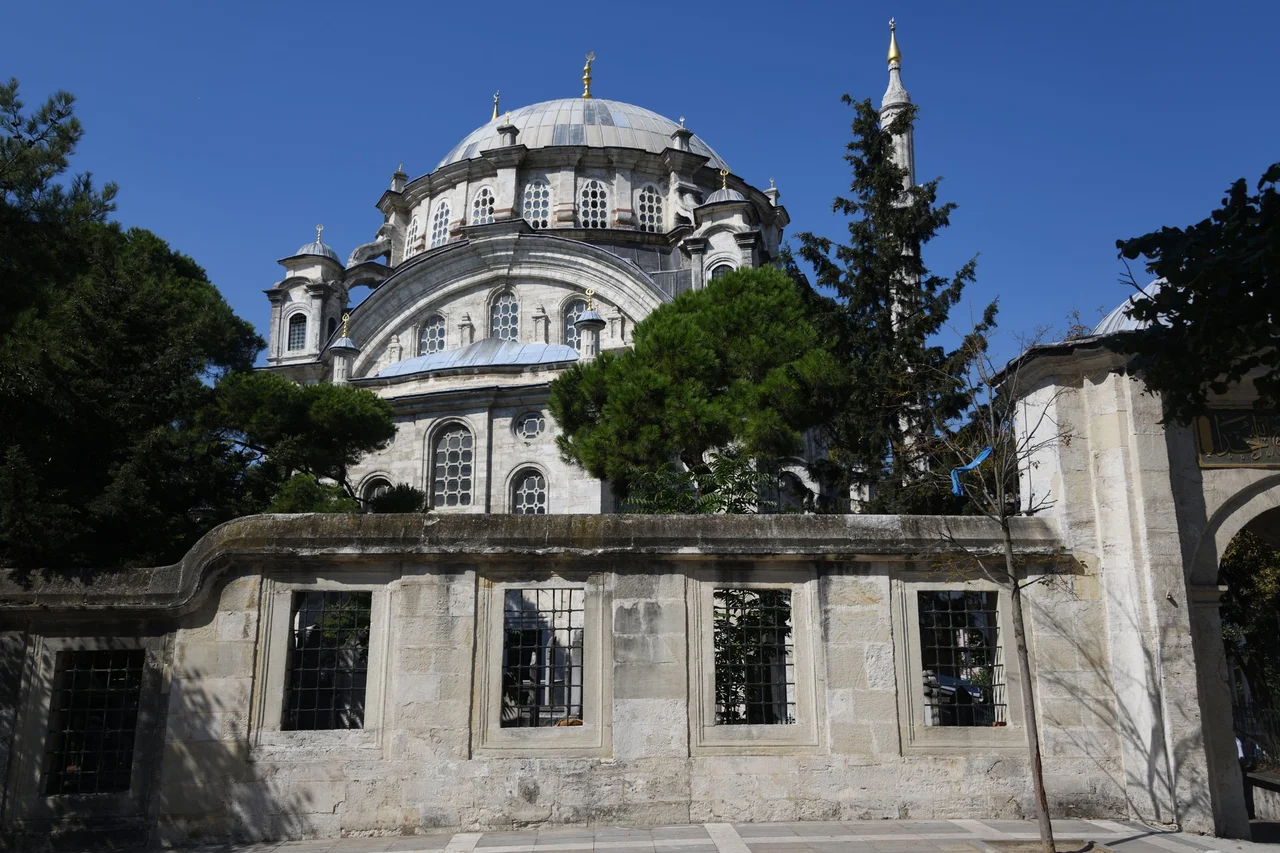

Selimiye Mosque, Üsküdar
Selim III was trying to save the empire. The late eighteenth century had not been kind to the Ottomans — military defeats, lost territory, the sense that European powers had pulled decisively ahead. Selim's answer was the Nizam-ı Cedid: the 'New Order,' a systematic modernization program that built a new Western-style army, reorganized finances, and introduced factories and printing presses. He needed a physical symbol for this project. Between 1800 and 1805, on the Asian shore of Istanbul in Üsküdar, he built both a vast new barracks and, next to it, a mosque. The two buildings announced each other: the barracks said military power, the mosque said divine sanction. Together they were a declaration that the Ottoman Empire could be renewed.
A Mosque for the New Order
The Selimiye Mosque was built between 1801 and 1805 as the devotional centerpiece of a külliye — a charitable complex — that also included a primary school, a timekeeper's house, a fountain, a hamam, and something genuinely novel: an array of factories, shops, and a printing house arranged on a regular street grid to form the nucleus of a new neighborhood. This was urban planning in the service of modernization. Selim wanted the mosque complex not just as a place of worship but as a generator of the kind of rational, productive city life his reforms were trying to create.
Three men served as chief court architects during construction, though scholars believe the main designer was Foti Kalfa, a Christian master carpenter — an unusual choice that itself reflects something of the reform spirit. The minarets were rebuilt in 1822. During the First World War, British forces bombed the area around the mosque.
Ottoman Baroque in Its Finest Form
The mosque is built in the Ottoman Baroque style that defined sacred architecture in Istanbul through the eighteenth century, and it shows that style at a high point of refinement. The exterior is distinguished by Baroque stone mouldings along every edge, sculpted keystones over its arches, and — one of the period's charming signatures — small ornate birdhouses carved in stone on the corner turrets.
The most striking architectural feature is the imperial pavilion stretching across the mosque's front façade. Earlier mosques gave their sultans a loge inside the prayer hall, often a screened balcony; here, the pavilion is a multi-story structure in its own right, with two wings raised on a marble arcade, containing rooms and halls that functioned as a kind of portable palace. Between the wings, a staircase and entrance portico create a suitably grand approach. The Ionic capitals on the arcade columns, the Baroque mihrab and minbar carved in rich marble — every detail signals a building trying to be both Ottoman and cosmopolitan at once.
Light and the Open Interior
Step inside the prayer hall and the Baroque ambition becomes most apparent. The dome rises on pendentives, its single large span uncomplicated by the half-domes and lateral galleries that characterized classical Ottoman mosques. Those side galleries have been moved entirely outside the prayer hall, running along the exterior of the building — a decision that leaves the interior unusually open and unencumbered, the space belonging entirely to the dome above and the congregation below.
A long inscription in gold lettering on a black background runs as a band around most of the hall, in the manner of the earlier Nuruosmaniye Mosque. It contains the Surah al-Fath — the Quranic chapter of 'victory.' Whatever the painted decoration looks like today (it has been repainted in an anachronistic classical style and is not original), the inscription remains.
The Hamam and Its Second Life
The complex's bathhouse, the Selimiye Hamamı, once served both mosque visitors and soldiers from the adjacent barracks. Over the decades following the empire's collapse, it fell into decay. Restoration work began in 2018, and in 2021 the hamam reopened to the public — converted to house a library, a restaurant, and a small museum area. The classroom that once educated students in the original külliye now serves as a reading room.
The barracks next door have fared less elegantly; they remain a working military headquarters, largely closed to the public. But the mosque Selim III built to sanctify them is accessible, and still holds the form he gave it — the Baroque curves and gold inscriptions of a sultan trying, in the first years of the nineteenth century, to build his way into a new era.
From the Air
The Selimiye Mosque in Üsküdar sits at 41.0097°N, 29.0166°E on the Asian shore of Istanbul, adjacent to the large rectangular form of the Selimiye Barracks. Both are visible from the Bosphorus at 2,000–3,000 feet, with the Sea of Marmara to the south and the European historic peninsula and Topkapı Palace across the water to the west. The nearest airport is Sabiha Gökçen International Airport (LTFJ), approximately 20 km to the southeast. The Bosphorus Bridge is visible several kilometres to the north.
Nearby Stories
- Kocaeli Peninsula 7.6 km away
- Second Battle of Çatalca 11 km away
- Istanbul's Rural Outskirts 14 km away
- MV Struma 20 km away
- HMAS AE2 36 km away
- Bursa 66 km away
- Sangarius Bridge 71 km away
- Januarius MacGahan 101 km away