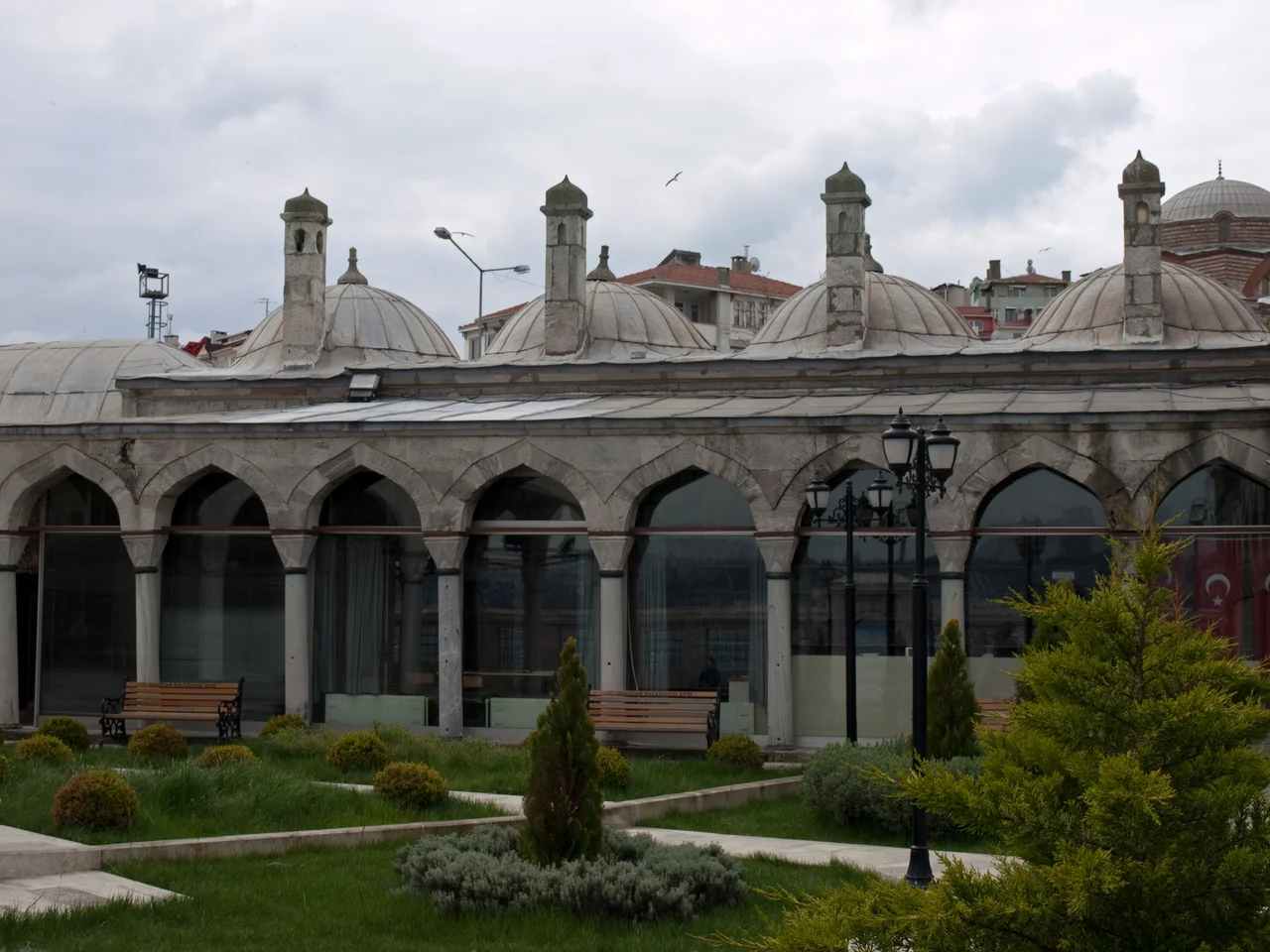

Şemsi Pasha Mosque
Mimar Sinan built mosques for sultans, for grand viziers, for the most powerful people in the Ottoman world. He also, at the very end of his career, built one for Şemsi Pasha — a smaller commission, a smaller building, but one that gave him a problem no other Istanbul site had quite posed before. The lot was a narrow strip along the Bosphorus shoreline in Üsküdar. The client wanted a mosque, a mausoleum, and a madrasa. The water was right there. Sinan's solution, according to the portal inscription completed in 1580, was to make the sea wall part of the building — to let the Bosphorus be the fourth wall of the courtyard, its grill-windows framing the water like a series of paintings. The result is one of the most quietly perfect places in Istanbul.
A Site That Demanded Ingenuity
The complex occupies a roughly rectangular site oriented east–west along the shoreline. Working from this constraint, Sinan arranged the elements with the precision of a puzzle. The mosque itself abuts the coast at a slight angle, its single dome rising eight metres in diameter above a square prayer hall. The mausoleum of Şemsi Pasha projects toward the water on the mosque's north side. An L-shaped madrasa — twelve domed cells and a large classroom, fronted by an arcade of nineteen columns — runs along the west and south edges of the precinct. The fourth side is the Bosphorus, bounded by a sea wall pierced with grille windows.
Standing in the courtyard, you see the mosque to one side, the madrasa arcade opposite, and through those grilles, the water moving. The architects who studied this complex after Sinan have described the experience as being in a picture gallery, with each window framing a different Bosphorus seascape. That is not an exaggeration.
The Mosque and the Tomb
One of the Şemsi Pasha Mosque's most unusual features is the relationship between the prayer hall and the founder's mausoleum. Rather than placing the tomb in the garden nearby, as was conventional, Sinan attached it directly to the mosque's north wall. A grilled archway opens between the mausoleum chamber and the prayer hall interior, so that worshippers praying inside the mosque are separated from the tomb of Şemsi Pasha by only an ornamental screen.
The tomb chamber is crowned by a mirror vault at the same height as the prayer hall's drum. Three casement windows face the Bosphorus; nine upper windows on three walls are filled with coloured glass. Decoration is restrained — stalactite carvings on the portal, painted floral and geometric motifs on the vault. Although the tomb's portal inscription has been lost, inscriptive plaques over the archway into the prayer hall were preserved.
The private walled cemetery behind the mosque's qibla wall has become, over the centuries, a burial site for generations of the Şemsi Pasha family.
Inside the Prayer Hall
The prayer hall is entered through a marble portal on its northwest wall. Its dome — about eight metres across — sits on four squinches over an octagonal drum pierced with four arched windows. Nine casement windows light the walls, each topped by an arched window filled with coloured glass of a different composition. A circular window is placed above the mihrab. The mihrab itself is simple marble with a muqarnas hood; muqarnas carvings also mark the springing of the squinch arches. The minbar is a modern wooden replacement.
This is a small space, deliberately so. After the vast domed interiors Sinan had been building for decades, the Şemsi Pasha Mosque is almost domestic in scale. What it sacrifices in grandeur it gains in intimacy — the coloured light through the windows, the sound of the Bosphorus just outside, the sense of the water pressing right up against the walls.
Sinan's Gift to the Shoreline
Sinan is remembered for the Süleymaniye Mosque, for the Selimiye in Edirne, for the great domed compositions that redefined what Islamic architecture could achieve. The Şemsi Pasha Mosque sits at the other end of his achievement — not a demonstration of structural ambition but a demonstration of taste. Here the genius is in what he chose not to do: no grand forecourt, no twin minarets, no imperial scale. Just a careful arrangement of modest volumes that fits its impossible waterfront site so naturally that it looks, from the Bosphorus, as though it grew there.
In 1940 the General Directorate of Religious Endowments undertook an extensive restoration supervised by architect Süreyya Yücel, including rebuilding the mosque portico. The madrasa was refurnished as a library in 1953, with the old classroom serving as the reading room. Ferries pass close to the shore here, and passengers who glance toward Üsküdar's waterfront still catch what commuters have seen for more than four centuries: a small dome and a single minaret sitting exactly at the water's edge, as if the Bosphorus and the building had agreed on a boundary and kept it.
From the Air
The Şemsi Pasha Mosque sits at 41.0259°N, 29.0114°E directly on the Bosphorus shoreline in Üsküdar, on Istanbul's Asian side. Approaching from the south at 1,500–2,500 feet, the small dome and single minaret are visible against the waterfront just south of the Üsküdar ferry landing. The Bosphorus itself is the dominant landmark — approximately 700 metres wide at this point — with the European side of Istanbul visible across the water. The nearest airport is Sabiha Gökçen International Airport (LTFJ), approximately 18 km to the southeast. The Bosphorus Bridge is visible roughly 2.5 km to the north.
Nearby Stories
- Kocaeli Peninsula 7.6 km away
- Second Battle of Çatalca 11 km away
- Istanbul's Rural Outskirts 14 km away
- MV Struma 20 km away
- HMAS AE2 36 km away
- Bursa 66 km away
- Sangarius Bridge 71 km away
- Januarius MacGahan 101 km away