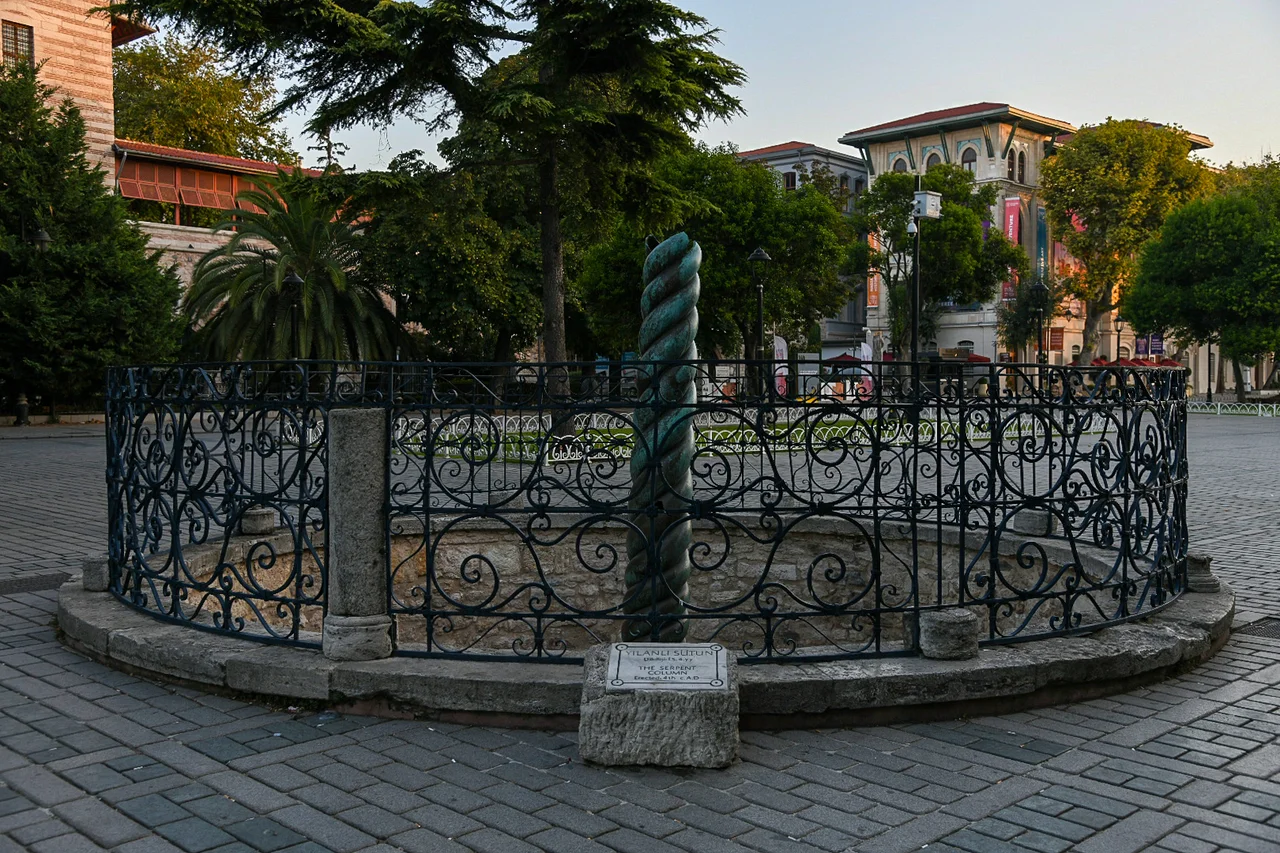

Serpent Column
Walk into the At Meydanı — the old Hippodrome of Constantinople, today an open plaza in the Sultanahmet district of Istanbul — and you will find, embedded in the ground near the Egyptian obelisk, a twisted bronze column roughly eight meters tall. It has no inscription at eye level, no explanatory grandeur. Most visitors walk past it quickly. But the Serpent Column is older than the Hippodrome, older than Constantinople itself, older than the Roman Empire. Its raw material came from the shields and armor of Persian soldiers killed on the plain of Plataea in 479 BC — Greek soldiers melted the bronze of a defeated army and fashioned it into an offering to Apollo at Delphi. It has been read by Herodotus, admired by Pausanias, moved by Constantine, and struck by a sultan who wanted to prove something. It is the longest-surviving object from the Greek world, and it is still there.
Born from Defeat at Plataea
In August 479 BC, a Greek alliance under the Spartan regent Pausanias confronted the Persian general Mardonius on the plain of Plataea in Boeotia. Xerxes had already withdrawn from Greece after the naval defeat at Salamis the previous September, but he had left a large land force behind. At Plataea, that force was broken. Mardonius was killed; the Persians fled north under Artabazus. It was the decisive land engagement of the Persian Wars — after it, the Persian Empire never again invaded the Greek mainland.
In the months that followed, the Greek cities gathered the spoils and debated how to commemorate what they had survived. Their choice was a votive offering to Apollo at Delphi: a golden tripod and cauldron set atop a column of three intertwined bronze serpents. The bronze came from the armor and shields of the Persian dead. In the spring of 478 BC, the column was dedicated at the sanctuary. The names of 31 city-states that had fought the war were inscribed on the coils — a collective memorial, deliberately, because the Spartan commander Pausanias had tried to claim sole credit and had his personal inscription forcibly removed by the Lacedaemonians.
Eight Centuries at Delphi
The Serpent Column stood at Delphi for roughly eight centuries, witnessed by every pilgrim who came to consult the oracle. Writers across the ancient world noted it: Herodotus described its dedication, Thucydides referenced the political scandal of Pausanias's erased inscription, and Pausanias the travel writer confirmed in the second century AD that the bronze column survived even after the golden tripod had been looted. That looting happened from 356 BC onward, when the Phocian general Philomelus seized the Delphic sanctuary and raided its treasury to pay mercenaries during the Third Sacred War — an act considered so sacrilegious that it triggered his expulsion from the Amphictyonic league and a fine of 400 talents imposed by Philip II of Macedon.
By then the column had already outlasted the political world that made it. The Delian League, the Peloponnesian War, the Macedonian conquest — history accumulated around it. The column remained, coils intact, the serpent heads still recognizable, the names of those 31 cities still readable on the bronze.
Constantine Moves the Column West
In 324 AD, the emperor Constantine the Great had just consolidated sole rule of the Roman Empire after defeating his rival Licinius. He was refounding the old Greek city of Byzantium as his new imperial capital — a project of extraordinary ambition that would reshape the ancient world. To furnish the city's Hippodrome, the great racing and ceremonial ground at the heart of the new capital, Constantine stripped monuments from across the empire. The Serpent Column was among them.
It was placed on the spina — the central spine of the Hippodrome — where it stood alongside the Egyptian Obelisk of Thutmose III and other transported treasures. A later emperor converted it into a triple-mouthed fountain. In its new setting it served a different function: not a panhellenic war memorial but a spectacle of Roman cultural inheritance. Yet the names of the Greek cities were still there, inscribed on the coils, legible to anyone who looked.
Mehmed's Mace and the Mystery of the Heads
Ottoman miniatures from the decades immediately following the conquest of Constantinople in 1453 show the Serpent Column with all three serpent heads intact. At some point between roughly 1500 and 1700, the heads were destroyed — and the question of when, and by whom, generated competing stories that tell us something about how power performs itself.
The most famous account, transmitted by Edward Gibbon, has Mehmed II striking off the jaw of one serpent head with his iron mace or battleaxe on the night he entered the city. Gibbon's phrasing is telling: the column, he wrote, 'in the eyes of the Turks were the idols or talismans of the city.' Other Ottoman historians attributed the same gesture to Selim II, Suleiman II, or Murad IV. The column had acquired the reputation of a talisman — Ahmed Bican, writing around the time of the conquest, called it a charm against snakebite — and shattering part of it was a way of demonstrating dominion over the old city's protective magic.
By October 1700, all three heads had fallen. An Ottoman chronicle records that they simply fell off on the night of the 20th. One upper jaw survived and is now displayed at the Istanbul Archaeology Museum. The headless bronze column remains in the Hippodrome plaza.
What the Coils Still Say
In 1855, excavations supervised by Charles Thomas Newton exposed the base of the column, which had been buried when ground levels around the Hippodrome rose in 1630. Fifteen coils had been hidden underground; the inscription began at the 13th coil and ran down to the 3rd. By 1856 it had been deciphered, and by 1886 further scholarly work had clarified what it contained: the names of the city-states that fought the Persian Wars, arranged roughly by the size of their contribution.
The coils still bear sabre cuts and dents — marks of someone testing the blade, or testing the legend, or simply testing time. They record a version of history that was already contested in antiquity, when Pausanias tried to claim individual credit and the alliance forced his name off the monument. The column has traveled from Delphi to Constantinople to Istanbul, survived the loss of its golden tripod, its three serpent heads, and eight centuries of weather. It has been read, touched, struck, and moved. It is still there, in the square that was once the center of the Byzantine world, among the foundations of what was once the greatest city in the Christian world.
From the Air
The Serpent Column stands at approximately 41.006°N, 28.975°E in the Hippodrome plaza (At Meydanı) of Sultanahmet, Istanbul. Approaching from the northwest at 3,000 feet over the Golden Horn, the distinctive rectangular form of the old Hippodrome footprint is visible between the Blue Mosque (Sultan Ahmed Mosque) to the south and the Hagia Sophia complex to the northeast. The column itself is too small to resolve from altitude, but the plaza's orientation — running roughly north-south between the two great Ottoman monuments — provides a clear ground reference. Nearest airport is Istanbul Airport (LTFM), approximately 35 km to the northwest; Sabiha Gökçen (LTFJ) lies to the southeast across the Bosphorus. At lower altitudes in clear weather, the Bosphorus Strait, the Golden Horn, and the Sea of Marmara create a distinctive three-water panorama that marks this unique peninsula.
Nearby Stories
- Kocaeli Peninsula 7.6 km away
- Second Battle of Çatalca 11 km away
- Istanbul's Rural Outskirts 14 km away
- MV Struma 20 km away
- HMAS AE2 36 km away
- Bursa 66 km away
- Sangarius Bridge 71 km away
- Januarius MacGahan 101 km away