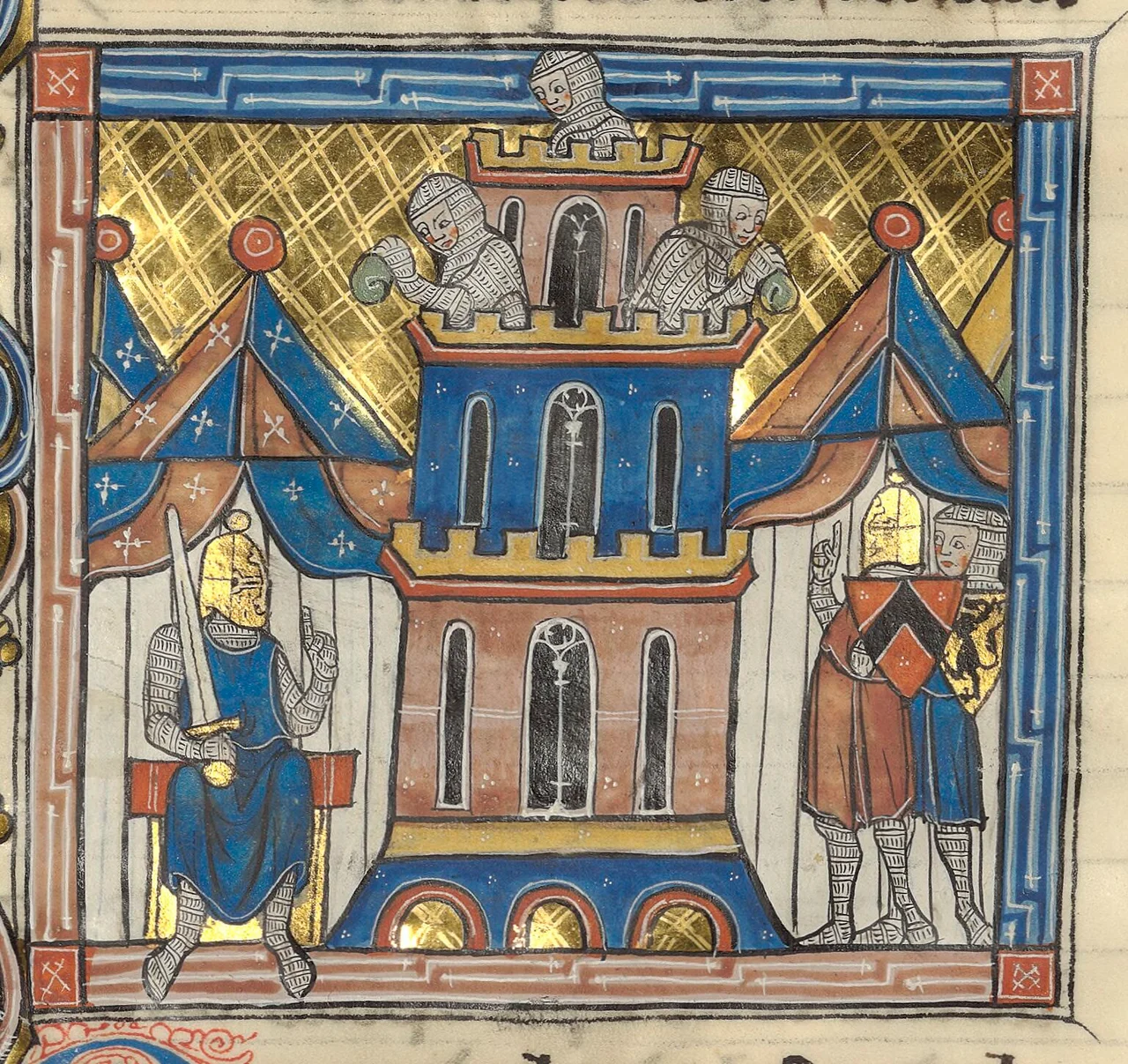

Siege of Constantinople (1203)
They had set out to fight Muslims in Egypt. Instead, a Crusading army of some 10,000 soldiers and sailors arrived in the summer of 1203 off the walls of Constantinople — the largest Christian city in the world, ruled by the Byzantine Empire that had protected eastern Christendom for nine centuries. Their stated purpose was to restore the deposed emperor Isaac II Angelos, whose son Alexios had promised them rich rewards for the service. Their actual trajectory led somewhere far darker: within eighteen months, they would sack the city they had come to protect. The siege of 1203 was where that catastrophe began.
A Crusade Diverted
The Fourth Crusade had been preached by Pope Innocent III in 1198. It departed from Venice in 1202, deeply in debt to the Republic for the ships and supplies it had contracted. Unable to pay, the Crusaders accepted a Venetian proposal to capture the Christian city of Zara on the Adriatic first — an act that earned them excommunication from the pope before they had reached any Muslim territory.
The diversion to Constantinople came next, arranged through the young Alexios Angelos, whose father Isaac II had been deposed and blinded by his own brother Alexios III in 1195. Young Alexios had escaped, made his way to the courts of Europe, and found in the Crusaders an army for hire. His promises were lavish: he would pay their Venetian debts, subsidize 500 knights for the Holy Land, place the Greek Orthodox Church under papal authority, and provision the entire expedition. The Crusaders voted to go. Whether the outcome was likely to match the promises was a question many of them chose not to examine too closely.
Crossing the Bosphorus
The fleet arrived off Constantinople in late June 1203. About 200 ships — horse transports, galleys, war vessels — carried the army across the narrow strait. Alexios III had drawn up the Byzantine army in battle formation along the shore north of Galata, but when the Crusader knights charged directly out of the horse transports onto the beach, the Byzantine forces withdrew.
The first objective was the Tower of Galata, which anchored the great chain stretched across the Golden Horn to block enemy ships from entering the harbor. The tower was held by a mixed garrison of English, Danish, and Italian mercenaries — men who had served Byzantine emperors as the Varangian Guard or its successors. They mounted sorties against the besiegers with some success, but during one attempt to retreat they were cut off; many were killed or drowned in the Bosphorus. The chain fell. The Venetian fleet entered the Golden Horn.
Fire, Walls, and Failure of Nerve
The formal siege began on 17 July 1203. Four Crusader divisions attacked the Theodosian land walls from the west while the Venetian fleet pressed the sea walls from the Golden Horn. The Venetians, fighting from their ships and scaling ladders hung from the masts, broke through a section of the sea wall and took perhaps 25 towers. The Varangian Guard, elite troops of the emperor, shifted to meet this threat, and the Venetians fell back under cover of fire. That fire burned for three days and destroyed roughly 440 acres of the city, leaving an estimated 20,000 people without homes — collateral destruction from a battle fought in streets and across rooftops.
Alexios III led a counterattack from the St. Romanus Gate with an army of about 8,500 men against a Crusader force less than half that size. According to the Byzantine chronicler Niketas Choniates, whose account historians largely accept, the emperor's resolve failed at the critical moment. He returned to the city without engaging. That night, Alexios III fled Constantinople into Thrace.
Restoration and Its Ruin
The morning after Alexios III's flight, the citizens of Constantinople made a decision: they released Isaac II Angelos from prison and proclaimed him emperor again, despite the fact that he had been blinded — a mutilation that traditionally made a man ineligible to rule. On 1 August 1203, the Crusaders forced Isaac to proclaim his son Alexios IV co-emperor, the very restoration they had come to achieve. The siege was over.
What followed was not peace but a slow unraveling. Alexios IV found that his extravagant promises were impossible to keep — the Byzantine treasury could not cover the Venetian debts, and the Orthodox clergy would not accept submission to Rome. Riots broke out between Greeks and Latins in the city. On 27 January 1204, Alexios Doukas seized power, imprisoning both Isaac II and Alexios IV; Isaac died shortly after, and Doukas declared himself Alexios V. Alexios IV was executed on 8 February. The Crusaders declared war on the new emperor. By March 1204, the decision had been made to conquer Constantinople outright. The siege of 1203 had ended with a restored emperor; what came next was the sack that would mark the Byzantine Empire for the rest of its existence.
From the Air
The action of 1203 unfolded across the waters and walls at roughly 41.017°N, 28.977°E. From the air, the geography of the siege is legible at a glance: the Golden Horn curving northwest from the Bosphorus creates the harbor the chain once defended; the Galata shore across the Horn was where the Crusaders made their first breach. The Theodosian land walls ran along the western landward approaches, now largely still standing. The Venetian fleet's attack came from the Golden Horn side, against the sea walls along the Horn's southern bank. Nearest airport is Istanbul Airport (LTFM), approximately 35 km to the northwest. At 3,500 feet on a clear day, the distinctive peninsula bounded by the Golden Horn, the Bosphorus, and the Sea of Marmara makes the strategic logic of the siege immediately apparent.
Nearby Stories
- Kocaeli Peninsula 7.6 km away
- Second Battle of Çatalca 11 km away
- Istanbul's Rural Outskirts 14 km away
- MV Struma 20 km away
- HMAS AE2 36 km away
- Bursa 66 km away
- Sangarius Bridge 71 km away
- Januarius MacGahan 101 km away