
Siege of Constantinople (1235–1236)
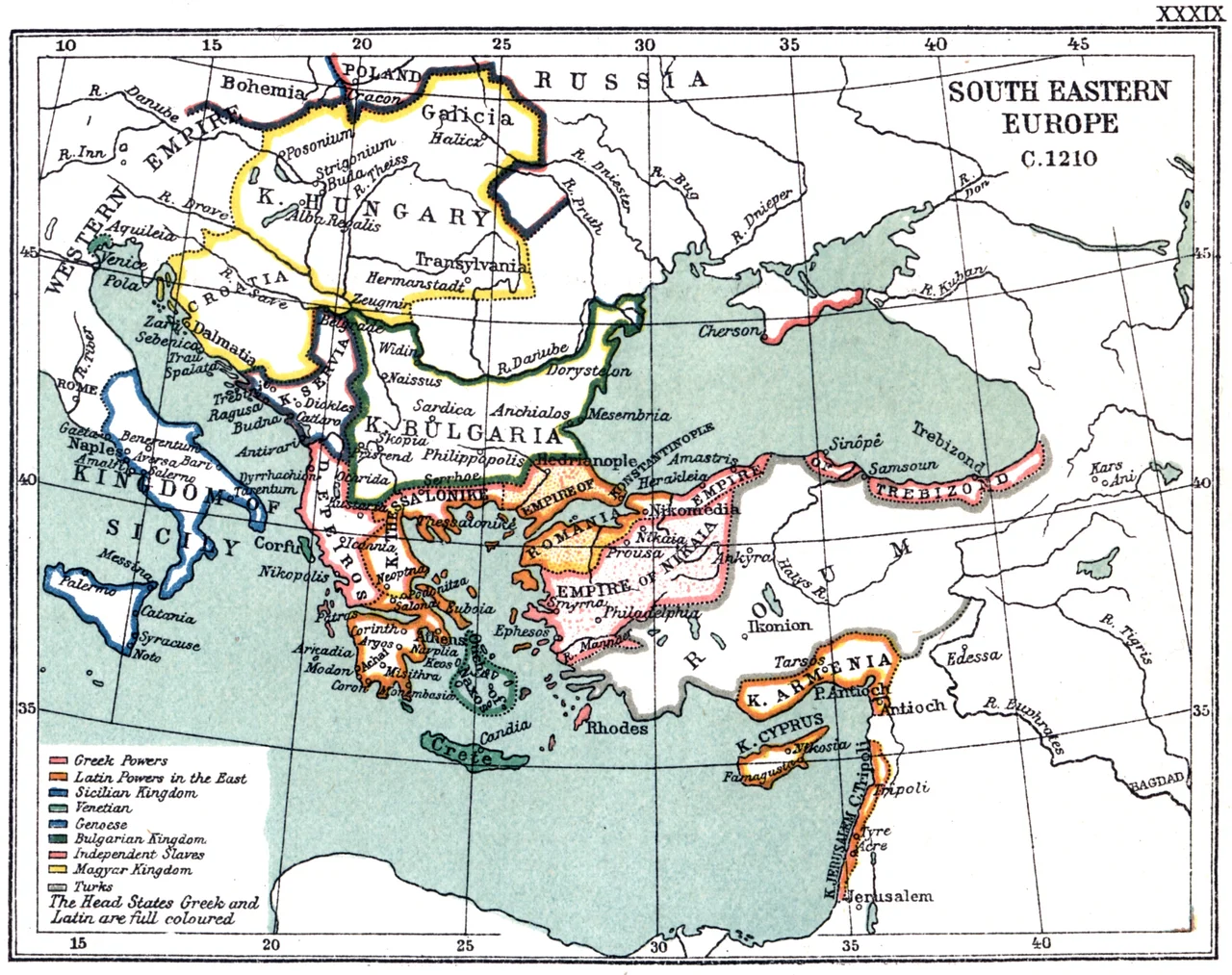
Thirty years after the Fourth Crusade shattered the Byzantine Empire and installed a Latin emperor in Constantinople, the city remained in Western hands — but only barely. The Latin Empire was broke, its garrison thin, its hold on the surrounding Balkans increasingly contested. Into this fragile situation came two rulers who had been rivals and became, for a single season, partners: Tsar Ivan Asen II of Bulgaria and Emperor John III Doukas Vatatzes of Nicaea. In the summer of 1235 they brought their combined armies to the walls of Constantinople. The Theodosian Walls held. The siege failed. But the pressure it created would not lift.
A Promise Betrayed
The Latin Empire that emerged from the sack of Constantinople in 1204 faced an almost impossible task: governing a fractured empire with limited manpower, contested legitimacy, and constant hostility from its neighbors. Among those neighbors was Ivan Asen II of Bulgaria, who had been led to believe — through negotiations with the Latins in the late 1220s — that he might himself become emperor of Constantinople following the death of the Latin emperor Robert of Courtenay in 1228.
The Latins had been stringing Asen along to prevent him from allying with the rival Byzantine state of Epirus. When the Bulgarians crushed Epirus at the Battle of Klokotnitsa in 1230, eliminating the threat the Latins had feared, the Latins promptly dropped the negotiations — and secretly arranged for the elderly crusader John of Brienne to become the new emperor instead. When that arrangement became known, Asen's anger was understandable. He turned to Nicaea.
The Alliance at Gallipoli
In the spring of 1235, John III Doukas Vatatzes crossed the Dardanelles and secured Gallipoli. Asen traveled there with his family to meet the Nicaean emperor, and the two rulers concluded a formal alliance. The agreement was sealed with careful political architecture: the Bulgarian Church was granted autocephaly, with the archbishop of Tărnovo recognized as Patriarch; in return, Asen recognized the Nicaean patriarch as ecumenical and surrendered certain ecclesiastical claims. A dynastic marriage bound the two courts — Asen's daughter Elena wed the Nicaean heir Theodore Laskaris.
The alliance was thus more than a military convenience. It was a restructuring of Orthodox Christendom in opposition to the Latin presence in Constantinople. Two powerful rulers, each with legitimate claims and strong armies, had agreed to act together. The city they aimed to take was held by a small garrison — the sources suggest between 160 and 800 knights — guarding walls that were still among the most formidable in the medieval world.
At the Theodosian Walls
The Nicaean army swept north through Thrace from Gallipoli, seizing Latin-held territory up to the fortress of Tzurulum west of Constantinople. The two armies joined before the city. Asen and Vatatzes participated directly in the fighting. But the garrison of the Latin Empire — outnumbered as it was — had a decisive advantage: the walls.
The Theodosian fortifications, built in the fifth century, comprised a moat, a lower outer wall, and a massive inner wall behind it. John of Brienne, the aging Latin emperor who had been a renowned soldier in the crusades, led cavalry sorties from the gates that disrupted the besiegers and caused casualties. The Nicaean fleet tried to force the Golden Horn but was repelled by the defenders. Then 25 armed Venetian galleys arrived in relief. The Venetians pursued the retreating Nicaean ships and captured 24 of them — a severe blow. The allied army withdrew in the autumn, agreeing to renew the siege in 1236 after the Venetian fleet departed.
Second Season, Shifting Ground
The siege resumed in 1236. The defenders this time had additional support: Geoffrey II Villehardouin of Morea and contingents from the Italian republics of Venice, Genoa, and Pisa. The allies made no significant progress. Asen faced mounting pressure from Pope Gregory IX, who was calling for a crusade against him for refusing submission to Rome and for allying with Orthodox opponents of Catholicism against a Catholic-held city. Diplomatic concerns began to compete with military objectives.
At some point in 1236, Asen shifted allegiance, abandoning the alliance with Nicaea and negotiating with the Latin Empire instead. Historians have proposed two explanations: he may have concluded that a captured Constantinople would become a Greek imperial capital, benefiting Nicaea far more than Bulgaria; or the papal threat from the west compelled him to de-escalate. His alliance with the Latins also collapsed, and by the end of 1237 he had reconciled with Vatatzes. The siege had ended without result — except that it had not been forgotten.
The Pressure That Endured
The siege of 1235–1236 did not topple the Latin Empire. But its aftermath accelerated the empire's decline. Some of John of Brienne's soldiers, unpaid, left his service after the allied withdrawal. The city's Greek inhabitants, disarmed by the Latins out of distrust, had nowhere to direct their loyalties. Sporadic Western reinforcements arrived over the following years — at one point, a force estimated at 30,000 to 60,000 soldiers crossed Hungary and Bulgaria bound for Constantinople — but they dispersed quickly, and the structural weakness of the Latin position remained.
Nicaea continued to expand in Thrace and Macedonia. After Asen's death in 1241, Vatatzes isolated Constantinople further by taking Thessalonica in 1246. On 25 July 1261 — twenty-five years after the siege of 1235–1236 ended — a Nicaean advance force under the general Alexios Strategopoulos found an unguarded gate and entered Constantinople without a battle. The Byzantine Empire was restored. The pressure that had been building since 1235 had finally, quietly, succeeded.
From the Air
The siege of 1235–1236 was fought around the full perimeter of Constantinople at approximately 41.008°N, 28.975°E. From the air at 4,000 feet, the Theodosian land walls are visible as a long, roughly north-south line along the western edge of the old city — sections of these walls still stand and can be seen from the approach to Istanbul. The Golden Horn to the north and the Sea of Marmara to the south mark the limits of the Latin Empire's defended perimeter. The fortress of Tzurulum (modern Çorlu), which the Nicaean army captured before the siege, lies roughly 70 km to the west-northwest. Nearest airport is Istanbul Airport (LTFM), approximately 35 km to the northwest.
Nearby Stories
- Kocaeli Peninsula 7.6 km away
- Second Battle of Çatalca 11 km away
- Istanbul's Rural Outskirts 14 km away
- MV Struma 20 km away
- HMAS AE2 36 km away
- Bursa 66 km away
- Sangarius Bridge 71 km away
- Januarius MacGahan 101 km away