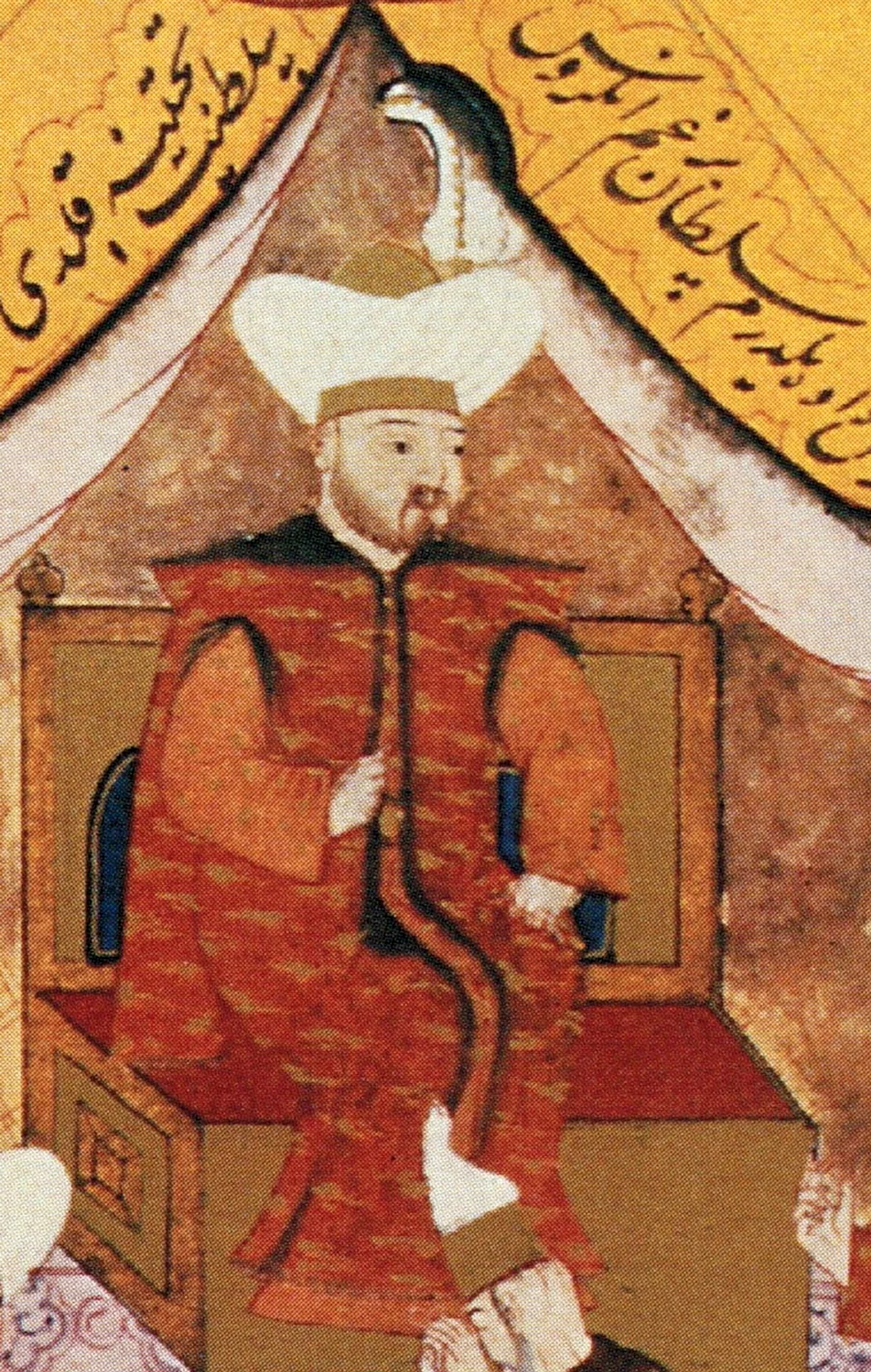
,_Library_of_the_Topkapi_Palace_Museum,_Hazine_1523,_f._96b.jpg)
Siege of Constantinople (1394–1402)
Imagine an emperor who must leave his own besieged capital and travel thousands of miles, hat in hand, begging the courts of Western Europe for soldiers. That is what happened to Manuel II Palaiologos in December 1399. The city behind him had been encircled by Ottoman forces since at least 1394 — cut off from its agricultural hinterland, watched from a new fortress Bayezid had planted on the Asian shore of the Bosphorus to throttle seaborne trade. Relief did not come from France or England or Venice. It came, unexpectedly, from the steppes of Central Asia, when the warlord Timur turned his armies against Bayezid and changed everything in a single afternoon.
The Noose Tightens
By 1391, the Ottoman advance through the Balkans had already severed Constantinople from the farming villages and grain stores that fed it. The city stood on its triangular peninsula — the Golden Horn to the north, the Sea of Marmara to the south, the Theodosian Walls sealing its landward side — but the roads and sea lanes that once supplied it were now hostile territory. Sultan Bayezid I, whom contemporaries called Yıldırım (Thunderbolt) for the speed of his campaigns, understood that he did not need to storm the walls. He needed only to wait. Around 1394, he completed the fortress of Anadoluhisarı on the Asian bank of the Bosphorus strait, giving him a choke point over the channel. The land blockade was tighter than the naval one — Byzantine galleys could still slip through at times — but the slow hemorrhage of the city's resources was unmistakable. The population inside the walls shrank. Gardens were planted in former public spaces. The suffering was real and cumulative, even if it was not spectacular.
The Crusade That Could Not Help
Western Christendom was not indifferent to Constantinople's plight, but it was not united either. In 1396, a large crusading army assembled under John I of Nevers — drawn from French, Burgundian, Hungarian, and Wallachian forces — and marched toward the Ottomans. At Nicopolis on the Danube, Bayezid's army met them and inflicted a decisive defeat. Thousands died in the battle; many more, captured, were executed. The Crusade of Nicopolis became one of the defining disasters of late medieval Christian military ambition. For Constantinople, the defeat meant that the force which might have broken the blockade was gone. In 1399, Marshal Jean II le Meingre — Boucicaut — arrived with a French expeditionary contingent and managed some minor naval operations, but could not fundamentally alter the city's situation. He escorted Emperor Manuel II when the emperor left for his long western tour, unwilling to leave him unguarded on the road.
An Emperor on the Road
Manuel II Palaiologos left Constantinople in December 1399 and would not return for more than three years. His journey took him to Venice, Milan, Paris, and London. Everywhere he was received with ceremony and expressions of sympathy. The English king Henry IV hosted him at Eltham Palace. French chroniclers marveled at his dignity. But no monarch signed a binding commitment of troops or funds sufficient to relieve the blockade. The gap between honorable reception and actual military aid was absolute. Manuel was not naive — he understood the constraints his hosts faced, including their own dynastic wars. He kept the diplomatic effort alive even as months stretched into years, sustained by word that the city still held. The citizens within the walls endured under a regency, rationing what they had, repairing what crumbled, trusting in the Theodosian Walls and in God. History would eventually vindicate that trust, but not through any western lance.
Timur and the Road from Ankara
The siege ended not because Constantinople was defended but because its attacker was destroyed. In 1402, Timur — the Turco-Mongol conqueror who had already shattered kingdoms from Delhi to the Black Sea — confronted Bayezid at Ankara. The Battle of Ankara on 20 July 1402 was catastrophic for the Ottomans: Bayezid was captured and died in captivity months later. His sons immediately fell into civil war — the Ottoman Interregnum — fighting one another for the throne he had vacated. The forces blockading Constantinople had no sultan to answer to and no strategic purpose. The pressure on the city dissolved. Manuel II returned home to find his capital intact. In the Treaty of Gallipoli that followed, the Byzantines recovered some of the territories Bayezid had seized. It was the most improbable of reprieves: a city saved not by its own sword, nor by any crusader, but by a collision of empires far to the east.
A Borrowed Decade
The lifting of the 1394–1402 blockade did not restore Byzantine power. It bought time — roughly half a century — and not much else. Constantinople remained a shrinking imperial capital surrounded by Ottoman territory, its revenues drained, its population diminished, its army a shadow. The walls still stood, magnificent and thick, but the empire they protected had contracted to little more than the city itself and a few coastal enclaves. The respite allowed Manuel II to reign another two decades and to see his dynasty continue, but the structural reality was unchanged: the Ottoman Empire would reconstitute itself after its civil war and return. In 1453, Mehmed II would finally succeed where Bayezid had failed. The eight-year blockade of 1394–1402 belongs in the long prologue to that ending — a story of endurance made possible by an accident of geopolitics, and of suffering that no western monarch chose to share.
From the Air
The siege centered on Constantinople's historic peninsula, now Istanbul's Fatih district, at approximately 41.01°N, 28.98°E. The Bosphorus strait is clearly visible from the air — the fortress of Anadoluhisarı, which Bayezid built to control it, still stands on the Asian shore at roughly 41.08°N, 29.06°E. The Theodosian Walls that held through the blockade run north–south across the landward neck of the peninsula. Nearest commercial airport is Istanbul Airport (LTFM), approximately 35 km northwest. Approach from the northwest over the Golden Horn offers the clearest view of the land walls and the strait together. Recommended viewing altitude: 3,000–5,000 feet for wall visibility; the Bosphorus chokepoint is best appreciated above 8,000 feet where both shores are simultaneously visible.
Nearby Stories
- Kocaeli Peninsula 7.6 km away
- Second Battle of Çatalca 11 km away
- Istanbul's Rural Outskirts 14 km away
- MV Struma 20 km away
- HMAS AE2 36 km away
- Bursa 66 km away
- Sangarius Bridge 71 km away
- Januarius MacGahan 101 km away