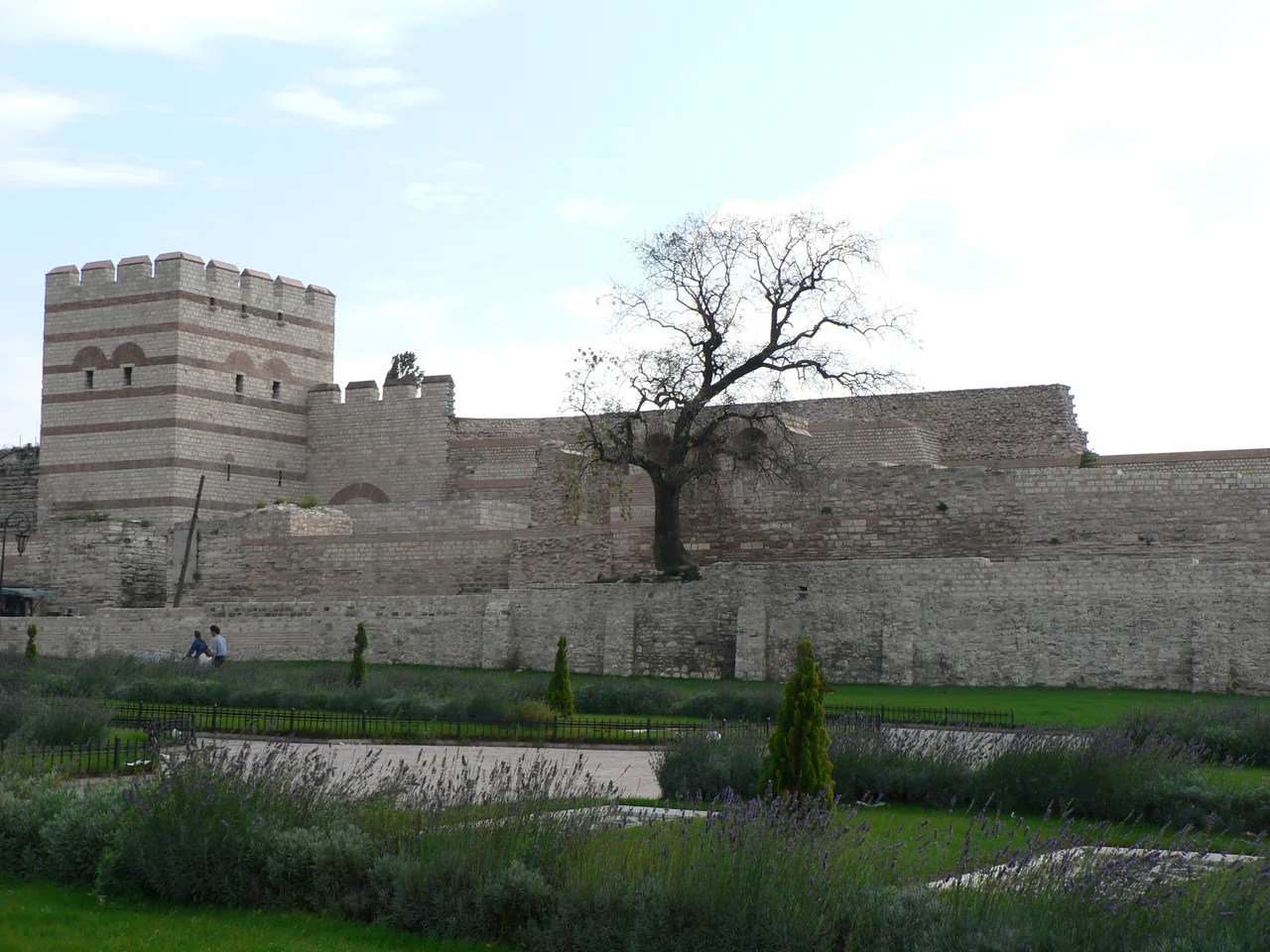

Siege of Constantinople (1422)
On 10 June 1422, a Wednesday at roughly four in the afternoon, an Ottoman vanguard under the commander Mihaloğlu struck the suburbs of Constantinople. It was the opening move of a siege that lasted into late summer — and the first Ottoman assault on the city to use cannons, crude 'falcons' that were short and wide, lobbing stones toward the massive Theodosian Walls. The eyewitness John Kananos left a detailed account. Murad II arrived with the main army and his siege engines ten days later, and for weeks the guns and the garrison traded blows. The walls held. They had held for a thousand years, and they held again — though not only through force of arms. Murad ultimately left not because he was beaten but because his empire had caught fire behind him.
The Provocation
The siege grew from a deliberate Byzantine policy. For decades, the empire had played its neighbors against one another: supporting rival claimants, financing rebellions, using diplomacy to forestall military threats it could no longer answer with force. After Mehmed I died in 1421 and the question of Ottoman succession opened again, Emperor Manuel II revived the tactic, backing pretenders against Murad II. From the Byzantine perspective it was rational statecraft — they lacked the soldiers and money to confront the Ottomans directly. From Murad's perspective, it was an intolerable act of interference that could not go unanswered. When he consolidated power in Anatolia, he marched west. The siege of 1422 was the bill for Byzantine manipulation of Ottoman succession politics.
Cannon at the Walls
The introduction of Ottoman artillery in 1422 marked a technological threshold — the first time the Turks brought cannon to bear on Constantinople's fortifications. These 'falcons' were modest by later standards: short, wide-mouthed guns that threw stone shot rather than iron. The technological balance was roughly even; Byzantine defenders also operated bombards, and the Ottomans found they needed to construct barricades to protect their own men from the returning stones. Neither side held a decisive artillery advantage. The Theodosian Walls, triple-layered across the landward approach and anchored by towers every 70 meters or so, were designed to absorb exactly this kind of battering. Murad's engineers could not find the weak point. The defenders manned the walls daily, repaired what was damaged, and watched the siege lines for vulnerabilities. It was grinding, dangerous, exhausting work — and it held.
Revolt at Bursa
What the walls could not do alone, Murad's younger brother managed. Küçük Mustafa — 'Little Mustafa,' so called to distinguish him from the earlier pretender — launched a rebellion in Anatolia, supported by men from the Germiyan and Karaman beyliks, the Anatolian principalities that feared Ottoman reconsolidation after the Interregnum. The historian Doukas adds that the Byzantine emperor contributed money to the rebellion as well. Whether or not that is accurate, Mustafa gathered a significant army and by late August or early September 1422 had laid siege to Bursa, the Ottoman capital in Anatolia. Murad faced a choice: continue the siege of Constantinople, or defend his own throne. He chose to defend his throne. The siege was lifted. Mustafa would be caught and executed before the year was out, but Constantinople had survived another assault.
The Woman in Purple
Byzantine accounts of the lifting of the siege carry a detail that their authors treated as both literally and spiritually real: an apparition of the Theotokos — Mary, Mother of God — walking the outer ramparts of Constantinople in purple robes. John Kananos recorded that defenders saw her and were emboldened; he also recorded the remarkable claim that Ottoman soldiers in the siege lines saw the same figure and were unsettled by it. Whatever the truth of the vision, its meaning to contemporaries is clear. Constantinople's defenders understood themselves to be under divine protection. Patriarch, priest, and soldier had processed along the walls with icons in previous sieges; the spiritual and the martial were not separate in Byzantine experience. The Theotokos tradition around Constantinople was ancient and specific: the city believed itself guarded. That belief had sustained defenders through the Avar siege of 626, the Arab sieges of the seventh and eighth centuries, and every Ottoman assault since.
An Empire in Name Only
The Byzantine victory of 1422 deserves honest reckoning. What the empire saved was a city, and not much more. By this point, Byzantine territory had contracted to Constantinople itself plus a few scattered coastal strips; everything else was gone. The military was hollowed out. Economically, the empire was in crisis. The new cannons the defenders used had been gifts from European states — Constantinople could not manufacture them itself. No Byzantine military renaissance followed the 1422 success. Murad II would eventually sign a peace that left the empire intact but subordinate; his son Mehmed II, in 1453, would not offer terms at all. Looking back from 1453, the siege of 1422 reads as the final close call — the last time the city's walls and its attacker's circumstances combined to preserve it. When Mehmed II came, he came with bigger cannons, more troops, and no revolt at home to pull him away.
From the Air
The siege of 1422 was fought along Constantinople's landward Theodosian Walls, which ran north–south across the western neck of the city's peninsula at roughly 41.01°N, 28.94°E. The walls are still partially standing today in Istanbul's Fatih district and visible from low-altitude passes. The Ottoman siege lines would have spread westward from the walls across what is now densely built-up urban Istanbul. Istanbul Airport (LTFM) is approximately 35 km to the northwest. A flight approach from the west over the Sea of Marmara, turning north along the Bosphorus, gives the clearest aerial sense of the peninsula's geography — and of how narrow the land approach the Ottoman attackers were using actually was.
Nearby Stories
- Kocaeli Peninsula 7.6 km away
- Second Battle of Çatalca 11 km away
- Istanbul's Rural Outskirts 14 km away
- MV Struma 20 km away
- HMAS AE2 36 km away
- Bursa 66 km away
- Sangarius Bridge 71 km away
- Januarius MacGahan 101 km away