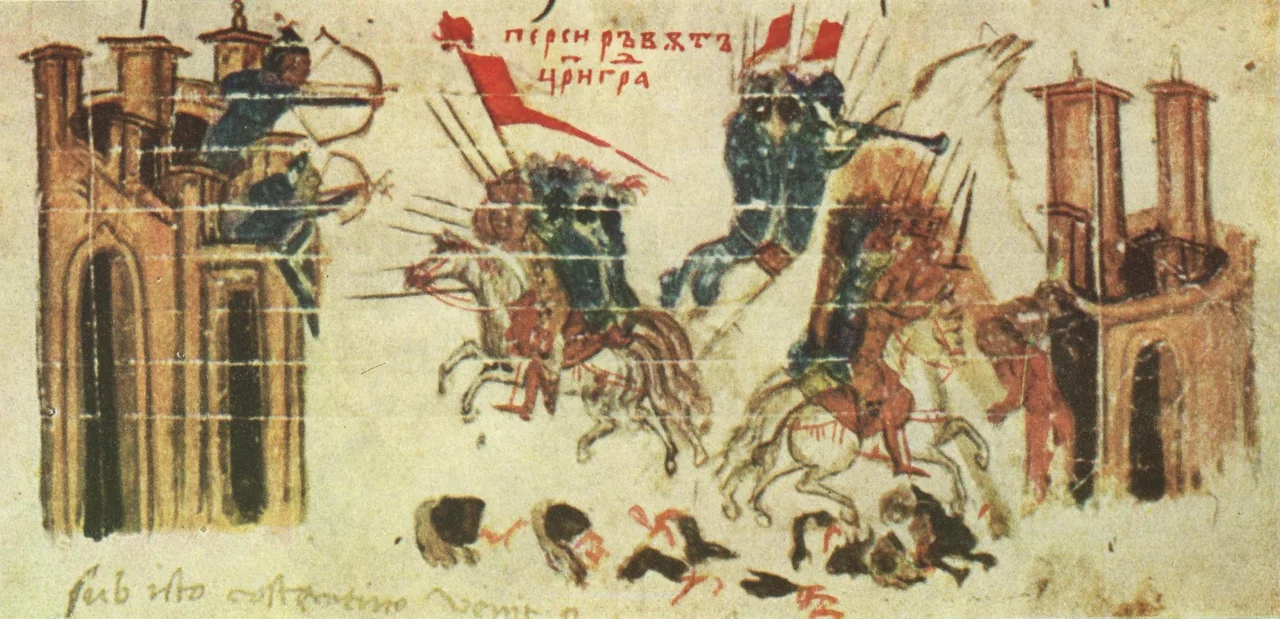

Siege of Constantinople (626)
In the summer of 626, Constantinople looked more isolated than it ever had. Emperor Heraclius was hundreds of miles away raiding deep into Persia. The Sassanid army of the general Shahrbaraz was camped at Chalcedon, just across the Bosphorus — close enough to see the city's walls but unable to cross the water in force because Byzantine galleys controlled the strait. On the European shore, some 80,000 Avars and allied Slavic fighters had assembled, dragging siege engines toward the Theodosian Walls. Khosrau II, the Sassanid king, had timed this with the Avar Khagan in an attempt to crush the city simultaneously from east and west. What stood between the attackers and Constantinople's fall was a narrow stretch of water, a determined garrison of roughly 12,000 cavalry troops fighting on foot, Patriarch Sergius carrying an icon along the walls, and a Byzantine navy that proved decisive when it counted.
The World in Crisis
The siege of 626 arrived at the end of a generation of catastrophe. In 602, the Byzantine emperor Maurice had been overthrown and killed by the general Phocas, whose brutal reign destabilized the empire's eastern frontier. The Sassanid king Khosrau II had been a personal friend of Maurice's — Maurice had helped restore him to his throne years earlier — and he used the coup as justification for invasion. By the time Phocas himself was overthrown by Heraclius in 610, the Sassanids had driven deep into Byzantine territory. Over the following decade, they took Syria, Palestine, and Egypt, stripping the empire of its wealthiest provinces. Heraclius responded with a counter-offensive into Mesopotamia and the Persian heartland, but he could not be everywhere at once. By coordinating with the Avar Khagan — offering him gold and goods to move his forces south — Khosrau opened a second front that Heraclius could not cover. Constantinople was left to defend itself.
The Bosphorus Holds the Line
The tactical situation in 626 turned on a geographical fact: the Bosphorus was Byzantine. Shahrbaraz had his army at Chalcedon, on the Asian shore — a trained, experienced force that excelled in siege warfare. The Avars had numbers and siege equipment on the European shore. Coordination between the two forces was nearly impossible across a strait guarded by Byzantine warships. The Persians could not move their siege engines across to reinforce the Avars. They could not even communicate reliably with their allies. The partnership that looked devastating on a map was, in practice, two separate sieges rather than one combined operation. Heraclius grasped this. He split his army, sending some reinforcements to Constantinople to bolster morale and sending his brother Theodore with a separate force to pin the Persian general Shahin in Mesopotamia. The emperor himself remained in Persia, raiding. His confidence in the capital's ability to hold was not naive — it was calculated.
Under the Theodosian Walls
The Avars launched their coordinated assault on 29 June 626. What followed was weeks of sustained bombardment and assault against the Theodosian Walls — those triple-layered fortifications that Theodosius II had completed in 413 and that would not be breached until 1453. Patriarch Sergius led processions along the walls, carrying an icon believed to be of the Virgin Mary, his religious fervor serving as a form of command. The defenders knew they were outnumbered; the Patriarch's insistence that divine protection accompanied them mattered for morale in a way that is hard to reconstruct but is consistently attested in the sources. The Slavic forces attempted to cross the Golden Horn and attack from the sea walls. Patrician Bonus, commanding the city's defense, deployed Byzantine galleys to meet them. The Slavic boats were rammed and destroyed. The Avar assault from the land failed as well. The news that Theodore had decisively defeated the Persian general Shahin — reportedly triggering Shahin's death from depression at his failure — was decisive. The Avars withdrew to the Balkans within two days of learning it.
The Persian Army That Stayed
Shahrbaraz and the Sassanid army camped at Chalcedon did not participate in the August naval battles — the Bosphorus denied them that opportunity. After the Avar withdrawal, Shahrbaraz's position became untenable. But what happened next was not simply military. Heraclius, exploiting intelligence from intercepted letters, showed Shahrbaraz correspondence from Khosrau ordering his own general's execution. Whether the letters were authentic or a Byzantine forgery is not established in the sources, but the effect was real: Shahrbaraz switched sides. He marched his army to northern Syria, where he would wait to see which way the wind blew between Khosrau and Heraclius. Heraclius had neutralized Khosrau's most capable general without a direct engagement. In the following year, 627, Heraclius invaded Mesopotamia again, defeated a Persian army at Nineveh, and marched on the Sassanid capital Ctesiphon. The Romans and Persians would not cross swords again. Both empires were shattered by the Arab-Islamic conquests that followed within a generation.
A Hymn for Survival
Byzantine tradition credited the salvation of 626 to the Theotokos — the Virgin Mary, whose icon Patriarch Sergius had carried along the walls. An unknown author, possibly Sergius himself or the poet George of Pisidia, wrote a new proemium for the Akathist Hymn in thanksgiving. The Akathist — a celebrated liturgical poem of praise — thus carries in its opening verses a memory of this specific siege, this specific summer of fear and relief. The association between Constantinople and divine protection was not invented in 626, but the events of that year intensified it. For centuries afterward, defenders of the city would invoke the Theotokos at moments of crisis. The siege also showed something the Avars and Persians had not fully understood: that Constantinople's strength was not reducible to numbers or siege engines. Its position, its water barriers, its navy, and the discipline of its garrison formed a system. Break the Bosphorus stranglehold and the system fails. They never broke it.
From the Air
The siege of 626 played out across Constantinople's peninsula and the Bosphorus strait, centered at 41.01°N, 28.98°E. The Theodosian Walls — where the Avar-Slavic assault was repulsed — run north–south at the peninsula's landward neck, visible from the air in Istanbul's Fatih district. The Golden Horn, where Patrician Bonus' galleys destroyed the Slavic fleet, is the inlet curving northeast from the Bosphorus junction. Chalcedon, where Shahrbaraz's Persian army was encamped, is the area now known as Kadıköy on the Asian shore, at approximately 40.99°N, 29.03°E — a crossing plainly visible from altitude. Nearest commercial airport: Istanbul Airport (LTFM), about 35 km northwest. An approach from the northeast at 6,000–9,000 feet shows both shores of the Bosphorus and the Golden Horn together, making the strategic logic of the city's position immediately apparent.
Nearby Stories
- Kocaeli Peninsula 7.6 km away
- Second Battle of Çatalca 11 km away
- Istanbul's Rural Outskirts 14 km away
- MV Struma 20 km away
- HMAS AE2 36 km away
- Bursa 66 km away
- Sangarius Bridge 71 km away
- Januarius MacGahan 101 km away