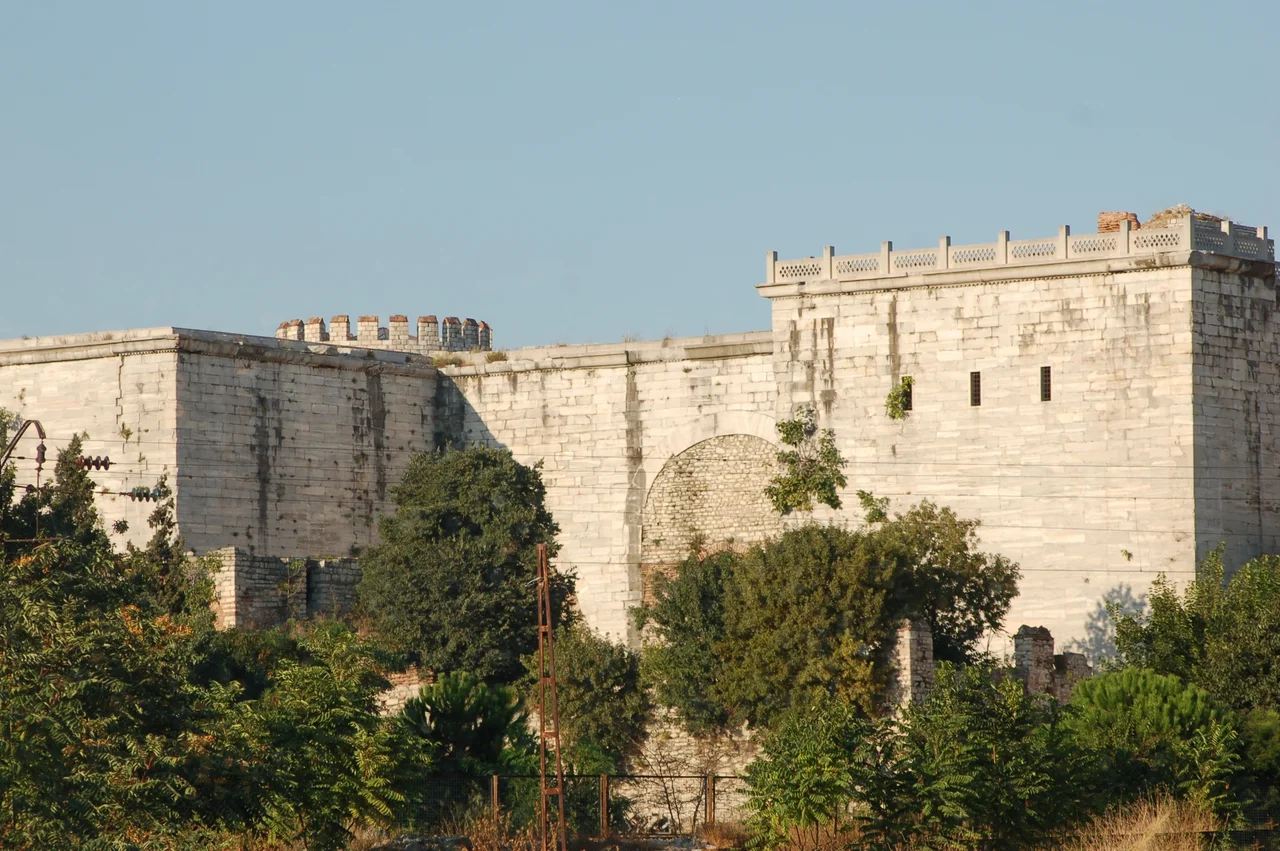

Siege of Constantinople (674–678)
Every spring for four years, the Arab fleet left its winter base at Cyzicus and crossed the Sea of Marmara to attack Constantinople. Every autumn, it withdrew. The chronicler Theophanes the Confessor describes the pattern with a soldier's flat precision: 'Every day there was a military engagement from morning until evening, between the outworks of the Golden Gate and the Kyklobion, with thrust and counter-thrust.' This was not the swift, shocking assault of a battlefield. It was a siege conducted in installments — patient, methodical, and ultimately unsuccessful. Caliph Mu'awiya I had built a navy, seized island bases from Rhodes to Crete, and prepared this campaign for years. What stopped him, and what has made the siege of 674–678 one of the most consequential episodes in medieval Mediterranean history, was a weapon his admirals had not expected: Greek fire.
The Road to the Marmara
The Arab offensive against Constantinople in the 670s grew from decades of cumulative pressure. After the Battle of the Yarmuk in 636, the Byzantine Empire had lost Syria, and Egypt fell soon after. Mu'awiya, serving as governor of the Levant, drove Muslim naval expansion into the eastern Mediterranean — Cyprus fell, and Arab fleets raided as far as Kos, Rhodes, and Crete. In 655, the young Muslim navy inflicted a crushing defeat on the Byzantine fleet at the Battle of the Masts. A temporary truce in 659 gave Byzantium a reprieve, but when Mu'awiya emerged from the First Muslim Civil War in 661 as Caliph of the new Umayyad dynasty, the campaign resumed. By 672–673, three Muslim fleets had established bases along the coast of Asia Minor; Cyzicus, on the southern shore of the Sea of Marmara, became the forward staging point. Constantinople was the objective. Its capture would, Mu'awiya believed, end Byzantine power entirely.
The Rhythm of Siege
The pattern established in 674 was methodical and grim. Each spring the Arab fleet entered the Marmara and pressed against the city's sea walls and the outworks between the Golden Gate and the Kyklobion. Soldiers died daily in those engagements — both Byzantine defenders and Arab attackers — for months at a time, across four successive campaigns. The sources do not preserve individual names for most of the men who fought and died in those daily clashes, but the toll was real and cumulative. Emperor Constantine IV prepared for the onslaught with care. Among the weapons he commissioned were siphon-bearing ships designed to deploy a newly developed incendiary substance — the liquid fire that Byzantine sources call 'liquid fire' and that history has called Greek fire. Its exact formula was a state secret closely held; it burned on water and could not easily be extinguished. Arab chroniclers do not record the siege in detail — their sources focus on individual expeditions rather than a sustained campaign — but the weight of Byzantine evidence, and the poem by Theodosius Grammaticus that celebrates a decisive naval victory, supports the general outline.
Fire on the Water
Greek fire changed the naval balance decisively. In late 677 or early 678, Constantine IV resolved to confront the Arab fleet directly. His siphon ships deployed the incendiary against the Arab fleet and routed it. The Arab admiral Yazid ibn Shagara died, according to Arab sources, around this time — likely in this engagement. Simultaneously, the Arab land army in Asia Minor, commanded by Sufyan ibn 'Awf, was defeated by a Byzantine force under the generals Phloros, Petron, and Cyprian. Byzantine sources report Arab losses of 30,000 men in the land battle, a figure that should be treated cautiously but that reflects the scale of the disaster. The Arab fleet, retreating toward Syria, was then struck by a storm off Syllaion and nearly annihilated. The siege was over. Mu'awiya began negotiating a truce. The peace treaty that followed required the Caliph to pay an annual tribute to Byzantium of 3,000 gold pieces, 50 horses, and 50 slaves — a remarkable reversal of the power dynamic that had prevailed for decades.
A Saint at the Walls
Among the soldiers, sailors, and commanders who served in the Arab forces before Constantinople, later Muslim tradition singled out Abu Ayyub al-Ansari — one of the earliest companions of the Prophet Muhammad, his standard-bearer during Muhammad's lifetime. Abu Ayyub came to the siege old and ill, and died there, before the city walls, of illness. He was buried where he fell, outside Constantinople. According to Muslim tradition, when Constantine IV threatened to destroy the tomb, Mu'awiya warned that Christian communities under Muslim rule would suffer if he did. The tomb was left in peace. After the Ottoman conquest of Constantinople in 1453, Sultan Mehmed II ordered the construction of a marble tomb and a mosque beside it. The complex became the Eyüp Sultan Mosque, and it remains one of the holiest Muslim sites in Istanbul today — a trace of a seventh-century siege that never succeeded, kept alive across fourteen centuries in stone and tradition.
What the Siege Preserved
Had Constantinople fallen in 674–678, the consequences for the Mediterranean world would have been profound. The Byzantine state depended on its capital; without Constantinople, the scattered provincial armies and administrative structures would have had no center to hold them together. The Arab advance into southeastern Europe, already considerable, might have proceeded unchecked. That it did not — that the siege failed — allowed Byzantium to endure another eight centuries, to preserve Greek learning and Orthodox Christianity through the medieval period, and to serve as a cultural bridge between the ancient world and what came after. The peace that followed 678 was fragile: Justinian II broke it in 692, with devastating results, and the Arabs returned for a second great siege in 717–718. But in 678, Constantine IV had bought his empire time. The news of the Arab defeat reached as far as China, where Tang dynasty historians recorded that the great fortified city of Fu lin had repelled the Da shi — the Umayyad Arabs — and extracted tribute in the aftermath. Even from the far side of the world, the survival of Constantinople was news.
From the Air
The Arab siege of 674–678 was fought primarily around Constantinople's sea walls and the approaches from the Sea of Marmara, centered at 41.01°N, 28.98°E. The Golden Gate, one of the named battleground landmarks, stood at the southern end of the Theodosian Walls near the Marmara coast. The winter base at Cyzicus occupied a peninsula on the southern shore of the Sea of Marmara, roughly 100 km to the southwest. From altitude above the Marmara, both Cyzicus (modern Erdek peninsula area) and Constantinople's peninsula are visible on a clear day, giving a sense of the spring crossing the Arab fleet made each year. The Eyüp Sultan Mosque, marking the tomb of Abu Ayyub al-Ansari, sits at the northern end of the Golden Horn at approximately 41.05°N, 28.94°E — still a functioning shrine and easily spotted from a low-altitude pass along the Horn. Nearest commercial airport: Istanbul Airport (LTFM), approximately 35 km northwest. Recommended viewing altitude: 8,000–12,000 feet for a Marmara overview; 2,000–3,000 feet for the Golden Horn and Eyüp Sultan detail.
Nearby Stories
- Kocaeli Peninsula 7.6 km away
- Second Battle of Çatalca 11 km away
- Istanbul's Rural Outskirts 14 km away
- MV Struma 20 km away
- HMAS AE2 36 km away
- Bursa 66 km away
- Sangarius Bridge 71 km away
- Januarius MacGahan 101 km away