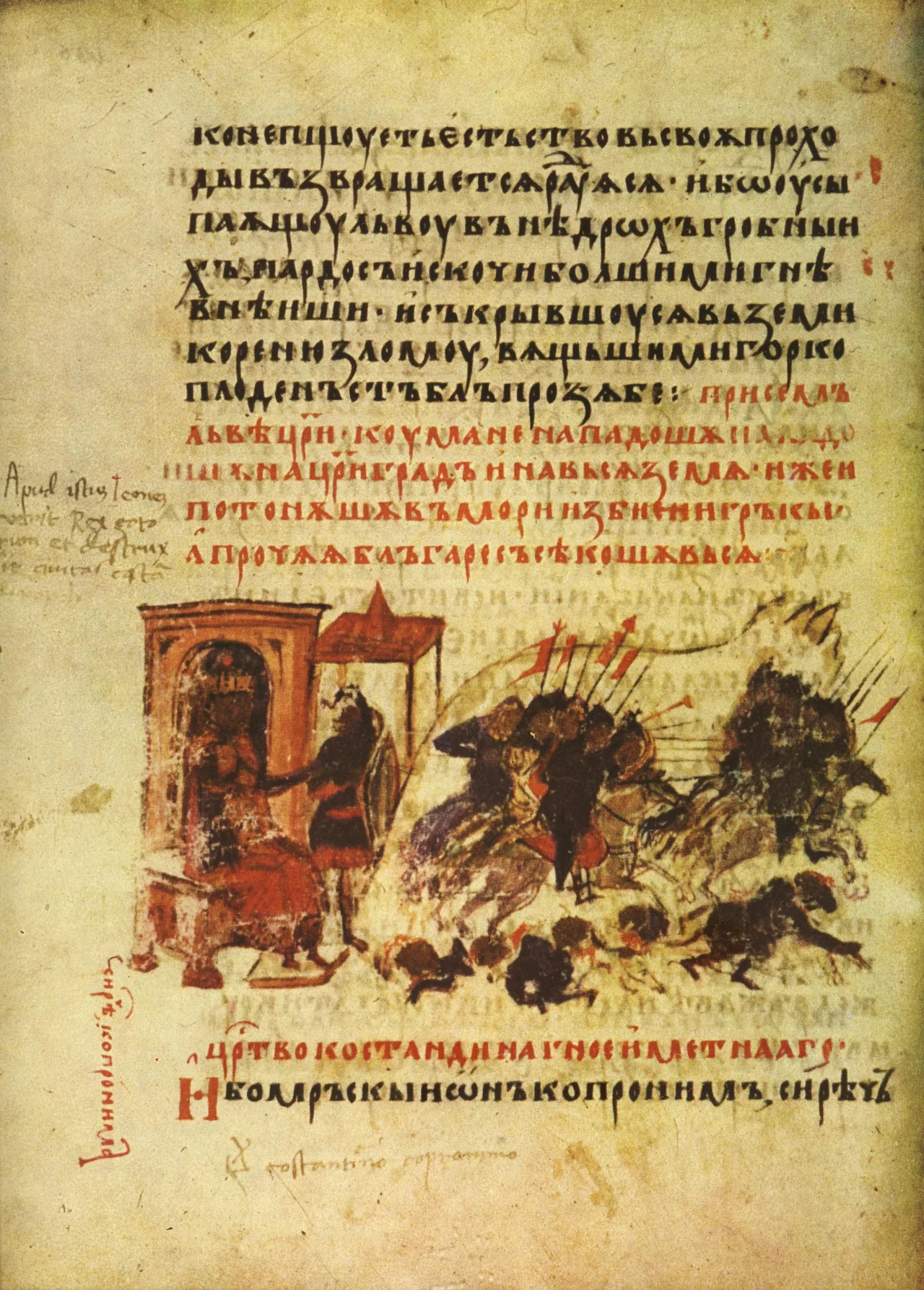

Siege of Constantinople (717–718)
Caliph Sulayman ibn Abd al-Malik had sworn an oath. He would not stop fighting until he had exhausted the Arab world or taken Constantinople. His forces assembled at the plain of Dabiq, north of Aleppo — an army so large that medieval chroniclers scrambled for adjectives: 80,000 men, 1,800 ships, supply trains of 12,000 porters, 6,000 camels, 6,000 donkeys. The city they aimed at had already survived one Arab siege, in 674–678, but that had been a loose, grinding blockade. This time the Caliphate meant to end the matter. For thirteen months in 717 and 718, the fate of Byzantium — and, historians have argued ever since, the fate of Europe — hung above the waters of the Bosphorus.
The Emperor Who Played Both Sides
The siege began before the first soldier crossed into Thrace. Arab general Maslama ibn Abd al-Malik had spent years cultivating a Byzantine general named Leo the Isaurian, who was fighting for the throne against the sitting emperor. Maslama expected a willing client; Leo gave him something else. Playing for time while the Arab army wintered on the Aegean coast, Leo used the breathing room to march on Constantinople himself. In the spring of 717 he secured the capital and was crowned emperor — then shut the gates against the army he had just encouraged to come. The deception did not save anyone from what followed, but it meant the Byzantines entered the siege with a calculating, energetic emperor rather than a paralyzed one. Leo III would prove the most consequential figure in a story crowded with consequential figures.
Fire on the Water
The Arab fleet arrived in the Bosphorus on 1 September 717. More than a thousand ships — the figure in Theophanes, though numbers in medieval sources invite skepticism — spread across the strait. Their task was to complete the blockade the land army had already drawn tight around the landward walls. It almost worked. Then the wind shifted. Twenty heavy Arab warships, their rearguard, drifted toward the sea walls. Byzantine sailors met them with Greek fire: a naval incendiary that burned on water and could not be doused. Some ships went down with all aboard; others, aflame, drifted south toward the Princes' Islands. That same night Leo drew an iron chain across the mouth of the Golden Horn, sealing the harbor. The Arab fleet, suddenly cautious, withdrew north to Sosthenion. Constantinople could still be fed from the sea. The siege would last another year, but that night on the Bosphorus shifted its logic entirely.
The Winter That Broke an Army
The winter of 717–718 was brutal even by the standards of the northern Balkans, with snow lying on the ground for more than three months. Cut off from foraging because their army had already stripped the Thracian countryside on its march, and unable to break the naval blockade, the Arab forces around the walls began to starve. They slaughtered their horses and camels. They stripped bark from trees and dug for roots under the snow. Contemporary sources, though prone to exaggeration, record desperate measures that leave little doubt about the scale of the suffering. The soldiers who died that winter — and they died in very large numbers — were people far from home, many of them conscripted into a campaign whose scale dwarfed anything they had seen. The Lombard historian Paul the Deacon put Arab casualties from famine and disease at 300,000, a figure almost certainly inflated; Arab sources themselves claimed 150,000 perished over the entire campaign. Whatever the true toll, it was immense.
Defection, Ambush, and the Bulgar Blow
Spring 718 brought Arab reinforcements: 400 ships from Egypt under Sufyan and 360 ships from North Africa under Izid, all heavy with supplies. But most of the Egyptian fleet's crews were Coptic Christians. When they saw the Bosphorus and its Greek-fire-equipped defenders, they deserted to the Byzantines. Leo turned their intelligence against their former commanders, launching a coordinated naval attack that destroyed or captured the relief fleets along with their cargo. On land, a fresh Arab army marching overland through Asia Minor was ambushed and destroyed south of Nicomedia. Then the Bulgars, allied with Leo by treaty, struck the Arab encampments in Thrace, killing — according to Theophanes — 22,000 men. Caliph Umar II, who had inherited the siege from his predecessor, sent Maslama the order to withdraw. On 15 August 718, after thirteen months, the Arab army departed. Their fleet encountered a storm in the Sea of Marmara; other ships were set alight by volcanic ash from Thera. Theophanes claims only five vessels made it back to Syria.
An Ecumenical Date
The historian John B. Bury called 718 'an ecumenical date,' and the assessment has stuck. The Caliphate's goal of outright conquest of Constantinople was abandoned. The Arab eastern fleet entered a century-long decline. The Umayyad regime, financially drained and politically weakened, would fall to the Abbasid Revolution within a generation. Byzantium, by contrast, stabilized. The frontier settled along the Taurus Mountains and held there for two centuries. Historian Ekkehard Eickhoff observed that had Constantinople fallen at the beginning of the Middle Ages as it did at the end — to a conquering Islamic power — the consequences for Western Europe would have been incalculable. Whether one accepts such counterfactuals or not, the practical result was clear: no Arab army came within sight of Constantinople again until the Abbasid advance of 782, and that army did not attack the city. The walls that had held in 718 would stand for another seven centuries.
From the Air
Constantinople (modern Istanbul) sits at 41.01°N, 28.98°E, where Europe and Asia meet across the Bosphorus strait. Flying from Istanbul Airport (LTFM), the historic peninsula is roughly 35 km to the east-southeast; at 3,000 feet the Theodosian Walls — the very fortifications that held against the 717–718 siege — are visible running across the peninsula's landward side. The Golden Horn inlet, where Leo III drew his famous chain barrier, is the narrow waterway separating the historic peninsula from the Galata district. The Bosphorus strait, where Greek fire destroyed the Arab fleet, stretches north toward the Black Sea directly below. The Sea of Marmara, where the retreating Arab fleet was shattered by storms, lies to the south. Visibility permitting, the Princes' Islands — where burning Arab ships drifted after the first Greek-fire attack — are visible as dark shapes in the Marmara, about 15 km southeast of the city center.
Nearby Stories
- Kocaeli Peninsula 7.6 km away
- Second Battle of Çatalca 11 km away
- Istanbul's Rural Outskirts 14 km away
- MV Struma 20 km away
- HMAS AE2 36 km away
- Bursa 66 km away
- Sangarius Bridge 71 km away
- Januarius MacGahan 101 km away