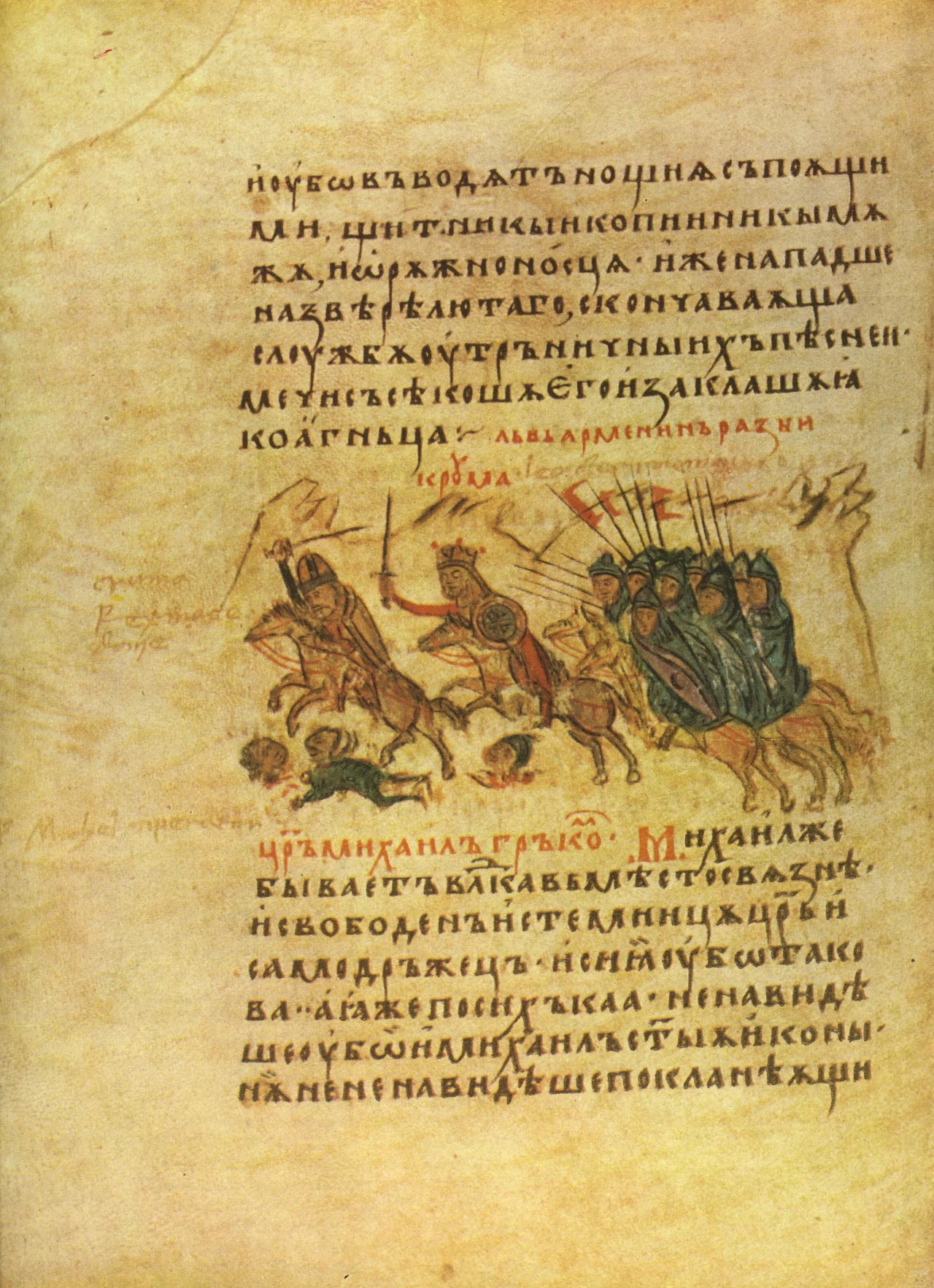

Siege of Constantinople (813)
Three Byzantine emperors had fallen because of one man. That was the situation in July 813, when Khan Krum of Bulgaria rode his cavalry up to the Theodosian Walls of Constantinople and found himself staring at the most heavily fortified city in the medieval world. He had just annihilated a Byzantine army at the Battle of Versinikia on 22 June 813. Emperor Michael I Rangabe, shamed by the defeat, had been forced to abdicate and enter a monastery — the third Byzantine emperor Krum had removed from power since 811. Whatever the Khan intended when he arrived at those walls, he quickly understood the walls themselves would decide nothing in his favor that summer.
The Conqueror at the Gate
Krum arrived at Constantinople on 17 July 813 — not with a sustained siege in the manner of the Arab campaigns, but with a demonstration of power. He performed a pagan sacrificial ritual outside the walls involving animals and people, intended to overawe the defenders into surrender. It did not work. The walls were impregnable to anything he had brought, and he had no fleet to close the sea approaches. What Krum possessed instead was momentum and leverage. A new Byzantine emperor had just taken the throne — Leo V the Armenian — and Krum recognized an opportunity for negotiation. He proposed a peace meeting. The Byzantines, apparently seeing their own opportunity, set a trap: archers were concealed near the meeting place. Krum was wounded in the ambush but escaped. The attempt on his life transformed a tense standoff into something far worse.
Wrath Across Thrace
What followed Krum's wounded retreat was systematic devastation. He turned his army loose on the territory around Constantinople, burning and pillaging before heading back toward Bulgaria. He then besieged and captured Adrianople, the second city of Thrace, and deported its entire population across the Danube into Bulgarian territory. Among those deported were the parents of a child who would eventually reign as Emperor Basil I — a detail that illustrates how thoroughly Krum's campaigns reshuffled the population of the region. Despite the onset of winter, Krum sent 30,000 men into Thrace; they occupied Arcadiopolis and reportedly captured some 50,000 prisoners. The spoils enriched the Bulgarian aristocracy and its new capital at Pliska, where looted architectural elements from Thracian cities were incorporated into construction, and deported craftsmen put to work rebuilding.
The Siege That Never Came
Krum spent the winter of 813–814 preparing what Byzantine sources described as a truly massive attack on Constantinople: artillery pieces transported on five thousand wagons, according to rumor. Whether the scale was real or inflated by fear, the attack never happened. Krum died on 13 April 814. His son Omurtag succeeded him and, facing his own political challenges, chose a different course. The planned assault on Constantinople was abandoned. In 815, Omurtag signed the Byzantine–Bulgarian Treaty, ending the cycle of war that Krum had driven since 811. The Theodosian Walls had not been tested in 813; they had simply been looked at. That was enough. Their reputation — built on centuries of standing fast — outlasted yet another conqueror who chose not to press the point.
Three Emperors and a Legacy
The 813 episode belongs to a longer arc. Krum had already defeated and killed Emperor Nikephoros I at the Battle of Pliska in 811 — the first Byzantine emperor to die in battle against a foreign enemy in over four centuries — and used his skull as a drinking cup, according to Byzantine sources. Michael I Rangabe's fall at Versinikia made him the third emperor the Khan had destabilized. Leo V the Armenian, who succeeded Michael and survived the Krum crisis, would himself be assassinated on Christmas Day 820. The Balkans of the early 9th century were brutally unstable, and the inability of any Bulgarian force to actually breach Constantinople's walls was the one fixed point in the chaos. The city absorbed the shocks, changed rulers, and endured.
From the Air
The walls of Constantinople — modern Istanbul — stand at 41.01°N, 28.98°E, near the western edge of the historic peninsula. Flying from Istanbul Airport (LTFM), approach the city from the northwest at low altitude to follow the approximate path of Krum's cavalry advance from Thrace. The Theodosian Walls are visible running inland from the Sea of Marmara shore; the area just outside their landward face is where Krum's forces encamped in July 813. Adrianople — the city Krum sacked after withdrawing — is modern Edirne, roughly 230 km northwest of Istanbul, visible as a low-lying city on the Meriç River plain in clear conditions from cruising altitude. The Bosphorus and Sea of Marmara frame the city's eastern and southern sides, illustrating why a land force alone could never seal Constantinople's fate.
Nearby Stories
- Kocaeli Peninsula 7.6 km away
- Second Battle of Çatalca 11 km away
- Istanbul's Rural Outskirts 14 km away
- MV Struma 20 km away
- HMAS AE2 36 km away
- Bursa 66 km away
- Sangarius Bridge 71 km away
- Januarius MacGahan 101 km away