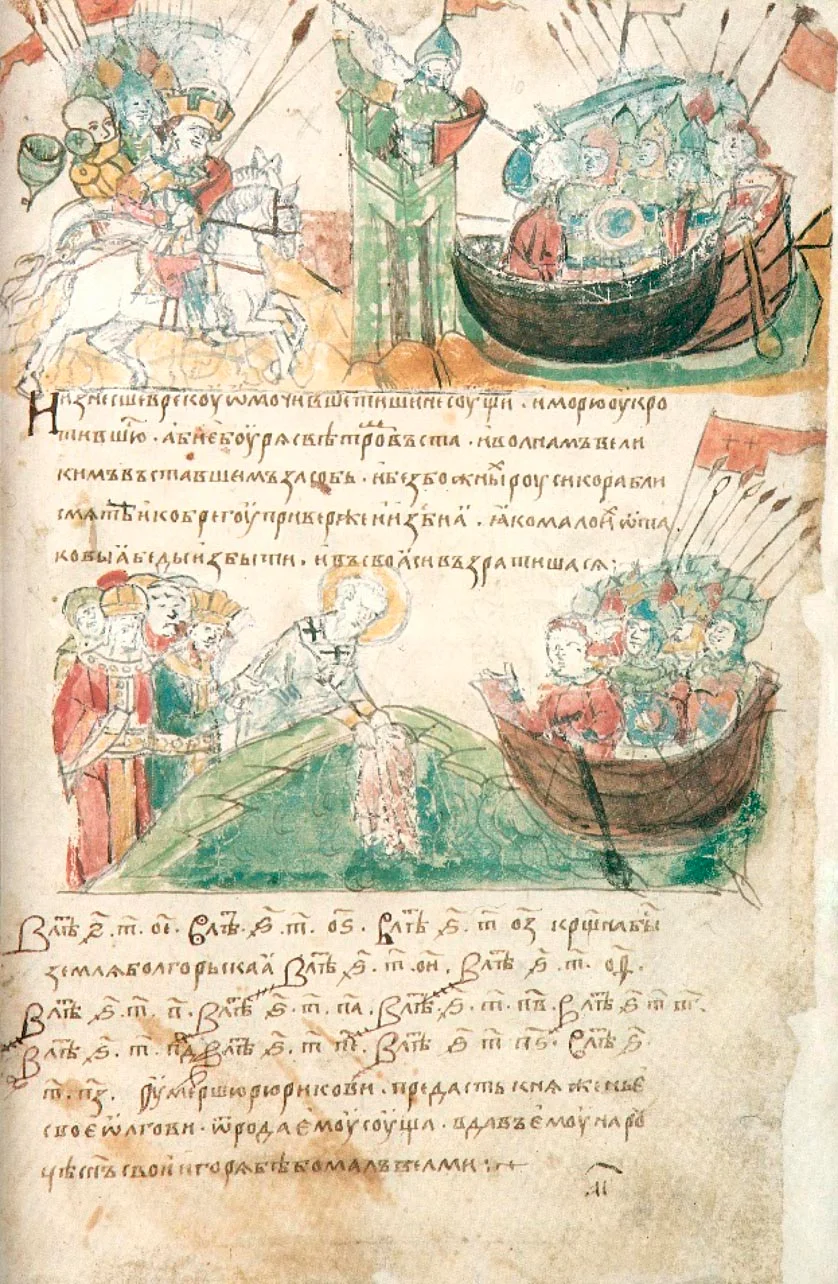

Siege of Constantinople (860)
Patriarch Photius reached for a metaphor and settled on wasps. The raid came, he wrote, 'as sudden and unexpected as a swarm of wasps.' That phrase, from one of the most learned men in the ninth-century world, tells you something about how completely the events of June 860 upended Byzantine assumptions. The empire was at war on its eastern frontier, its army absent, its navy deployed in the Aegean and the Mediterranean. Then, at sunset on June 18, 860, a fleet of roughly 200 vessels appeared in the Bosphorus. The people aboard were called the Rus'. Photius's own writings provide the earliest Greek-language use of that name — a measure of how little Byzantium had considered them before that evening.
A City Left Unguarded
The timing of the 860 raid was not accidental. In early June, Emperor Michael III had left Constantinople with his army to campaign against the Abbasid Caliphate in Asia Minor. The Byzantine navy was occupied in the Aegean and Mediterranean, fighting the same Arab enemy. The fortress of Loulon, a key border stronghold, had unexpectedly surrendered to the Arabs in March. The city's land and sea defenses, normally formidable, had been stripped to feed campaigns elsewhere. Whoever had informed the Rus' that Constantinople was exposed had read the situation correctly. The empire, juggling threats on multiple fronts, had left its capital as vulnerable as it would ever be. What the Rus' found when they arrived was a city in the grip of institutional panic, with Patriarch Photius urging the population to pray because there was nothing else immediately available.
Fire on the Suburbs
The Rus' ships entered the Bosphorus and began attacking the suburbs of Constantinople — the residential and commercial zones outside the walls proper, where ordinary people lived and worked. They set homes on fire. Residents who could not flee in time drowned or were killed. The patriarch's sermons, written during and after the siege, describe the terror in vivid detail; he was addressing people who had watched their neighbors' houses burn from the city walls. Having devastated the suburbs, the Rus' fleet moved into the Sea of Marmara and fell upon the Princes' Islands to the southeast, where the former Patriarch Ignatius was living in exile. The monasteries there were plundered. Twenty-two of Ignatius's servants were taken aboard a ship and killed with axes. The violence was systematic rather than random, and it continued for weeks.
The People Photius Could Not Name
Photius called them ἔθνος ἄγνωστον — 'unknown people,' or perhaps 'obscure people,' the translation is debated. He knew the word 'Tauroscythians,' an archaic Greek term for the peoples north of the Black Sea, but it felt inadequate. The Rus' did not fit the categories available to Byzantine scholarship. They came from 'some distant northern lands,' the patriarch wrote; they had 'no supreme ruler.' The scholarly consensus today connects the 860 Rus' with Varangian-influenced peoples from the region that would become Kievan Rus', but in 860 no such political entity yet existed in recognizable form. The raid introduced these people to Byzantine literature, and it introduced Byzantium to them. Within decades the relationship would evolve into diplomacy, trade, and eventually the baptism of Rus' princes. That future was invisible in June 860, when what the Rus' were known for was burning suburbs.
A Miracle, or a Withdrawal
The Rus' withdrew by August 4, 860 — the date Photius noted in a sermon thanking God for the city's deliverance. What caused the withdrawal is genuinely unclear. Later Byzantine and Slavic tradition built an elaborate miracle around it: Emperor Michael III, rushing back from Asia Minor, joined Photius in processing the robe of the Virgin through the city and dipping it in the sea, whereupon a storm destroyed the Rus' ships. The icon before which Michael is said to have prayed became a celebrated relic. But Photius's own sermons — the earliest, most direct sources — mention neither the emperor's return nor the miraculous storm. Pope Nicholas I, writing in 865, described the pagans as having 'retreated without punishment.' The Venetian Chronicle records the Rus' departing 'in triumph.' Whether the city was saved by weather, by the arrival of imperial forces, or simply because the Rus' had taken what they came for, the sources cannot agree.
The Weight of a Name
The 860 siege left marks far beyond the scorched suburbs. The sermons Photius wrote during and after the attack are among the most important primary sources for understanding 9th-century Byzantine life, and they contain the first Greek use of the name 'Rus.' The event became embedded in Russian Orthodox tradition as proof of divine protection for the city, and later of divine favor toward the Rus' themselves once they converted to Christianity. An old column at the Forum of Taurus reportedly bore an inscription predicting that Constantinople would one day be taken by the Rus' — a legend popular enough to be revived by Russian nationalists in the 19th century, when Russia was actually in position to press such claims. That future too lay far beyond the horizon of a summer evening in 860, when about 200 ships appeared from the north and a patriarch reached for a word that didn't quite exist yet.
From the Air
The Bosphorus, where the Rus' fleet entered in June 860, runs roughly north–south at 41.00°N, 28.90°E — fully visible from altitude as the narrow water corridor between Europe and Asia. Flying from Istanbul Airport (LTFM), the Bosphorus is about 30 km to the east-southeast. The historic peninsula where Patriarch Photius held his vigil sits at the strait's southern end. The Princes' Islands — raided by the Rus' after the main suburbs — are visible as a cluster of dark islands in the Sea of Marmara, approximately 15 km southeast of the historic peninsula. At 3,000 feet on a clear day, the entire theater of the 860 raid is visible in a single sweep: the Bosphorus approaches from the north, the suburban coastlines on both shores, the Sea of Marmara beyond, and the Theodosian Walls along the peninsula's western edge.
Nearby Stories
- Kocaeli Peninsula 7.6 km away
- Second Battle of Çatalca 11 km away
- Istanbul's Rural Outskirts 14 km away
- MV Struma 20 km away
- HMAS AE2 36 km away
- Bursa 66 km away
- Sangarius Bridge 71 km away
- Januarius MacGahan 101 km away