
Silahtarağa Power Station
On February 11, 1914, a Hungarian-built power plant at the upper end of the Golden Horn sent electricity humming along the tram lines of Istanbul for the first time at urban scale. The Silahtarağa Power Station was the Ottoman Empire's first large urban power plant, and its opening was a statement: the capital of a six-century empire was finally wiring itself into the modern age, three decades after New York and London had done the same. The station that launched Istanbul's electrical era now houses a museum where you can walk through the original turbine hall and work the levers yourself. The coal conveyors are gone; glass escalators have replaced them. But the steam turbines and electrical generators still stand, almost exactly where the workers who ran them left them in 1983.
A Budapest Company Lights the Bosphorus
The company that built Silahtarağa was Ganz, a Budapest-based Austro-Hungarian gas and electric firm. In 1910, in partnership with two Belgian banks — the Banque de Bruxelles and a Belgian-Hungarian credit institution — Ganz established the Ottoman Electric Company and secured a 50-year imperial concession. The chosen site was the Silahtarağa neighborhood in Eyüp, at the upper end of the Golden Horn. The location made logistical sense: coal could be delivered by water, and the electricity could run south along the Horn toward the city center. Construction moved quickly. The plant opened in 1914, initially with three 6-megawatt generators, supplying power first to the tram network and then to the sultan's palace at Dolmabahçe. Before long, electricity reached the more prosperous residential and commercial districts, permanently changing the texture of city life.
Nationalization, Monopoly, and the National Grid
The foreign-owned Ottoman Electric Company operated Silahtarağa for over two decades. In 1937 it was nationalized by the Turkish Republic, and on July 1, 1938 the plant passed to the Municipality of Istanbul, managed by the city's Electricity, Tunnel and Tram Company (IETT). For years Silahtarağa was the sole electricity producer for Istanbul — an entire metropolis depending on one facility. In 1952 the station was connected to the newly created Turkish national grid, ending that monopoly. Control shifted again in 1962 to Etibank, and in 1970 to the Turkish Electric Institution (TEK). Capacity had grown from the original 18 megawatts to a peak of 120 megawatts by the time the station closed. On March 13, 1983, Silahtarağa was shut down as no longer economical to operate. The turbines went cold, and the buildings stood largely empty for the next two decades.
From Derelict to Campus
In 1991 the plant was designated a protected cultural and natural heritage site, which prevented demolition but did not solve the question of what to do with it. The answer came in 2002, when Oğuz Özerden, founder of Istanbul Bilgi University, proposed converting the entire complex into a university campus with two museums. The plan — one museum for modern art, one for energy — competed with an alternative proposal from the Istanbul branch of the Chamber of Electrical Engineers working with Istanbul Technical University. Bilgi University's project won ministerial approval, and was completed in three years with support from Turkish companies. On September 8, 2007, the complex reopened as SantralIstanbul, taking its name from the Turkish word 'santral' meaning power station. Alongside the galleries and energy museum, the campus added a public library and an amphitheatre.
The Turbine Hall as Time Machine
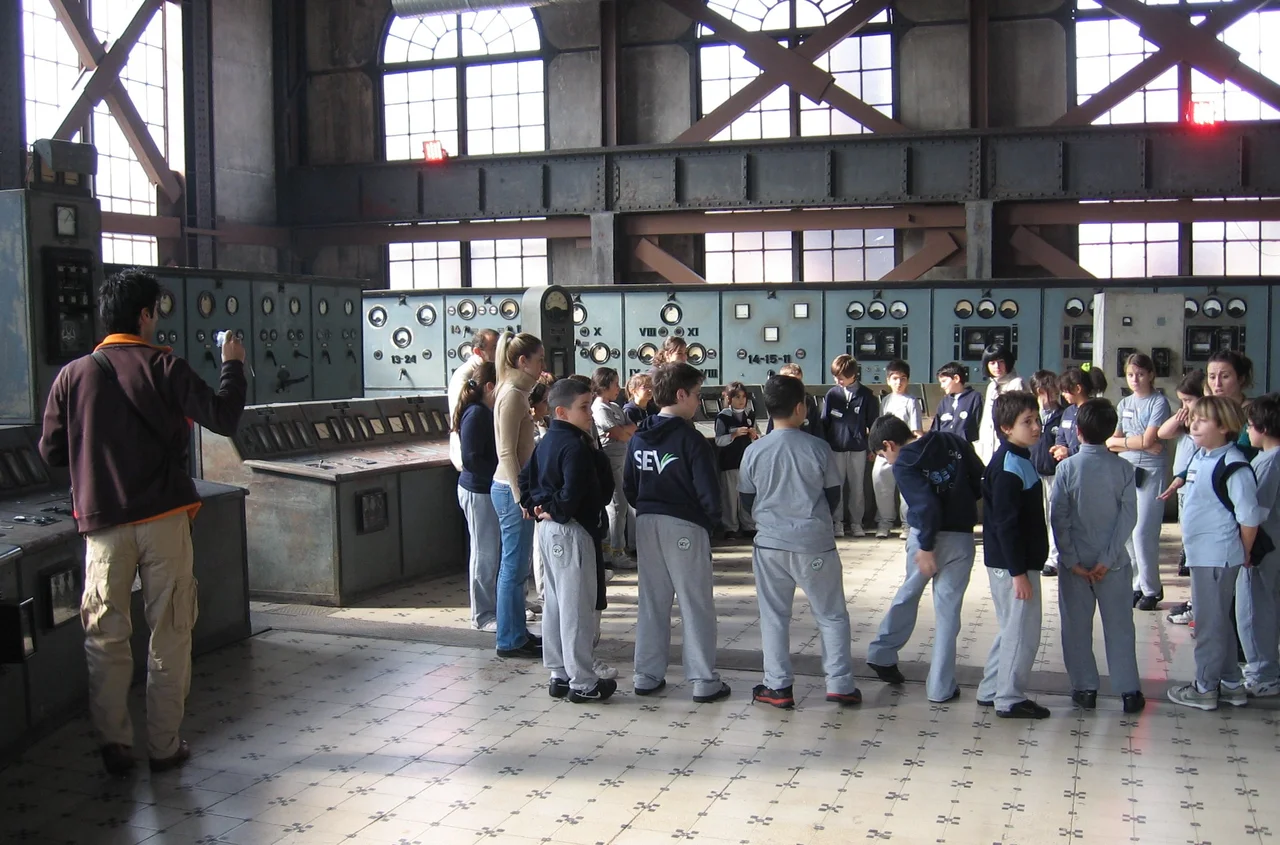
The Energy Museum at SantralIstanbul was designed by architect Han Tümertekin. The centerpiece is the turbine hall itself, with its three original generator groups preserved and displayed in something close to their original condition — the machines cleaned but not restored to working order, their age left legible in the steel and copper. A podium hangs 12 meters above the floor, giving visitors an overhead view of the machinery before leading them to the original control room, which was preserved nearly intact. Modern glass escalators run where coal conveyors once carried fuel. The lower level has interactive exhibits where visitors are encouraged to push buttons and work levers. The scale of the equipment is part of the point: the enormous turbines and switchgear, now filling a museum, once generated only a few dozen megawatts — a figure modern power plants exceed by orders of magnitude. Admission to the Energy Museum is free.
From the Air
The Silahtarağa Power Station sits at 41.07°N, 28.95°E, in the Eyüp district at the upper (northern) end of the Golden Horn inlet. Flying from Istanbul Airport (LTFM), head southeast along the European shore of the Bosphorus, then pick up the Golden Horn — the distinctive narrow arm of water cutting inland from the strait at the historic peninsula. The power station's brick industrial buildings are visible on the north bank near the inlet's headwaters, where the Horn narrows. At low altitude the smokestack and the converted turbine hall building are distinctive against the surrounding residential neighborhoods. The Bosphorus strait itself is about 3 km east of the site. Approach from the southwest for the best view of the building complex against the water.
Nearby Stories
- Kocaeli Peninsula 7.6 km away
- Second Battle of Çatalca 11 km away
- Istanbul's Rural Outskirts 14 km away
- MV Struma 20 km away
- HMAS AE2 36 km away
- Bursa 66 km away
- Sangarius Bridge 71 km away
- Januarius MacGahan 101 km away