
Sinan Pasha Mosque (Istanbul)
Two men named Sinan meet, in a sense, in the Beşiktaş district on the European shore of the Bosphorus. One is Mimar Sinan, the supreme architect of the Ottoman classical period, whose buildings range from modest neighborhood mosques to the Süleymaniye in Istanbul and the Selimiye in Edirne. The other is Sinan Pasha, grand admiral of the Ottoman fleet, who endowed the mosque that bears his name and died in 1553 before he could see it completed. The mosque Mimar Sinan built for him was finished in November or December 1555 — the date recorded in gilded Arabic script above the arched gateway. Across the street stands the türbe of Barbaros Hayrettin Pasha, the admiral known to Europe as Barbarossa, under whom Sinan Pasha had served. The neighborhood holds the memory of an entire era of Ottoman naval power.
The Admiral and His Architect
Sinan Pasha occupied a position at the intersection of two of the most powerful institutions in the 16th-century Ottoman state. He was the younger brother of Rüstem Pasha, who served twice as Grand Vizier and was married to Mihrimah Sultan, daughter of Suleiman the Magnificent. And he commanded the Ottoman fleet during a period of Mediterranean dominance that followed the great victories of his predecessor Barbaros Hayrettin Pasha. His decision to commission a mosque in Beşiktaş, a district closely associated with the navy, and to engage Mimar Sinan for the project, placed him firmly in the tradition of Ottoman grandees who understood that architectural patronage was a form of legacy-building. Sinan Pasha died in 1553. Work on the mosque began after his death and was completed the following year.
Six Arches and a 12-Meter Dome
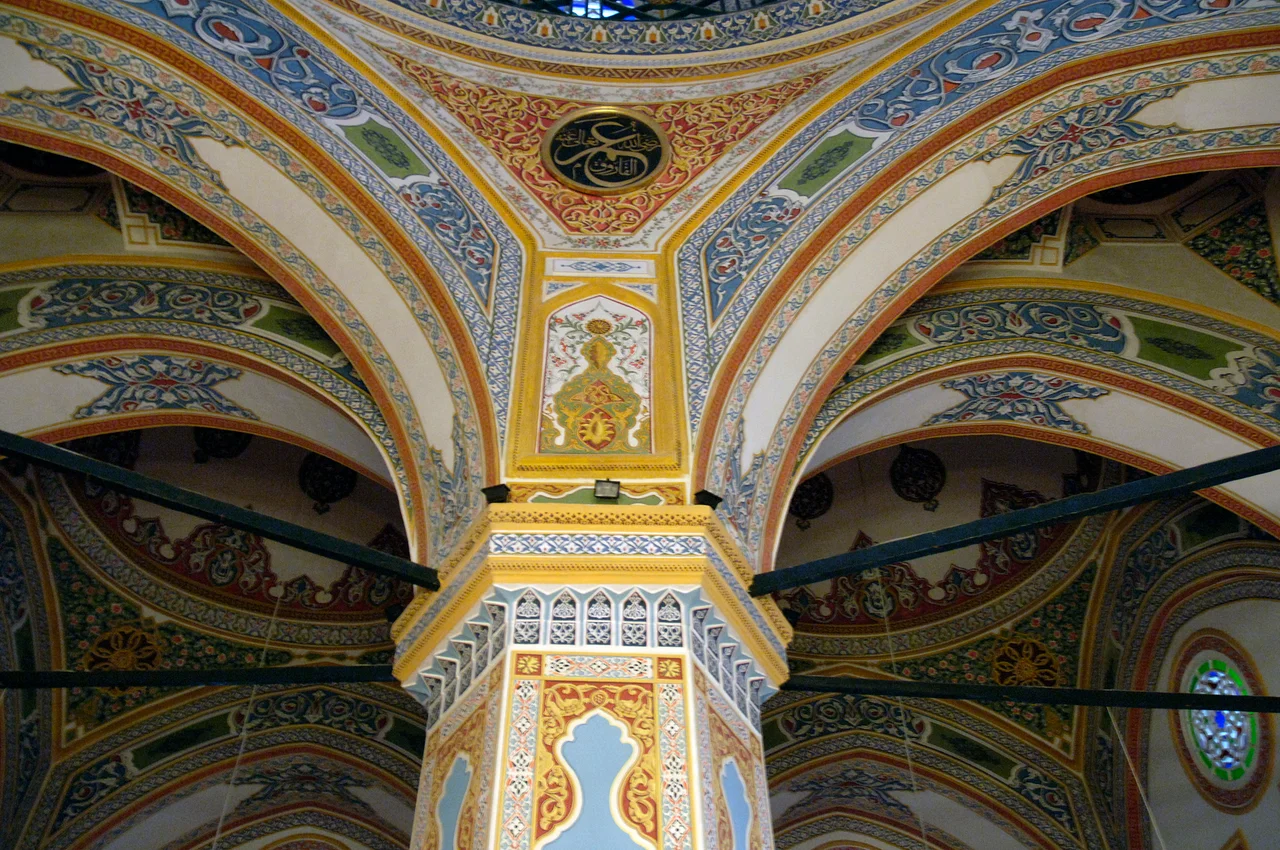
Mimar Sinan's design for the Sinan Pasha Mosque is compact by the standards of his later imperial commissions, but structurally inventive. The 12.6-meter dome is supported on six arches resting on two free-standing hexagonal piers — an arrangement that creates an unusually open interior for a mosque of this scale. Scholars have compared the structural logic to the earlier Üç Şerefeli Mosque in Edirne, built between 1437 and 1447, in which the same hexagonal-pier solution supports a wide central dome. Sinan was working within and extending an established tradition, not breaking from it. The mosque is built of alternating layers of ashlar stone and brick, a construction method common in Byzantine and early Ottoman architecture that gives the exterior a distinctive banded texture. The original painted interior decoration has not survived, leaving the space sober and geometric.
Courtyard, Fountain, and a Changed Portico
The forecourt of the Sinan Pasha Mosque is enclosed on three sides by a madrasa — a school — with a shed roof supported on short columns. At the center of the courtyard sits a rectangular drinking fountain, its date of 1555–56 recorded in Turkish around the white marble basin. The original north facade had a double portico: an outer covered walkway and an inner one with five domes. In 1749 the inner portico was incorporated into the prayer hall, expanding the interior space at the cost of the original architectural layering. The minbar — the pulpit from which the Friday sermon is delivered — is simple white marble. The bath-house that formed part of the original endowment was demolished in 1957. What remains is a coherent mid-16th-century Ottoman ensemble, modest in ambition by the standards of Sinan's larger works, but elegant in its proportions.
Beşiktaş and the Memory of the Fleet
The mosque sits in a neighborhood that still feels connected to the water. Beşiktaş is a busy transit hub on the European Bosphorus shore, with ferries arriving from the Asian side and buses radiating inland. The türbe of Barbaros Hayrettin Pasha — Barbarossa, the corsair-turned-admiral who built Ottoman naval supremacy in the Mediterranean — stands just across the street from the mosque, maintained as a monument to a man who came to symbolize Ottoman sea power. Together, the mosque and the tomb form a small precinct of 16th-century naval memory embedded in the commercial noise of a 21st-century waterfront district. Mimar Sinan, who outlived both men he worked for and went on to build for a generation of patrons, would have recognized neither the traffic nor the ferry terminal. The mosque, though, he would recognize immediately.
From the Air
The Sinan Pasha Mosque stands at 41.04°N, 29.01°E in the Beşiktaş district, directly on the European shore of the Bosphorus. Flying from Istanbul Airport (LTFM), approach from the northwest along the European Bosphorus coastline; Beşiktaş is identifiable by its ferry terminal and the busy waterfront square. The mosque's single minaret is visible from low altitude amid the dense urban fabric just inland from the shore. The Bosphorus strait is immediately to the east — at 1,500 feet the Asian shore and its settlements are visible across the water. The Barbaros Hayrettin Pasha tomb is within meters of the mosque; both sites are best identified by descending to around 1,000 feet on the European shore approach. The Dolmabahçe Palace, the 19th-century Ottoman imperial residence, is visible roughly 800 meters to the southwest along the waterfront.
Nearby Stories
- Kocaeli Peninsula 7.6 km away
- Second Battle of Çatalca 11 km away
- Istanbul's Rural Outskirts 14 km away
- MV Struma 20 km away
- HMAS AE2 36 km away
- Bursa 66 km away
- Sangarius Bridge 71 km away
- Januarius MacGahan 101 km away