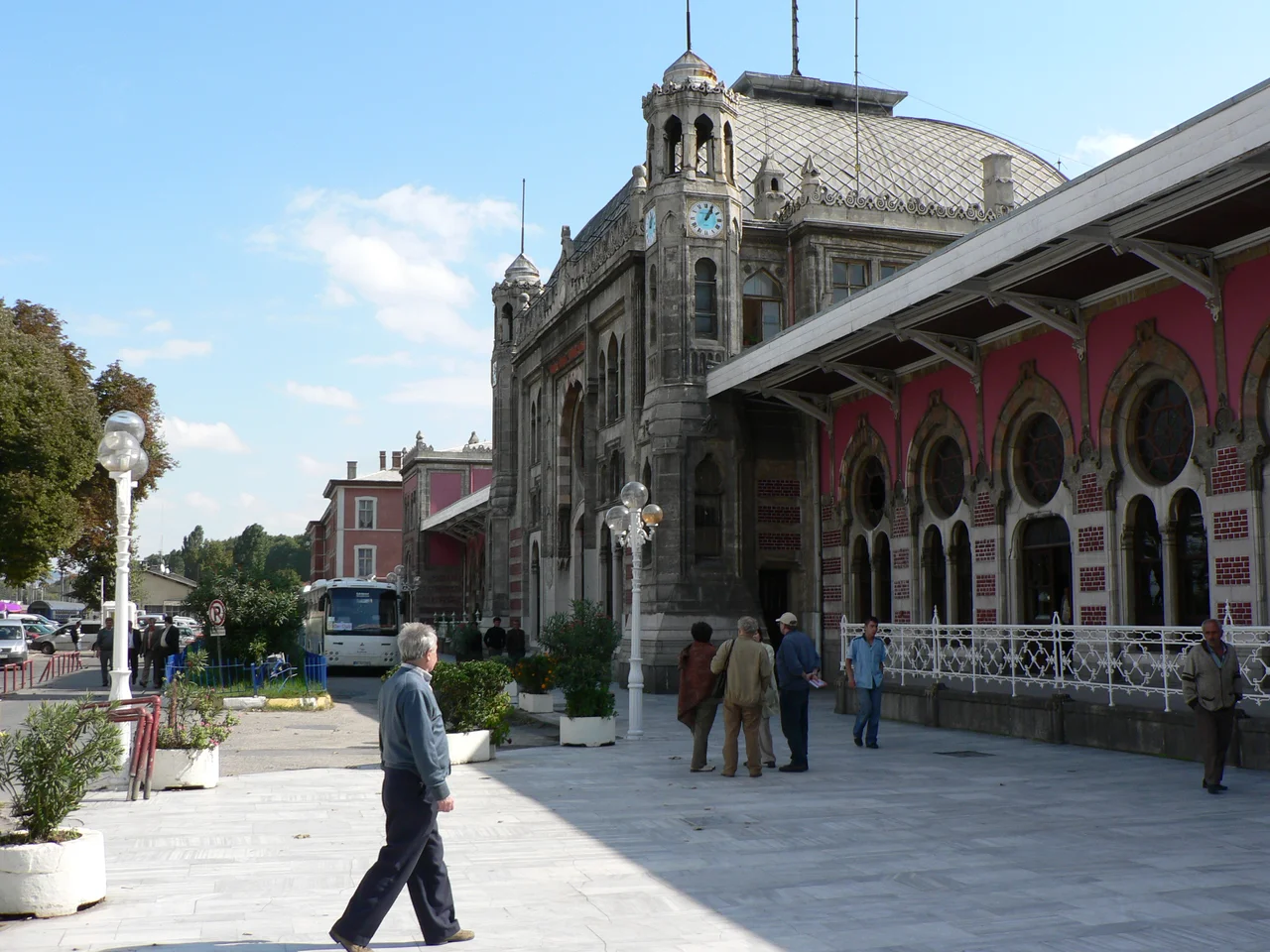

Sirkeci Railway Station
On 4 October 1883, the first Orient Express pulled out of the Gare de l'Est in Paris to the sound of Mozart's Turkish March. Eighty hours and 3,094 kilometres later, it arrived at the edge of the Golden Horn, where Europe ends and something older begins. Sirkeci Railway Station was built to be that arrival — a gateway worthy of the journey, set at the tip of Istanbul's historic peninsula between Gülhane Park and the blue glitter of the Marmara. The building has outlasted the train. It has also outlasted three eras of suspension and revival, and now carries the city forward underground, across a tunnel beneath the Bosphorus. But first, it carried the world here.
A Baron's Railroad and a Sultan's Permission
Before there was a station, there was a problem of real estate. After the Crimean War, Ottoman authorities understood that a European railway connection to Istanbul was strategically necessary. Three contracts were attempted — with British and Belgian entrepreneurs in 1857, 1860, and 1868 — and all three collapsed for lack of investment capital. The fourth attempt worked. On 17 April 1869, the concession for the Rumeli Railroad passed to Baron Maurice de Hirsch, a Bavaria-born banker operating out of Belgium. Construction of the first 15 kilometres, from Istanbul to Halkalı, began on 4 June 1870 and finished on 4 January 1871.
The line's endpoint was the sticking point. Yeşilköy, the original terminus, was too far from Eminönü, the city's commercial heart. An extension to Sirkeci was needed, and two routes were proposed. Sultan Abdülaziz chose the more dramatic one: along the Sea of Marmara shoreline, skirting the outer walls of the Topkapı Palace lower gardens. The extension opened on 21 July 1872, and a temporary station stood in Sirkeci from 1873. It stayed 'temporary' for fifteen years.
August Jasmund's Arabesque Gateway
The permanent terminal building that replaced the temporary one was something new in Ottoman architecture: a deliberate fusion. Construction began on 11 February 1888, and the station opened on 3 November 1890 under the name Müşir Ahmet Paşa Station, before the name Sirkeci took hold. German architect August Jasmund designed it in a style that drew on both European railway-hall conventions and Ottoman decorative traditions — horseshoe arches, geometric tilework, and a central dome that glowed warmly against the Marmara sky.
The building announced something about Istanbul's self-understanding: that the city at the end of the Orient Express was not a passive recipient of European modernity but a place with its own visual language. Jasmund's building was the eastern counterpart to the grand European termini — Paris's Gare de l'Est, Vienna's Westbahnhof — that sent trains this way. It said: you have arrived somewhere that was already somewhere.
Eight Decades on Track, Then Silence
For most of the twentieth century, Sirkeci served as Istanbul's main gateway to Europe. International trains departed here for Bucharest, Sofia, and Belgrade. The Friendship Express ran between Istanbul and Thessaloniki, jointly operated by Turkish State Railways and the Greek TrainOSE, until February 2011. And always, somewhere in the cultural imagination, the Orient Express lingered — even after the direct service was withdrawn on 19 May 1977, even after the Vienna route was progressively cut back, even after the last Orient Express ran in 2009 after 126 years.
On 19 March 2013, service to Sirkeci was indefinitely suspended for rehabilitation works linked to the Marmaray project. The platforms went quiet. Pigeons moved in. For nearly a decade and a half, the terminal stood as a monument to journeys that no longer departed from its tracks.
Under the Bosphorus and Back Again
The silence was not the end. While the surface station sat idle, something was being built beneath it. The Marmaray commuter rail project — a tunnel under the Bosphorus connecting the European and Asian railway networks — cut directly through Sirkeci, and an underground station opened there on 29 October 2013, along with four others on the line. Sirkeci underground recorded 681,212 boardings in February 2017 alone, making it the fourth-busiest station on the Marmaray system — 14 percent of all passenger boardings.
The surface station came back too. On 26 February 2024, Sirkeci reopened as part of the T6 Sirkeci–Kazlıçeşme Tramway and U3 Rail Line. The building that received the Orient Express now connects to a tunnel that runs 60 metres beneath the Bosphorus, linking two continents. The journey has changed entirely. The destination hasn't.
Where Europe Runs Out of Land
Stand on the platform at Sirkeci on a clear morning and the geography makes itself obvious. To the north, the Golden Horn curves inland, its water dark green between the hills. To the east, the Topkapı Palace walls rise above Gülhane Park. Ferries cross toward Üsküdar on the Asian shore. The Marmaray trains arrive and depart with no ceremony, every six to ten minutes, shuttling commuters under a strait that defeated every pre-industrial attempt at crossing.
The Venice-Simplon Orient Express still runs one journey per year to Istanbul — restored 1930s coaches, the last echo of the train that made this station famous. Most years, it arrives to less fanfare than it deserves. The building receives it anyway, in the same horseshoe arches and tilework that received the first one in 1883, patient as a station that has been temporarily closed before and knows it will reopen.
From the Air
Sirkeci Railway Station sits at 41.0150°N, 28.9765°E on the tip of Istanbul's historic peninsula, at the northern edge where the Golden Horn meets the Marmara. At 2,000–3,000 feet, the station's distinctive dome is visible against the shoreline, with Gülhane Park immediately to the east and the unmistakable silhouette of Topkapı Palace beyond. The Galata Bridge and the minarets of the New Mosque (Yeni Cami) frame the view to the northwest. Nearest major airport: LTFM (Istanbul Airport), approximately 35 kilometres to the northwest on the European shore. The Bosphorus strait is clearly visible from altitude, with the Asian shore — site of Haydarpaşa Terminal, Sirkeci's counterpart — directly across.
Nearby Stories
- Kocaeli Peninsula 7.6 km away
- Second Battle of Çatalca 11 km away
- Istanbul's Rural Outskirts 14 km away
- MV Struma 20 km away
- HMAS AE2 36 km away
- Bursa 66 km away
- Sangarius Bridge 71 km away
- Januarius MacGahan 101 km away