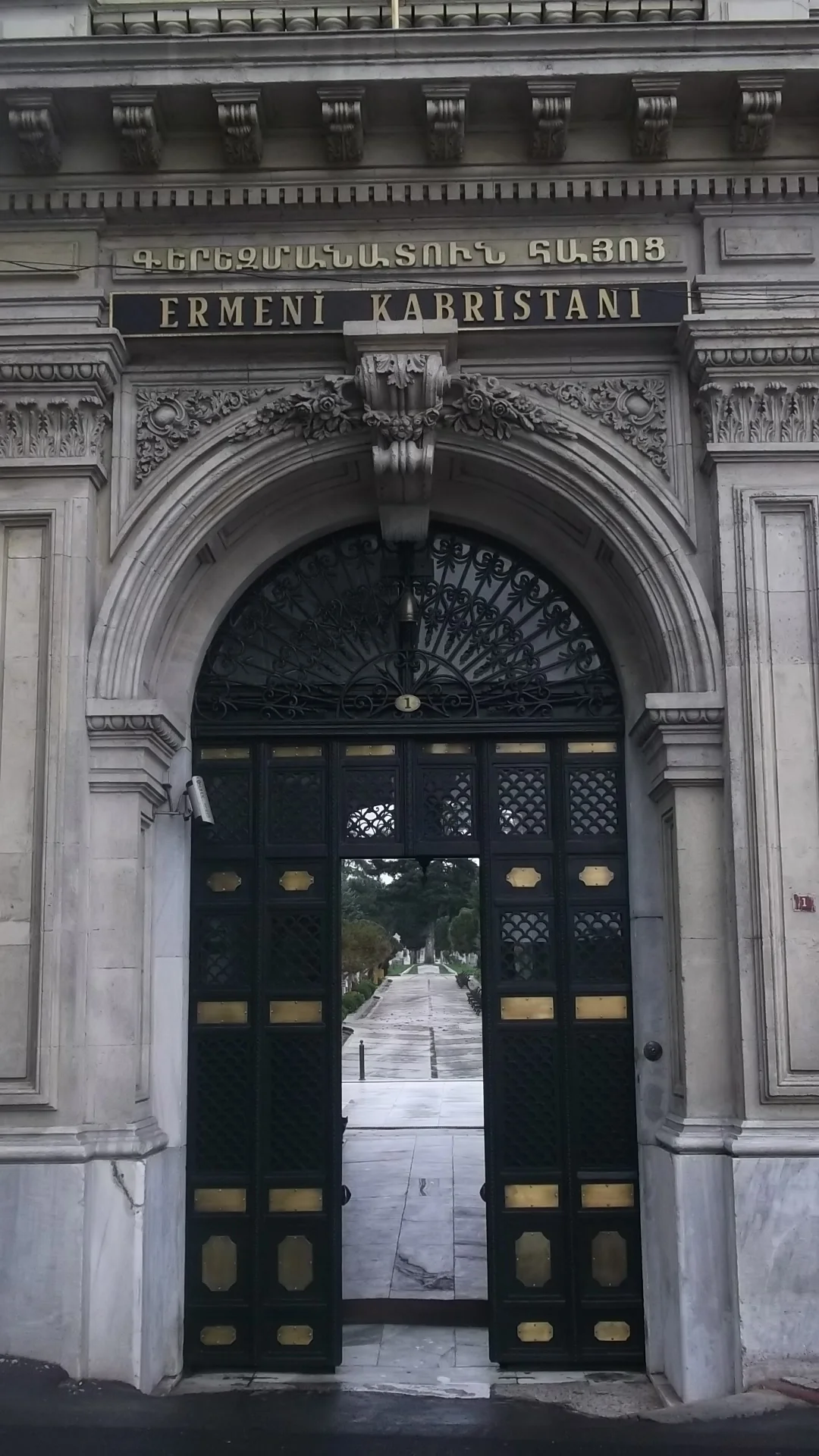

Şişli Armenian Cemetery
There is a particular kind of weight to a community cemetery. It is not just a collection of individual deaths but a record of a people's presence — proof that they were here, that they built lives worth commemorating, that they chose this ground as the place to mark their passage through the world. The Şişli Armenian Cemetery in Istanbul carries that weight with particular force. The Armenian community of Turkey operates and cares for it, and has done so since the 1860s. The graves speak to centuries of Armenian life in this city: to patriarchs and painters, to musicians who shaped Turkish popular music, to writers who gave form to an experience of survival and loss. To be buried here is to be counted among those who remained.
A Community and Its Ground
The Armenian presence in Istanbul — Constantinople before it — spans many centuries, predating the Ottoman conquest of 1453. Under Ottoman rule, the Armenian community was designated as one of the non-Muslim millets, with the Armenian Patriarch of Constantinople as its religious and administrative head. Armenians built churches, schools, hospitals, and neighbourhoods throughout the city. The Şişli district, where this cemetery stands, became one of the centres of that life in the modern era.
The cemetery, established in the 1860s, is operated by the Armenian community of Turkey — a community that numbers far fewer people today than it once did. The demographic contraction of the twentieth century, shaped by violence, displacement, and emigration, has made the cemetery more prominent as a site of memory even as the living community has diminished. What remains here is the accumulated witness of those who were buried before the departures.
Patriarchs of Constantinople
Two Armenian Patriarchs of Constantinople rest in this ground. Hovhannes Arsharouni and Malachia Ormanian both led the Armenian Patriarchate, the institution that anchored Armenian communal life in Istanbul across Ottoman and Republican eras alike. Malachia Ormanian, who served as Patriarch from 1896 to 1908, was also a prolific scholar; his major work on the history of the Armenian Church remains a reference text. The presence of these patriarchs here underscores what the cemetery represents: not just individual resting places, but the institutional continuity of a religious community.
Ormanian's life bridged extraordinary turbulence. He guided the Patriarchate through the catastrophic events of the late nineteenth and early twentieth centuries, during which the Armenian population of Anatolia suffered devastating losses. He died in 1918 in Istanbul, and is buried here. His grave, like the Patriarchate itself, is evidence of an endurance that cannot be taken for granted.
Artists, Musicians, and the Fabric of City Life
A cemetery is where biography compresses to an epitaph, but the names in this ground carry stories that resist compression. Udi Hrant — whose full name was Hrant Kenkulian — was among the most celebrated oud players of the early twentieth century, a musician who helped define the sound of Istanbul's cosmopolitan musical culture. Onno Tunç was a composer and musician who worked across genres and died young in a 1996 plane crash; his funeral brought much of Istanbul's music world to these gates.
Sirvart Karamanuk, composer and pianist, contributed to Armenian musical tradition. Harutyun Hanesyan was a musician of the Ottoman era. Stepan Papelyan was another musician whose work formed part of the layered cultural life of Istanbul's Armenian quarter. Maryam Şahinyan was a pioneering photographer — the first woman to practice photography professionally in Turkey — whose portraits documented Armenian social life for decades. These were not peripheral figures. They were part of what Istanbul was.
Writers, Sculptors, and the Work of Memory
Hagop Baronyan, the nineteenth-century poet and satirist whose sharp wit chronicled Armenian Istanbul, is among the literary figures buried here. Zabel Sibil Asadour was a writer. Zaven Biberyan was a novelist and journalist whose fiction explored Armenian life in twentieth-century Istanbul with unflinching honesty. Zahrad was a poet whose work in both Armenian and Turkish made him one of the most celebrated voices of his generation. Haykanush Mark was a writer and poet. These are the people who gave language and form to a community's experience — and whose graves now form part of that record.
Among the sculptors: Mari Gerekmezyan and Yervant Voskan. Toto Karaca and Anta Toros were actresses. Garbis Zakaryan was a boxer. Anahit Yulanda Varan was a street performer who played the accordion — a woman whose art was public, informal, and present in the daily life of the city. The range of the burials is itself a portrait of a full community: not just its eminent figures but the whole texture of lives lived.
Sevag Balıkçı and the Weight of Recent Loss
Not all the deaths recorded here are distant history. Sevag Balıkçı was a young Armenian conscript in the Turkish military who was killed in 2011 under circumstances disputed by his family and by human rights advocates — the initial military court found involuntary manslaughter, while a civilian retrial in 2020 convicted the perpetrator of voluntary manslaughter and sentenced him to over sixteen years in prison. He was 25 years old. His family tomb in this cemetery became a place of mourning not only for his family but for those who saw his death as part of a broader pattern of vulnerability.
His presence here, among the patriarchs and musicians and writers, is a reminder that a community cemetery records the full range of a people's experience — the celebrated and the ordinary, the natural deaths and the violent ones, the ancient losses and the recent ones. The Şişli Armenian Cemetery holds all of it, cared for by a community that has learned, across generations, that memory is not optional.
From the Air
The Şişli Armenian Cemetery is located at approximately 41.0652°N, 28.9903°E in the Şişli district of Istanbul, about 5 kilometres north of the historic peninsula's tip. At 2,000–3,000 feet, the Şişli district is recognisable by its dense urban grid and the prominent green space of the cemetery itself. The Cevahir Mall — one of Europe's larger shopping centres — stands nearby as a navigational landmark. Nearest major airport: LTFM (Istanbul Airport), approximately 30 kilometres to the northwest. The Bosphorus is visible to the east.
Nearby Stories
- Kocaeli Peninsula 7.6 km away
- Second Battle of Çatalca 11 km away
- Istanbul's Rural Outskirts 14 km away
- MV Struma 20 km away
- HMAS AE2 36 km away
- Bursa 66 km away
- Sangarius Bridge 71 km away
- Januarius MacGahan 101 km away