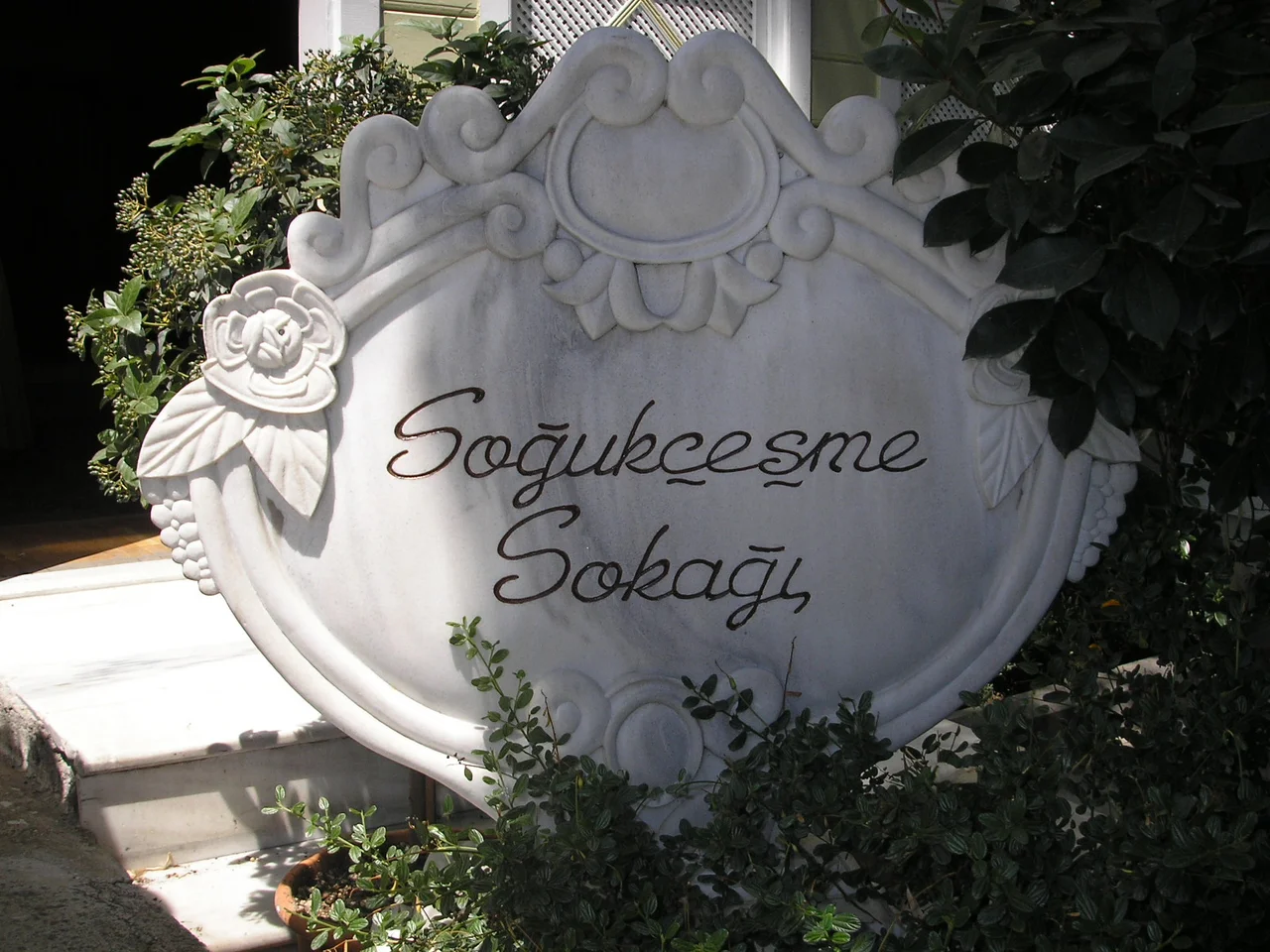

Soğukçeşme Sokağı
Between the Hagia Sophia and the outer walls of Topkapı Palace, there is almost no space at all. Almost. Soğukçeşme Sokağı — the Street of the Cold Fountain — threads through that near-impossibility, a pedestrian lane of two- and three-storey wooden houses wedged into one of the densest concentrations of World Heritage architecture on earth. The street is short, car-free, and in summer draped with jasmine and wisteria. It feels like a neighbourhood that survived by staying small enough not to be noticed — which is roughly what happened.
The Street That Fits Between Monuments
The geography of Soğukçeşme Sokağı is improbable. To one side rise the massive stone walls that enclose the Topkapı Palace precinct — walls built to keep the world at a distance. To the other, just metres away, stands Hagia Sophia, the great church-mosque-museum whose dome has anchored the Istanbul skyline for nearly fifteen centuries. Between them, the street drops from the upper plateau of Sultanahmet down toward Gülhane Park, following a gradient that the Ottoman builders of the nineteenth century used to stack two and three storeys of wooden domestic architecture into a remarkably compact canyon.
The fountain at the street's lower end, toward Gülhane, gives the lane its name: soğukçeşme means cold fountain, a modest amenity in a neighbourhood of grand monuments. At the opposite end, a marble street sign marks the entrance from the Sultanahmet side. Between them, roughly a hundred metres of cobbled lane hold one of Istanbul's most carefully preserved fragments of domestic Ottoman architecture.
Çelik Gülersoy and the Reconstruction of 1985
The houses that line Soğukçeşme Sokağı today are not quite what they appear. The original structures were wooden, as most Ottoman residential buildings were — warm in winter, adaptable, and prone to the catastrophic fires that periodically swept through Istanbul. By the late twentieth century, many were in serious disrepair.
In 1985 and 1986, Çelik Gülersoy oversaw their restoration. Gülersoy was a lawyer and author who directed the Touring and Automobile Club of Turkey and became one of Istanbul's most influential advocates for heritage preservation. His approach to Soğukçeşme was pragmatic: the original wooden structures were replaced with reinforced concrete frames, then veneered with wood to recreate the visual character of the originals. The result is honestly a reconstruction rather than a restoration, but a careful one. Nine of the houses were grouped together as 'Ayasofya Konakları' — the Hagia Sophia Mansions — now operating as a hotel in the Curio Collection by Hilton.
Houses Named for Flowers
The individual houses of Soğukçeşme carry names drawn from the plants growing beside them. Yaseminli Ev is the Jasmine House. Mor Salkımlı Ev is the Wisteria sinensis House. Hanımeli Ev is the Honeysuckle House. The naming convention has an Ottoman precedent — domestic spaces were often identified by their gardens rather than by numbers or family names — and in practice it gives the street a distinctly garden-like character in spring and early summer, when the flowering shrubs bloom against the painted wooden facades.
The interiors of the hotel houses are furnished in the nineteenth-century Ottoman style: silk curtains, velvet armchairs, gilded mirrors, beds with carved headboards. The decor is deliberately period, aimed at creating an experience that feels continuous with the street's visual character. Queen Sofía of Spain stayed here for four nights in the spring of 2000, which is the kind of detail the street wears lightly — it has housed more than royalty.
A President's Birthplace and a Library of Istanbul
Fahri Korutürk was born on this street in 1903. He served as Turkey's sixth president from 1973 to 1980, a period that included some of the most turbulent years of the Turkish Republic. The house where he was born still stands on Soğukçeşme Sokağı — not as a museum, but as a building with a fact attached to it, the kind of biographical accident that streets in old cities carry without needing to announce.
Another of the houses contains İstanbul Kitaplığı, the Istanbul Library — a collection of more than 10,000 books about Istanbul, owned by the Çelik Gülersoy Foundation and available to researchers. It is a quietly extraordinary resource, housed in a quiet extraordinary location: a library about the city, in a street that is itself a compressed argument for why that city repays the attention. Scholars come to work in a room that looks onto wisteria.
The Cistern Below
At the end of the street nearest Gülhane Park, beneath the street level, lies a Byzantine cistern. Istanbul has many underground cisterns — the great Basilica Cistern nearby is the most famous — but this smaller one, dating to the Byzantine period, has been repurposed as the Sarnıç Restaurant. The word sarnıç means cistern in Turkish, so the restaurant announces exactly what it is: a dining room inside a vaulted underground water chamber, with brick columns rising from what used to be the floor of a reservoir.
The cistern's conversion is typical of the pragmatic layering that characterises this corner of Istanbul. Hagia Sophia above it has been church, mosque, museum, and mosque again. Topkapı Palace above that has been imperial seat, museum, and pilgrimage destination. The wooden houses above the cistern have been homes, ruins, reconstructions, and hotels. Soğukçeşme Sokağı accommodates all of this without difficulty — it is, after all, a street that has always known how to fit between larger things.
From the Air
Soğukçeşme Sokağı runs at approximately 41.0093°N, 28.9802°E in the Sultanahmet neighbourhood, on the eastern slope of Istanbul's historic peninsula. From 1,500–2,500 feet, the street itself is not individually visible, but the spatial relationship between Hagia Sophia's massive dome and the Topkapı Palace walls — with the thin gap between them — locates it precisely. Gülhane Park's green space marks the lower end of the street. Nearest major airport: LTFM (Istanbul Airport), approximately 35 kilometres northwest. The Bosphorus is immediately visible to the east, with the Asian shore beyond.
Nearby Stories
- Kocaeli Peninsula 7.6 km away
- Second Battle of Çatalca 11 km away
- Istanbul's Rural Outskirts 14 km away
- MV Struma 20 km away
- HMAS AE2 36 km away
- Bursa 66 km away
- Sangarius Bridge 71 km away
- Januarius MacGahan 101 km away