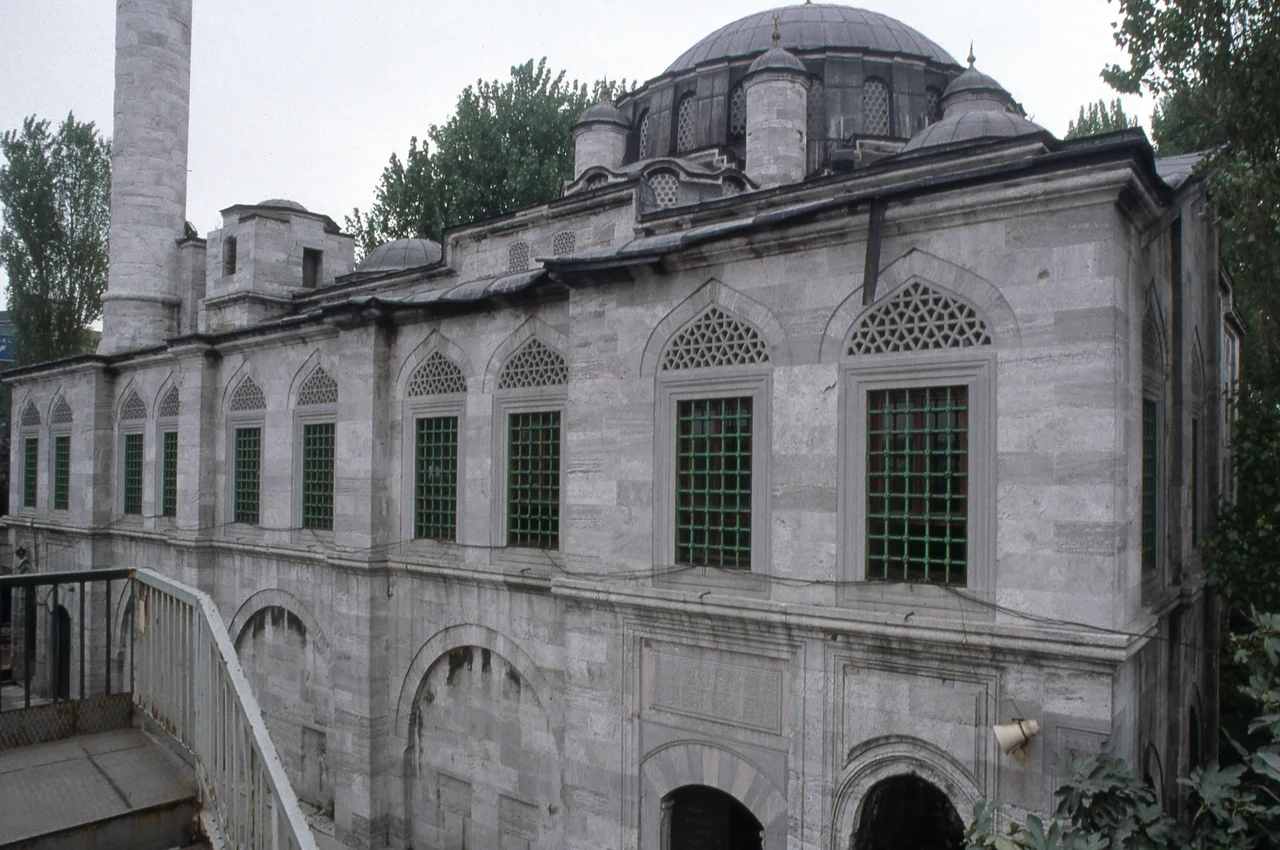

Sokollu Mehmed Pasha Mosque, Azapkapı
Sokollu Mehmed Pasha served three sultans and ran the Ottoman Empire for fifteen years. When he finally built a mosque for himself — not for a wife, not for a patron, but in his own name — he chose the most difficult possible site: the muddy, tide-washed shore of the Golden Horn at Azapkapı. He gave the commission to Mimar Sinan, then in his eighties and at the height of his powers. What Sinan produced was a building on stilts above the Bosphorus world, elegant and self-assured as the man who ordered it.
A Grand Vizier Builds for Himself
Sokollu Mehmed Pasha was born a Serbian Christian in the village of Sokolovići, taken into the Ottoman devşirme system as a boy, and rose through decades of service to become grand vizier under Suleiman the Magnificent, Selim II, and Murad III — an almost unimaginable span of influence. He directed wars, negotiated treaties, and effectively governed the empire. In 1577 or 1578, nearing the end of his life (he would be assassinated in 1579), he commissioned this mosque for himself at Azapkapı, the 'Gate of the Azabs,' named for the naval infantry once barracked nearby. It stands on the northern bank of the Golden Horn, in what is today Beyoğlu, a short walk from where the Atatürk Bridge crosses the water. This was his personal monument, distinct from the mosque he and his wife Esmahan Sultan commissioned together in Kadırga. Here, the name on the foundation inscription is his alone.
Sinan's Answer to a Waterlogged Shore
Building on the Golden Horn's edge in the sixteenth century meant building on saturated ground, essentially reclaimed shore, with the water table close enough to the surface to swallow conventional foundations. Sinan's solution was structural theater: he raised the entire mosque on a vaulted basement of arched brick chambers, lifting the prayer hall clear of the mud and tide. The system also gave the building a dramatic presence from the water — arriving by boat, you would have seen it elevated above the shoreline like a stone ship riding at anchor. Inside, an octagonal arrangement of eight supports carries the central dome, a structural logic Sinan explored more elaborately at the Selimiye Mosque in Edirne. Abundant windows flood the interior with light. A single minaret rises at an unusual angle from the entrance flank. Considered the most important Ottoman monument in the Galata district, it wears its distinction quietly — no grand plaza, no commanding hilltop, just a masterwork pressed close against the city's working waterfront.
What the Neighborhood Was
Azapkapı in the sixteenth century was a place of maritime industry: shipyards, warehouses, the constant traffic of vessels working the Horn. The Galata district across from the old city had long been a quarter of merchants and traders, a cosmopolitan margin of the Ottoman capital. Building here was a statement — not the pious withdrawal to a hilltop above the city, but an engagement with the commercial and naval life of the waterfront. The mosque and its associated charitable foundation (külliye) would have served the people of the docks and markets directly. That pragmatic, embedded quality has persisted. Today the mosque sits among the dense streets of Beyoğlu, visible from the metro viaduct at Haliç station, a sixteenth-century dome among apartment blocks and traffic. The rococo fountain added centuries later by the mother of Sultan Mahmud I stands nearby, a reminder that the Ottomans continued to layer this neighborhood with architecture long after Sinan's time.
The Pasha's End and His Legacy
Sokollu Mehmed Pasha was stabbed by a petitioner in the imperial council chamber in October 1579, less than two years after this mosque was completed. The assassination marked the end of an era — after him, the office of grand vizier never again concentrated such sustained power. His mosque at Azapkapı survived fires, floods, and the transformation of the waterfront over four and a half centuries. It remains an active place of worship, standing on the ground he claimed from the Golden Horn, the most personal building of the most powerful official the Ottoman Empire ever produced. Sinan outlived his patron by nearly a decade. Of the three Istanbul mosques bearing the Sokollu name that Sinan designed, this one, built on reclaimed mud for a man who built an empire, carries perhaps the most personal weight.
From the Air
The Sokollu Mehmed Pasha Mosque at Azapkapı is located at 41.025°N, 28.968°E on the northern shore of the Golden Horn in Beyoğlu, Istanbul. From the air, look for the single dome and minaret pressed against the waterfront near the Atatürk Bridge (Unkapanı Köprüsü). Viewing altitude of 1,500–3,000 feet offers clear orientation along the Golden Horn. The nearest major airport is Istanbul Airport (LTFM), approximately 25 km to the northwest. Sabiha Gökçen Airport (LTFJ) is on the Asian side, roughly 40 km southeast. On approach from the west, the Golden Horn appears as a narrow inlet cutting northeast from the Bosphorus, with this mosque near its mouth on the north bank.
Nearby Stories
- Kocaeli Peninsula 7.6 km away
- Second Battle of Çatalca 11 km away
- Istanbul's Rural Outskirts 14 km away
- MV Struma 20 km away
- HMAS AE2 36 km away
- Bursa 66 km away
- Sangarius Bridge 71 km away
- Januarius MacGahan 101 km away