
Sokollu Mehmed Pasha Mosque, Kadırga
Three fragments of the Black Stone of the Kaaba are set into the walls of this mosque. One hangs above the main entrance, framed in gilded brass. Another is above the minbar. A third is above the mihrab. To enter the Sokollu Mehmed Pasha Mosque in Kadırga is to pass beneath a piece of the most sacred object in Islam — and then to stand inside one of the most beautiful interiors Mimar Sinan ever designed.
A Princess and Her Grand Vizier
This mosque was commissioned jointly by the grand vizier Sokollu Mehmed Pasha and his wife Esmahan Sultan, who was a daughter of Sultan Selim II and a granddaughter of Suleiman the Magnificent. She was, in other words, Ottoman royalty — and her husband was the man who ran the empire. Together they endowed this foundation in the Kadırga neighborhood of the Fatih district, on the European shore of the old city, not far from the Sea of Marmara. The architect was Mimar Sinan, imperial architect to three sultans. According to the foundation inscription in Turkish above the north entrance to the courtyard, the building was completed in AH 979, which corresponds to 1571 or 1572 CE. There is a quiet complexity in that inscription: although Esmahan Sultan and her husband jointly funded and commissioned the mosque, only Sokollu Mehmed Pasha's name appears in the official record. Her contribution was real; the credit was his.
Sinan's Solution to a Hillside
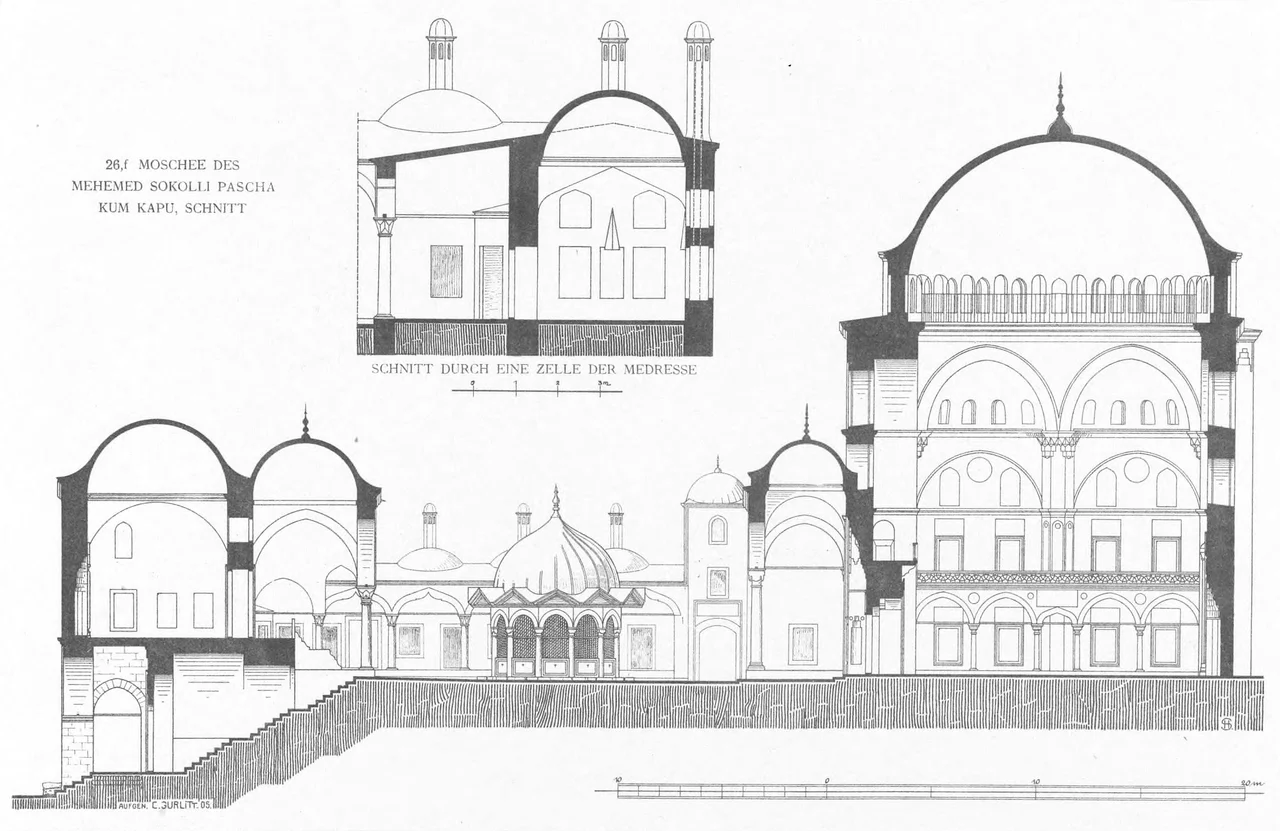
The site in Kadırga presented Sinan with a challenge that would have stumped a lesser architect: a steep slope that made a standard mosque footprint impossible. His answer was to make the difficulty invisible. He fronted the mosque with a two-storey courtyard that absorbed the grade change. The lower level he divided into shops, their rents funding the mosque's upkeep in perpetuity. The upper level he opened into a colonnaded courtyard, walling off spaces between columns on three sides to create small rooms — each fitted with a window, a fireplace, and a niche for bedding — that served as student cells for the attached religious school, or madrasah. The mosque itself occupies the fourth side of the courtyard, designed as a hexagon inscribed in a rectangle. Its central dome, thirteen meters in diameter and nearly twenty-three meters high, is flanked by four small semi-domes at the corners. The ablution fountain at the courtyard's center has twelve columns supporting an onion-shaped dome. A single minaret rises from the northeast corner. The whole complex makes no concession to the difficult terrain. It simply conquers it.
The Interior: Blue, Red, Green, and Light
The fame of the Kadırga Sokollu mosque rests above all on its İznik tiles. Produced in the city of İznik during the peak period of Ottoman ceramic production, they cover the interior walls in cascading panels of blue, red, and green floral designs. White thuluth calligraphy on a blue ground forms bands of Quranic inscription. The columns inside are polychrome marble. The minbar — the pulpit from which the sermon is delivered — is white marble with a conical cap, sheathed entirely in İznik tile. The windows above the mihrab glow with stained glass. Some of the original painted decoration survives above the vestibule of the north entrance, on the brackets of the entrance balcony, and under the ceilings of the side galleries. Standing inside, with light falling through stained glass onto the tilework, and the three fragments of the Black Stone set into their appointed places above mihrab, minbar, and door, the interior achieves something precise: it is intimate and overwhelming at once.
Stones from the Kaaba
The Black Stone (al-Hajar al-Aswad) at the Kaaba in Mecca is the most venerated object in Islam. Pilgrims on the Hajj circumambulate the Kaaba and, if they can, touch or kiss the Stone. That three fragments of this stone were embedded in the walls of a mosque in Istanbul — above the main entrance, above the pulpit, above the prayer niche — transforms the building into something more than an act of architectural patronage. It makes it a site of connection to Mecca itself, a physical extension of the sacred toward the faithful. The fragments are set in their gilded bezels with care, each one positioned to be seen and contemplated. They remain in place today, four and a half centuries after the building was completed. The mosque is still active, still visited by worshippers and pilgrims, its tiles still shining in the filtered light of a Kadırga afternoon.
From the Air
The Sokollu Mehmed Pasha Mosque at Kadırga is located at 41.0047°N, 28.9719°E in the Fatih district of Istanbul, on the European side of the city, a few hundred meters north of the Sea of Marmara shoreline. From the air, look for the distinctive dome and single minaret in the densely built Kadırga neighborhood southwest of the Hippodrome area. Best viewed at 1,500–2,500 feet. The nearest major airport is Istanbul Airport (LTFM), approximately 28 km to the northwest. Sabiha Gökçen Airport (LTFJ) is on the Asian side, around 40 km southeast. On approach from the west over the Marmara, the old city's peninsular form — bounded by the Golden Horn to the north and the Sea of Marmara to the south — is clearly visible, with this mosque tucked into the southern quarter near the water.
Nearby Stories
- Kocaeli Peninsula 7.6 km away
- Second Battle of Çatalca 11 km away
- Istanbul's Rural Outskirts 14 km away
- MV Struma 20 km away
- HMAS AE2 36 km away
- Bursa 66 km away
- Sangarius Bridge 71 km away
- Januarius MacGahan 101 km away