.jpg)
Sparrenberg Castle
In 1879 the city of Bielefeld bought a fortress. The price was 8,934 marks and 90 pfennigs against an assessed value of 70,000, which tells you how badly Prussia wanted rid of it. The Sparrenburg had been militarily pointless for nearly two centuries by then. It had done time as a prison, and its outer walls had already been carted off to build an army barracks down in the town. What the city acquired was not a defensive asset. It was a silhouette - a tower on the ridge that Bielefeld had been able to see from anywhere in town for six hundred years.
The Pass Was the Whole Point
The Teutoburg Forest crosses eastern Westphalia as a single narrow wooded ridge, and there are only a few places to get over it. The Sparrenburg sits on one of them, on a hill of 180 metres that stands 60 metres above the city centre, covering the Bielefeld Pass and serving as the seat of the counts of Ravensberg.
The stonework is older than the paperwork. The castle is first mentioned in 1256, but the town below was probably founded around 1200, and since a protective castle almost always precedes the town it protects, an earlier one is assumed to have stood here first. The dynasty ran out early. Count Bernard of Ravensberg died childless in 1346, ending the Calvelage-Ravensberg line, and the castle passed by marriage to Gerhard I of Jülich-Berg. Emperor Charles IV slept here on 18 November 1377. After a last spell as a ruling seat between 1410 and 1428, the Sparrenburg became something a distant duke owned rather than somewhere a count lived.
What Gunpowder Cost
Cannon changed the arithmetic. Around 1530 the dukes of Cleves, by then also counts of Ravensberg, added a round bastion on the west side, reachable only by a bridge from the castle itself, from which artillery could sweep the pass. Preliminary work began in 1535, and from 1556 the Italian fortress engineer Alessandro Pasqualini and his son ran a rebuild that finished in 1578 and produced the largest fortress in Westphalia.
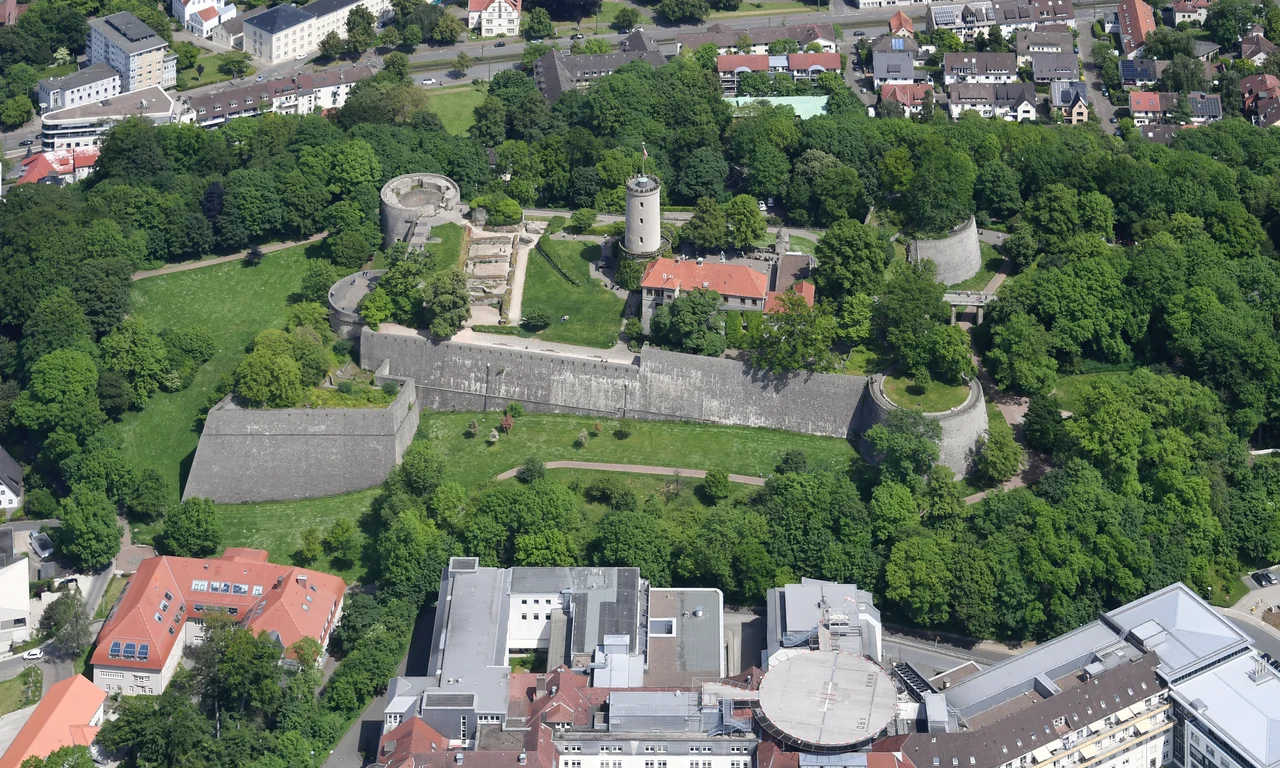
A terrace and a high defensive wall now wrapped the medieval core, and round bastions went up on the remaining three corners. The western work, the Mühlenrondell, was drawn out into a pointed bastion called the Scherpentiner - a term recorded nowhere else, traceable to the serpentine, the light gun of the fifteenth and sixteenth centuries whose name is simply the Italian for snake. Beneath it all run 285 metres of casemates.
Everyone Had a Turn
Then it was tested. When the last duke of Jülich died without a male heir in 1609, the shared government cobbled together by Brandenburg and Neuburg collapsed into the War of the Jülich Succession. An earthquake damaged the castle in 1612. The Treaty of Xanten handed it to Brandenburg-Prussia in 1614, which promptly let its Dutch allies move in.
The Thirty Years' War did the rest. The Dutch fell back before a Spanish advance in 1623; a Brandenburg colonel named Gent tried to retake the place in 1625 with the help of Ravensberg's peasants and failed; Swedish and Hessian troops besieged the Spanish garrison for close to a year before it surrendered in 1637. Between the sieges came bandits and arson, and the bill fell on the farming country around the ridge. The Peace of Westphalia confirmed Brandenburg's claim in 1648, and the Grand Elector Frederick William stayed often enough that two of his children were born here.
Prison, Quarry, Landmark
By the end of the seventeenth century the fortress no longer met anyone's military requirements, and it was left to slide. Frederick II of Prussia agreed to have the outer walls pulled down for building stone.
Then the nineteenth century decided ruins were beautiful. A committee formed in Bielefeld under the unhurried name Comité zur Wiederherstellung des Thurmes auf dem Sparrenberg and rebuilt the tower in 1842-43. After the city bought the site and argued about the design for years, a new Gothic great hall with ballroom, restaurant and museum rooms opened on 24 April 1888. In 1900 a monument to the Grand Elector went up in the courtyard, with Emperor William II - nominally the last count of Ravensberg - present to watch it happen.
Flak Battery, Bat Roost, Concrete Box
In the Second World War the castle carried an anti-aircraft position, and the air raid on Bielefeld of 30 September 1944 wrecked most of what was left. Only the 37-metre tower came through undamaged. Clearing and restoration ran from 1948 to 1987, and the German Museum of Playing Cards occupied the rebuilt estate building from 1955 to 1983. Later work found the fortress's real floor level three metres below the present surface.
The northwestern stretch of the underground corridor stays shut, because bats live in it and get it to themselves except for three tours a year. A visitor centre by Max Dudler opened in September 2014 on the southeast edge of the courtyard: eighty square metres, single storey, compressed concrete. Money remains the permanent problem. A campaign called Ein Stein für die Burg let donors adopt a stone in the wall - 3,100 of them, engraved, eventually laid into the paving of the roundels - and closed in 2006 when the stones ran out. Against a restoration estimate of 7.5 million euros, the town's foundation is still asking.
From the Air
The Sparrenburg stands at 52.015°N, 8.527°E on the Teutoburg Forest ridge immediately south of central Bielefeld. The ridge itself is the navigation feature: a single dark wooded line running north-west to south-east across otherwise open Westphalian country, with the city spilling through the gap at its foot. The castle reads as a square stone block with one tall round tower on the crest, roughly 180 m elevation and 60 m above the streets, best picked up at 1,500-3,000 ft AGL from the north or south where it stands clear against the trees. Bielefeld (EDLI) lies about 7 km south, Paderborn-Lippstadt (EDLP) about 45 km south-east, Münster/Osnabrück (EDDG) about 60 km west and Hannover (EDDV) about 95 km east-north-east. Terrain is easy, but the ridge makes its own weather: low cloud caps it in strong north-westerlies, and autumn mornings often leave the tower standing above valley fog.
Nearby Stories
- Osnabrück Zoo 4.9 km away
- Warendorf 6.5 km away
- Battle of Villinghausen 6.5 km away
- Wewelsburg 8.5 km away
- Meller Möbelfabrik 19 km away
- Bad Nenndorf Interrogation Centre 21 km away
- Reich Harvest Thanksgiving Festival 22 km away
- Sababurg 31 km away