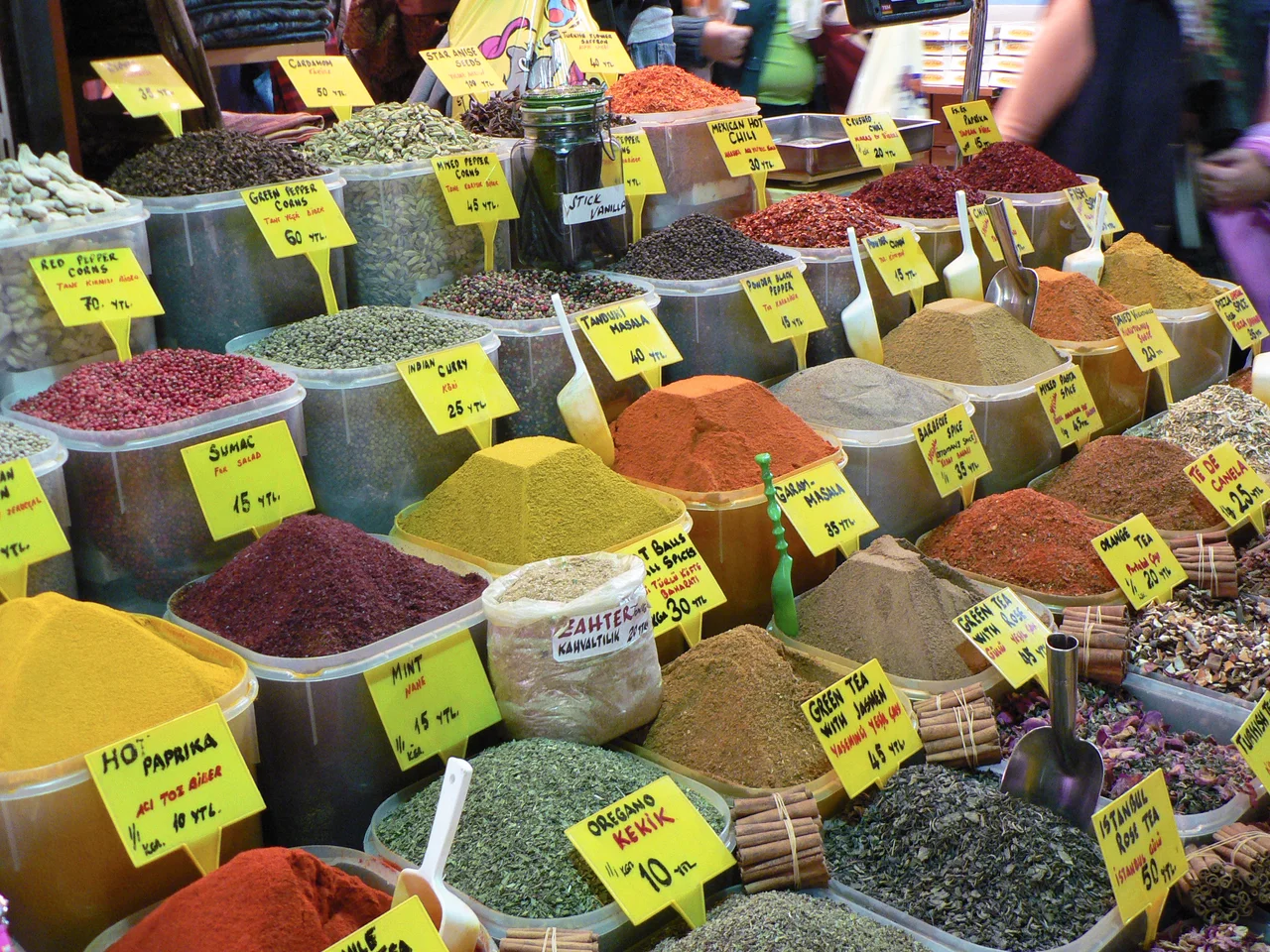

Spice Bazaar
The Turkish word mısır means two things: Egypt, and maize. The Spice Bazaar's proper name — Mısır Çarşısı, the Egyptian Bazaar — comes from the first meaning, because it was built with revenues from Egypt. But for centuries, visitors who didn't know the etymology assumed it meant corn, and called it the Corn Bazaar. Both names miss the point. What it actually is, and what it has been since 1660, is the place where Istanbul keeps its smells.
Born from Fire and a Queen Mother's Commission
In 1660, a catastrophic fire swept through the dense wooden neighborhoods of Istanbul. The rebuilding that followed was one of the great urban construction projects of the Ottoman seventeenth century. Among the buildings commissioned in the aftermath was the New Mosque (Yeni Cami) in Eminönü — whose construction had been started in 1597 and then halted for fifty-seven years — and, as part of the same complex, the Spice Bazaar. Both buildings were commissioned by Turhan Hatice Sultan, the Valide Sultan, meaning the Queen Mother of Sultan Mehmed IV. The bazaar was funded specifically with revenues from the Ottoman province of Egypt. Construction began in 1660. When it was completed, the L-shaped covered market became part of the mosque's külliye — the charitable complex of associated buildings whose rents and revenues supported the religious foundation. The bazaar was built to pay for the mosque's upkeep. Commerce and faith, in Ottoman urban planning, were never very far apart.
What You Smell Before You See
The Spice Bazaar sits at the edge of Eminönü, where the Golden Horn meets the Bosphorus and the ferry docks press against the old bridge piers. The air around it carries its contents outward: saffron threads in glass jars, whole dried chilies in sacks, pyramids of sumac and cumin, dried rose petals and hibiscus flowers, powdered turmeric so bright it seems to glow. Inside the arched stone galleries, the eighty-five shops that line the main corridors sell spices, Turkish delight, dried fruits and nuts, honey, and herbs. The covered bazaar is L-shaped, its two wings meeting near the main entrance gate. Light comes through small windows in the vaulted ceiling. The stone and mortar that have held the building together since the seventeenth century absorb and release the scents of four centuries of trade. You are smelling Ottoman Istanbul, and something much older still — the spice routes that connected Istanbul to the Indian Ocean world, to Persia, to the Arab lands, to the eastern Mediterranean.
The Second Bazaar
Istanbul has two famous covered bazaars. The Grand Bazaar (Kapalıçarşı) is the largest — a labyrinthine city within a city, dating to the fifteenth century, covering sixty-six streets and containing thousands of shops. The Spice Bazaar is smaller, more contained, easier to navigate, and in some ways more alive to a single purpose. Where the Grand Bazaar has diversified into gold, leather, carpets, and souvenirs over the centuries, the Spice Bazaar has held closer to its original function, though modern pressures have pushed in candy shops and tourist goods here too. The difference in scale is also a difference in atmosphere. In the Grand Bazaar you can get genuinely lost. In the Spice Bazaar you are always near the end of a corridor, always able to orient yourself by the smell of a particular stall. It is a smaller, more legible world — which is part of why it remains one of the most visited places in the city.
Eminönü, the City's Hinge
Step outside the Spice Bazaar and you are in Eminönü, the quarter where old Istanbul's geography becomes most physical. The New Mosque fills the square with its grey stone and twin minarets. The ferries for the Bosphorus and the Prince's Islands load at the docks a few meters away. The Galata Bridge, linking the old city to the Beyoğlu district on the northern shore, begins here. The Golden Horn opens to the left. The Bosphorus strait stretches ahead. For centuries, Eminönü was the point through which goods from every direction passed into the city — and the Spice Bazaar was where those goods were stored, traded, priced, and dispersed. The function has changed less than the buildings around it. Istanbul is still a city through which things pass. Eminönü is still where you can feel that movement most directly, and the Spice Bazaar is still, as it has been since 1660, the city's fragrant hinge.
From the Air
The Spice Bazaar (Mısır Çarşısı) is located at 41.0164°N, 28.9706°E in the Eminönü quarter of the Fatih district, Istanbul, at the point where the Golden Horn meets the Bosphorus. From the air, look for the L-shaped roof of the bazaar immediately adjacent to the twin minarets of the New Mosque (Yeni Cami). The Galata Bridge is visible just to the north. Best viewed at 2,000–3,500 feet, which gives clear sight of the Eminönü waterfront and the Golden Horn's southern shore. The nearest major airport is Istanbul Airport (LTFM), approximately 22 km to the northwest. Sabiha Gökçen Airport (LTFJ) is on the Asian side, around 38 km southeast.
Nearby Stories
- Kocaeli Peninsula 7.6 km away
- Second Battle of Çatalca 11 km away
- Istanbul's Rural Outskirts 14 km away
- MV Struma 20 km away
- HMAS AE2 36 km away
- Bursa 66 km away
- Sangarius Bridge 71 km away
- Januarius MacGahan 101 km away