.jpg)
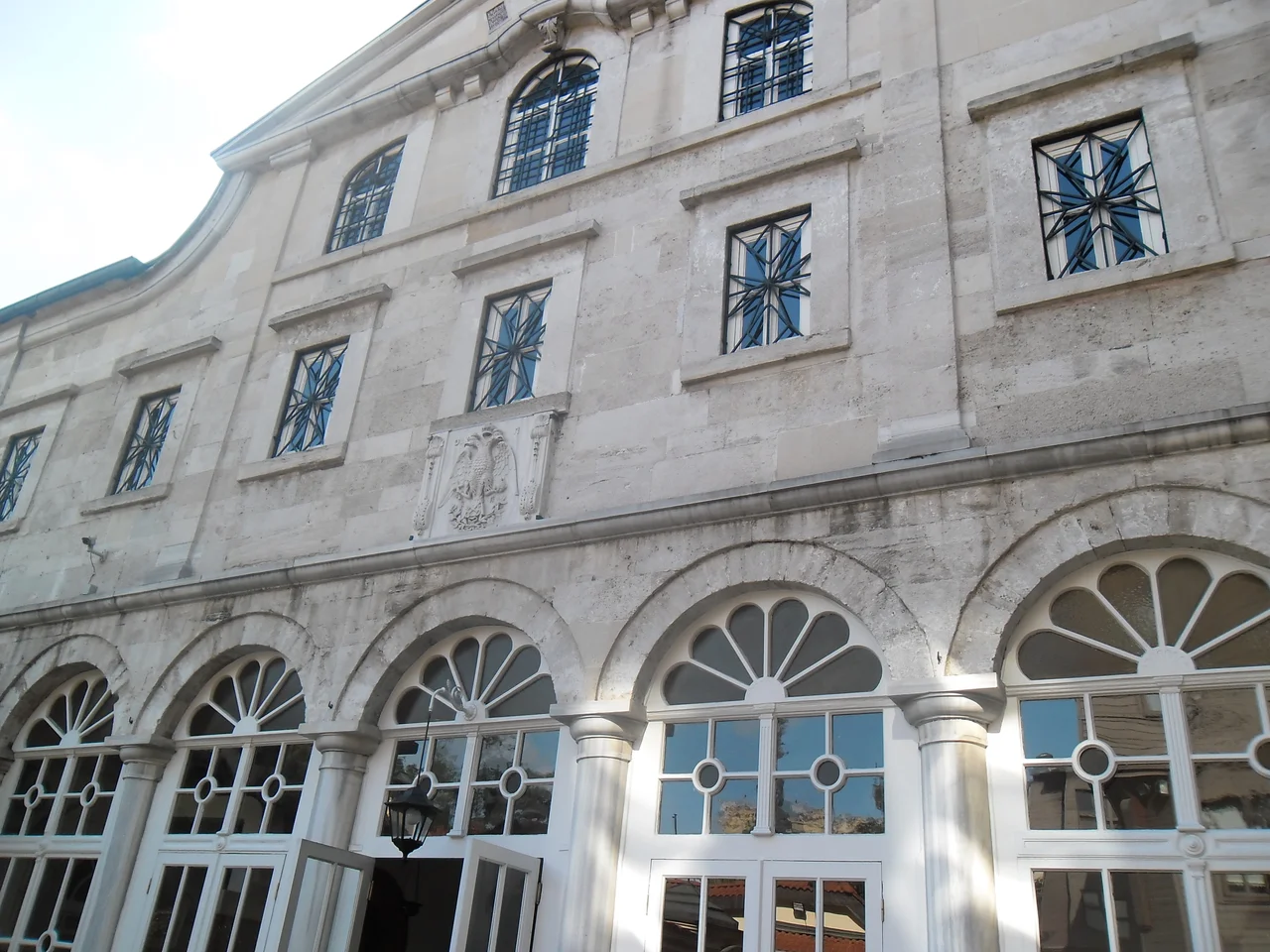
St. George's Cathedral, Istanbul
The cathedral is not large. By the standards of world-historical religious institutions — and the Ecumenical Patriarchate of Constantinople is unquestionably one — it is, in fact, quite small. That smallness is not an accident. Under Ottoman law governing the rights of non-Muslim subjects, non-Islamic buildings were required to be smaller and humbler than mosques. Before the Ottoman conquest of 1453, the Patriarchal cathedral had been Hagia Sophia, one of the largest buildings in the world. What stands in the Fener district today is what was possible under the circumstances. And what was possible, it turns out, is magnificent.
Seat of a Scattered Church
The Ecumenical Patriarchate of Constantinople is the oldest continuing Christian patriarchate in the world, and its holder — currently addressed as 'His All-Holiness' — is regarded as the primus inter pares, first among equals, in the Eastern Orthodox Church. Around 300 million Orthodox Christians look to this office as a spiritual touchstone. The Patriarch consecrates the chrism — the sacred oil called myron — used across the Orthodox world, a responsibility that has given the cathedral its secondary name: the Patriarchal Church of the Great Myrrh. Since about 1600, the seat of this ancient institution has been the Church of St. George in the Fener (Phanar) district of Istanbul, on the Golden Horn's northern shore. Patriarch Matthew II moved the Patriarchate here in 1597, to a former convent, because this was where Greek Christian life in the Ottoman capital had come to center itself. The district took its name — Phanar, meaning lighthouse — from a Byzantine signal tower. The Greeks who remained in the city after 1453 made it their own.
Fires, Rebuildings, and a Gate That Has Not Opened
The church has burned and been rebuilt so many times that almost nothing of its original structure survives. Patriarch Timothy II rebuilt and enlarged it in 1614. It was reconstructed again under Patriarch Callinicus II later in the seventeenth century. A fire in the early eighteenth century caused severe damage. In 1720, Patriarch Jeremias III wrote to a colleague describing the permission he had received to rebuild 'from the very foundations the holy church of our Patriarchal and Ecumenical Throne.' Another fire struck in 1738. Large-scale restoration began in 1797 under Patriarch Gregory V, and the church as it largely appears today dates from that work. Further changes in the 1830s gave the exterior its neo-Classical marble doorway — atypical for Orthodox churches, which usually follow Byzantine forms. The last major rebuilding was in the late nineteenth century under Patriarch Joachim III. A fire in 1941 damaged it again; full restoration was not completed until 1991. The main gate of the Patriarchate complex — Saint Peter's Gate — has remained permanently shut since 1821, when Patriarch Gregory V was hanged from its architrave by order of Sultan Mahmud II, who held him responsible for his failure to suppress the Greek War of Independence. The gate still stands. It has not been opened since.
What Survived the Flames
Each time the church burned and was rebuilt, certain objects were carried out and saved. The most precious of these is the patriarchal throne, believed to date from the fifth century — older than the Ottoman Empire, older than the Muslim faith, older than the Fener district itself. There are rare mosaic icons, and there are the relics of three of the greatest fathers of the early Church: Saints Basil the Great, Gregory the Theologian, and John Chrysostom. The bones of two of these saints had been taken from Constantinople by the soldiers of the Fourth Crusade in 1204, looted along with much else that made the Byzantine capital worth plundering. In 2004, Pope John Paul II returned them to the Church of St. George — a gesture of ecumenical acknowledgment eight centuries in the making. Inside, the church is a three-aisled basilica with tall ebony pews, polychrome marble, and the synthrone arranged in a semicircle behind the altar — seats for the archpriests, and at the center, a higher marble throne for the Patriarch. It is intimate and layered, a church that holds its history in objects rather than space.
A Patriarchate Without a People, and What That Means
For most of its history, the Ecumenical Patriarchate served a substantial Greek Orthodox community in Istanbul — Rum, in Turkish, meaning Roman, the old name for the Greek-speaking Eastern Christians who saw themselves as heirs of the Byzantine Empire. By the mid-twentieth century, that community had been catastrophically reduced. Discriminatory taxes, property seizures, and the Istanbul pogrom of September 1955 — in which mobs attacked Greek, Armenian, and Jewish homes and businesses across the city — drove tens of thousands to emigrate. The Greek Orthodox population of Istanbul, which had numbered well over 100,000 in the early twentieth century, had fallen to a few thousand by the late twentieth century. The Patriarch, in the words of the Wikipedia article, was left in the anomalous position of a leader without a local flock. The church is financially supported by Orthodox communities in other countries. It remains under constant security, and has survived more than one bomb attack. On 3 December 1997, a bomb seriously injured a deacon and damaged the building. The Church of St. George endures as what it has become: a symbol, a pilgrimage site, a center of global Orthodoxy maintained in the city where it was born, by a community that refuses to let it disappear.
From the Air
St. George's Cathedral is located at 41.0291°N, 28.9518°E in the Fener (Phanar) district of Istanbul, on the northern (European) shore of the Golden Horn. From the air, look for the modest cathedral complex set into the dense streets of Fener, northwest of the historic peninsula. The Golden Horn is the narrow inlet running northeast from the Bosphorus; Fener sits on its southern bank, roughly midway along its length. Viewing altitude of 2,000–3,500 feet gives good orientation. The nearest major airport is Istanbul Airport (LTFM), approximately 20 km to the northwest — this location is on the European side of Istanbul. Sabiha Gökçen Airport (LTFJ) is on the Asian side, around 45 km to the southeast.
Nearby Stories
- Kocaeli Peninsula 7.6 km away
- Second Battle of Çatalca 11 km away
- Istanbul's Rural Outskirts 14 km away
- MV Struma 20 km away
- HMAS AE2 36 km away
- Bursa 66 km away
- Sangarius Bridge 71 km away
- Januarius MacGahan 101 km away