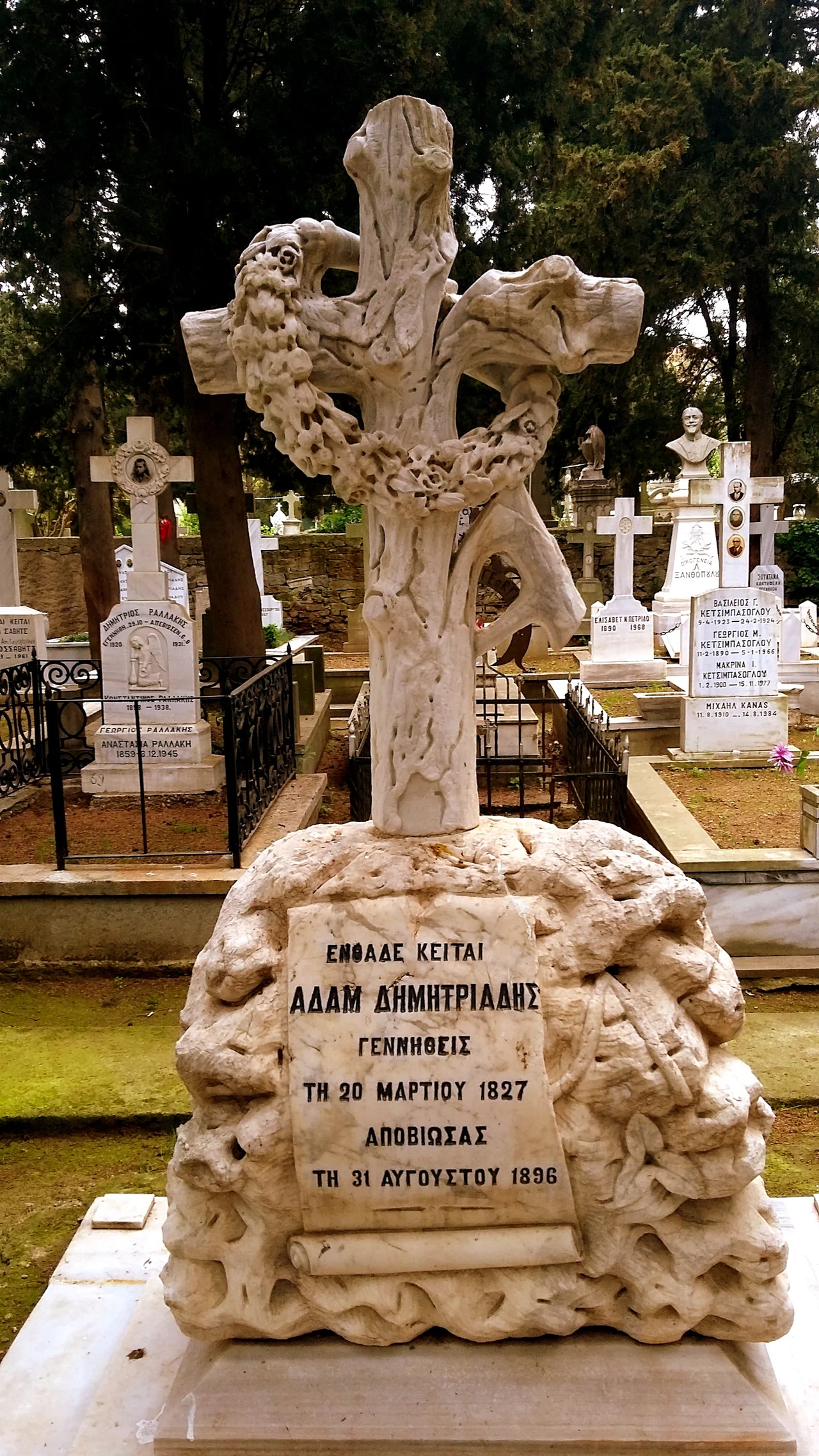

St. Ignatius Greek Orthodox Cemetery, Kadıköy
Kadıköy sits on the Asian shore of Istanbul, across the Bosphorus from the old city. It was ancient before it was Ottoman, before it was Byzantine — the Greeks called it Chalcedon, and it was here, in the year 451, that the Fourth Ecumenical Council of the Christian Church convened in the basilica of Saint Euphemia to settle foundational questions of Christian doctrine. The Greek Orthodox community of Chalcedon buried their dead near their churches for centuries. When the current cemetery was established in 1895, on land made available by Sultan Abdul Hamid II, they were continuing a tradition that reached back through the Byzantine period and beyond. The St. Ignatius Greek Orthodox Cemetery is a ten-acre estate in the Hasanpaşa quarter of Kadıköy, and it is still in use.
A Community's Long Presence
The Greek Orthodox Christians of Chalcedon — of Kadıköy — had buried their dead near their churches and monasteries for as long as they had lived in the city, which was a very long time. During the Byzantine period, a Christian cemetery near the monastery of Agia Vassi, close to the port of Haydarpaşa, served the community and continued to function after the Ottoman conquest of Constantinople in 1453. In the nineteenth century, as Istanbul's Greek population grew, the old burial grounds within the city became inadequate, and sanitary reform under Sultan Abdülaziz pressed cemeteries outside the city's settled areas. The church authorities continued to use the old in-city cemeteries through the 1880s. The solution, eventually, was the land in Hasanpaşa: a ten-acre estate granted by Sultan Abdul Hamid II for a new Eastern Orthodox cemetery. It was established in 1895. The graves it holds are mostly Greek, but the cemetery has also received the dead of other Orthodox communities — Russians, Serbians, Bulgarians, Arab Christians, Turkish and Turkic Christians. Its boundaries enclose what Ottoman Istanbul actually was: not a single community but a layered one, with different peoples sharing a city and, here, a ground.
The Church of Saint Ignatius
At the center of the cemetery stands the Church of Saint Ignatius, built in 1898. Permission to build a cemetery chapel on land assigned to Orthodox Christians was granted in that year, and the diplomat Pavlos Maksutov — then First Secretary of the Russian Embassy — was personally involved in securing the building permits, a reminder that the Orthodox communities of Istanbul were not only Greek, and that Russia had long taken an interest in the welfare of Eastern Christians in Ottoman territory. The church and the cemetery are dedicated to Ignatios of Constantinople, a ninth-century patriarch whose complex story — he was deposed, restored, deposed again, and eventually canonized — carries its own resonances in this place. The building itself bears the features of Russian church architecture, not the Byzantine forms one might expect. Its interior is a three-aisled domed basilica. Also in the cemetery grounds are a charnel house, built to preserve bones from old and unclaimed graves, and an ossuary beneath the chapel to hold remains from relocated burial grounds. The dead have been gathered here carefully, over generations, and rehoused when necessary.
The Weight of the Twentieth Century
The St. Ignatius cemetery is a place of quiet, but it is not a place that can be fully understood without knowing what happened to the community that maintains it. The Greek Orthodox population of Istanbul — of all of Turkey — was one of the oldest continuous Christian communities in the world. In the first decades of the Turkish Republic, discriminatory policies bore hard on non-Muslim minorities. The Istanbul pogrom of September 1955 drove tens of thousands of Greeks, Armenians, and Jews to emigrate. Property seizures, legal restrictions on religious institutions, and steady demographic pressure reduced the city's Greek Orthodox community from hundreds of thousands to a few thousand. The cemetery grew during the years of the community's flourishing. It continues to receive the dead of a much diminished community, and of Orthodox visitors and pilgrims from across the world. Among those buried here is Meliton, Metropolitan of Chalcedon (1913–1989), a senior prelate of the Eastern Orthodox Church who served the Metropolis of Chalcedon from 1966 until his death. The Ecumenical Patriarch has come to bless his grave. That act of commemoration — the highest office of world Orthodoxy honoring one of its own in this particular ground — says something about what this cemetery holds and what it means.
Ancient Chalcedon, Present Kadıköy
Walk out of the cemetery and you are in Kadıköy, a neighborhood that today is one of the liveliest parts of Istanbul — markets, restaurants, music venues, a distinct secular energy that distinguishes the Asian shore from the more conservative neighborhoods of the European side. The ancient name, Chalcedon, persists in ecclesiastical usage: the Metropolis of Chalcedon still functions as a diocese of the Ecumenical Patriarchate, and the clergy who served it are buried in this ground. The cemetery occupies a quiet corner of a busy city, across Doğuş University's campus. Its gates are open. The graves carry inscriptions in Greek, the dates spanning from the nineteenth century to the recent past. To read them is to read the history of a community that shaped this city, outlasted empires, survived catastrophe, and continues — in diminished but unbroken form — to bury its dead in the earth of Chalcedon, where it has buried them for more than fifteen centuries.
From the Air
The St. Ignatius Greek Orthodox Cemetery is located at 40.9992°N, 29.0476°E in the Kadıköy district of Istanbul, on the Asian side of the city, east of the Bosphorus strait. From the air, look for the cemetery grounds near the Doğuş University campus in the Hasanpaşa area of Kadıköy. Kadıköy is easily identified as the district immediately south of Üsküdar on the Asian shore. Viewing altitude of 2,000–3,500 feet is recommended. The nearest major airport is Sabiha Gökçen Airport (LTFJ), approximately 15 km to the southeast on the Asian side. Istanbul Airport (LTFM) is on the European side, roughly 45 km to the northwest across the Bosphorus.
Nearby Stories
- Kocaeli Peninsula 7.6 km away
- Second Battle of Çatalca 11 km away
- Istanbul's Rural Outskirts 14 km away
- MV Struma 20 km away
- HMAS AE2 36 km away
- Bursa 66 km away
- Sangarius Bridge 71 km away
- Januarius MacGahan 101 km away