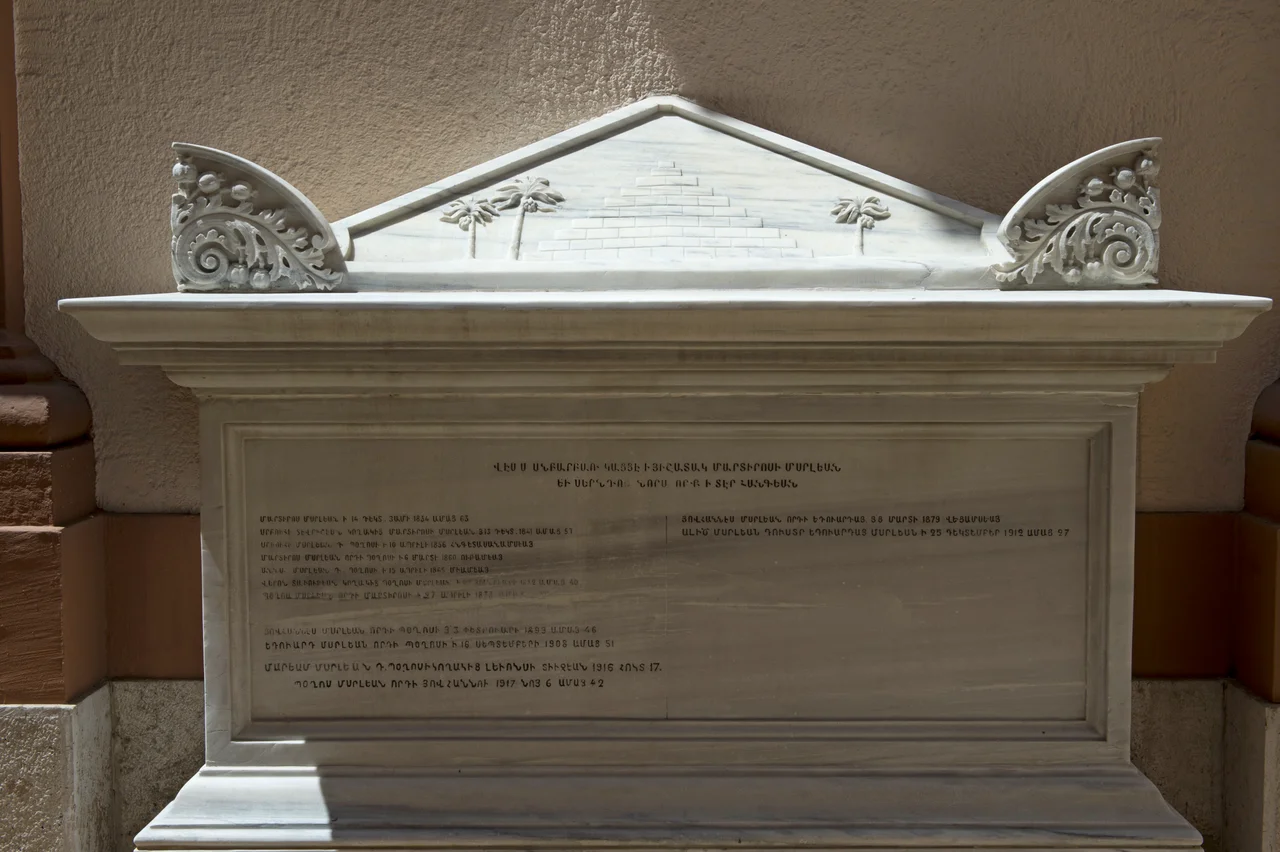

St. Mary of Sakızağaç Cathedral, Istanbul
The name is a mouthful even for locals — Surp Asdvadzadzin, meaning Holy Mother of God in Armenian — but the community it shelters has been saying it for generations. Tucked into the Beyoğlu district of Istanbul, the cathedral known in Turkish as St. Mary of Sakızağaç (the Mastic Tree) serves as the seat of the Armenian Catholic Archeparchy of Constantinople, a church that walks a singular path: Armenian in rite, Roman in obedience, Ottoman in history. In a city of grand imperial mosques and storied Byzantine basilicas, this quieter place holds a different kind of weight — the weight of a small community that has survived centuries of change and still gathers here to pray in the Armenian tradition.
A Church Between Two Worlds
The Armenian Catholic Church occupies a distinctive position in the landscape of Christianity. It follows the ancient Armenian rite — one of the oldest liturgical traditions in the Christian world — while remaining in full communion with the Pope in Rome. This dual identity was formalized in 1830, when Pope Pius VIII issued the papal bull "Quod jamdiu," creating the Armenian Catholic Archeparchy of Istanbul and formally establishing this cathedral as its mother church. The title Archieparchia Constantinopolitana Armenorum sounds grand in Latin, and in a sense it is: Constantinople, the city of emperors, recognized at last as the center of this particular fold. The cathedral's founding came during a period when the Ottoman Empire was navigating its own complex relationship with its non-Muslim communities, and the millet system allowed minority religious groups to maintain their own ecclesiastical structures. The Armenian Catholics found their place within that system, distinct from both the much larger Armenian Apostolic community and from the Latin-rite Catholics of the city.
Marble, Dome, and the Sound of Armenian
Step inside and the architecture speaks of the nineteenth century's enthusiasm for religious grandeur — vaulted ceilings, the play of light through tall windows, the hushed atmosphere of a working cathedral that has never become a museum. The liturgy here is celebrated in Classical Armenian, a language called Grabar, which has served Armenian Christian worship since the fifth century. To hear it sung is to encounter something ancient and alive simultaneously. The cathedral's full name, Surp Asdvadzadzin, places the Virgin Mary at the center of its identity — an emphasis common throughout Armenian Christianity, where the Mother of God holds a place of particular devotion. The building itself is modest by the standards of Istanbul's skyline-defining monuments, but that modesty is part of its character: this is a church for a community, not a statement of imperial power.
The Armenian Catholic Community of Istanbul
The Armenian Catholic presence in Istanbul is small but continuous. For centuries, Armenians have been woven into the fabric of this city — as merchants, craftsmen, architects, and musicians — and the Catholic branch of that community has its own particular story. When the archeparchy was established in 1830, it was a moment of official recognition after decades of informal existence. The cathedral was long led by Archbishop Boghos Lévon Zékiyan, a scholar and theologian who wrote extensively on Armenian history and identity, until his retirement in October 2024. Three Catholic cathedrals serve different rites in this part of Istanbul: the Latin-rite Cathedral of the Holy Spirit (Saint Esprit Kilisesi), the Greek Catholic cathedral (Ayatriada Rum Katoliki Kilise), and this one, the Armenian Catholic cathedral — three strands of Roman Catholicism, each carrying a different liturgical inheritance into the heart of a predominantly Muslim city. The coexistence of these communities is itself a piece of Istanbul's layered history.
Continuity as Its Own Kind of Statement
What keeps a small religious community alive across centuries of political upheaval, demographic change, and the particular pressures that minority communities face? There is no single answer, but the cathedral of Surp Asdvadzadzin offers at least a partial one: place. The physical fact of a church — its doors open, its bells ringing, its congregation returning — makes continuity visible and tangible. The Armenian Catholic community of Istanbul has faced the same headwinds as other minority groups in the city through the twentieth century, and their numbers have diminished. Yet the cathedral stands. Services are still held. The Armenian language is still sung here in liturgies that reach back to the earliest centuries of Christian worship. In a neighborhood like Beyoğlu, where layers of Greek, Armenian, Levantine, and Jewish history have been largely obscured by time and migration, the presence of an active Armenian Catholic cathedral is a form of living testimony.
From the Air: Beyoğlu and the Bosphorus Shore
Flying over Istanbul's European shore, the geography itself tells you about the city's layered identity. The Golden Horn cuts inland from the Bosphorus, separating the historic peninsula to the south from the Beyoğlu district to the north. This cathedral sits within Beyoğlu at approximately 41.04°N, 28.98°E, a short distance from the famous İstiklal Avenue. At 3,000 feet, the distinction between the Ottoman domes and minarets of the old city and the denser, more European character of Beyoğlu becomes clear. The nearest major airport is LTFM — Istanbul Airport — on the European side, roughly 35 kilometers to the northwest. On a clear day, with the Bosphorus glittering below and the silhouettes of the great mosques rising from the historic peninsula, the small scale of this cathedral amid the city's vastness only deepens its significance: small, yes, but still here.
From the Air
The cathedral is located in Beyoğlu at approximately 41.04°N, 28.98°E, on Istanbul's European side. Approach from the north over the Golden Horn to see the contrast between the historic peninsula's domed skyline to the south and the more densely built Beyoğlu district. Recommended viewing altitude: 2,000–4,000 feet for urban orientation. Nearest airport: LTFM (Istanbul Airport), approximately 35 km northwest. The Bosphorus strait is visible to the east; the Sea of Marmara opens to the south.
Nearby Stories
- Kocaeli Peninsula 7.6 km away
- Second Battle of Çatalca 11 km away
- Istanbul's Rural Outskirts 14 km away
- MV Struma 20 km away
- HMAS AE2 36 km away
- Bursa 66 km away
- Sangarius Bridge 71 km away
- Januarius MacGahan 101 km away