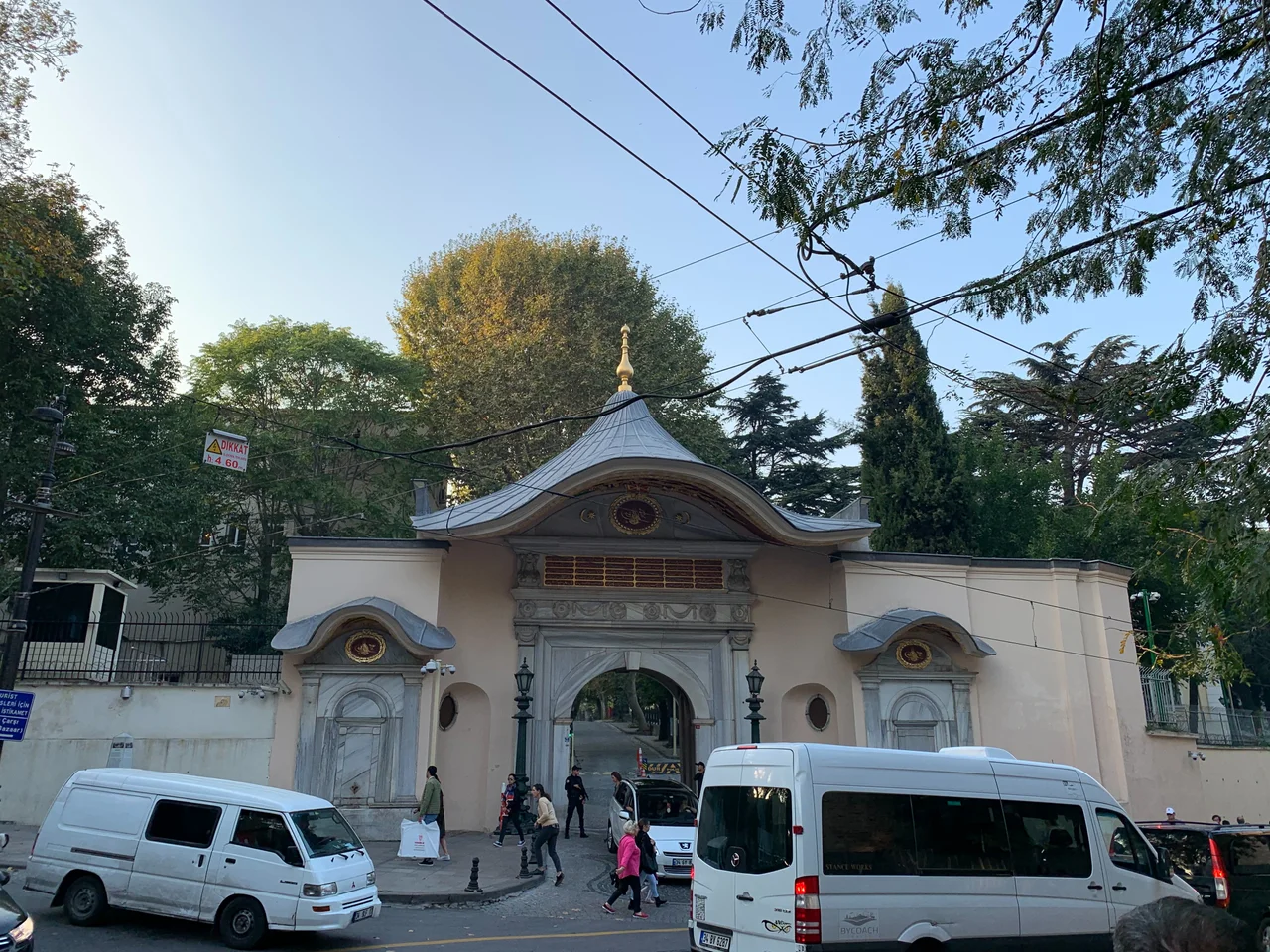

Sublime Porte
Ambassadors from Paris, Vienna, and London did not say they were traveling to Istanbul. They said they were traveling to the Porte. The gate — *Bâb-ı Âlî*, the High Gate — had lent its name to an entire empire. This is how power worked in the Ottoman world: not through the abstraction of a capital city, but through the physical threshold of authority. To pass through a great gate was to enter the seat of government itself. And so the Sublime Porte, which began as a monumental entrance to an official compound just west of Topkapı Palace, became the metonym through which the Ottoman Empire addressed the world and the world addressed it.
The Language of Gates
Long before a specific building carried the name, the idea behind the Sublime Porte had ancient roots. Both the Byzantine Empire and the early Ottoman sultans followed the same custom: the ruler pronounced judgments and announced decisions at the gate of his palace. The gate was the threshold between the ruler's private world and the public sphere of law and governance. When the Ottomans conquered Constantinople in 1453, they inherited not just the city but its symbolic geography. The Imperial Gate — *Bâb-ı Hümâyûn* — leading to the outermost courtyard of Topkapı Palace became the first location known as the High Gate, the Sublime Porte. The name had first been used for a palace in Bursa, the early Ottoman capital. With Constantinople taken, the geography of Ottoman power shifted, and so did the name. For two and a half centuries, it was the gate of the Topkapı Palace that European diplomats meant when they spoke of the Porte.
When Suleiman Met Francis
The year was 1536. Sultan Suleiman the Magnificent was at the height of his power, ruler of an empire stretching from Hungary to the Persian Gulf. King Francis I of France, eager for an ally against their common enemy the Habsburgs, sent diplomats to Constantinople. Those diplomats walked through the monumental gate of the vizierate — then called *Bâb-ı Âlî* — to reach the seat of Ottoman government. French, being the language of European diplomacy at the time, gave the world its enduring term: the *Sublime Porte*. The Franco-Ottoman alliance sealed that day was itself remarkable — a Christian king and a Muslim sultan finding common cause — but the linguistic legacy proved just as durable. In English, French, German, and Italian diplomatic correspondence for the next four centuries, "the Porte" meant the Ottoman government. A single gate had become the name for an empire.
The Italian Building and Two Fires
By the eighteenth century, the original Topkapı gate had lost its central function as the seat of government. A new grand Italian-styled office building was constructed just west of the Topkapı Palace area, across Alemdar Caddesi. This became the working center of Ottoman administration: the office of the Grand Vizier, the Ministry of Foreign Affairs, the Ministry of the Interior, and the Supreme Council of Judicial Ordinances all occupied the complex. The monumental gate leading to its courtyards carried forward the old name — *Bâb-ı Âlî*, the Sublime Porte. Colloquially it was also known as the Gate of the Pasha, *paşa kapusu*. The building was not immune to Istanbul's recurring catastrophes. Fire swept through it in 1839, forcing a rebuilding. Another fire badly damaged the complex in 1911. What stands today is the descendant of those reconstructions, now serving as the Istanbul Governor's Office.
A Coup at the Gate
The Sublime Porte witnessed its share of dramatic moments, but few matched the events of January 1913, when a group of officers of the Committee of Union and Progress — the Young Turks — stormed the building in what became known as the Raid on the Sublime Porte. The aim was to force a change of government as the Ottoman Empire reeled from military defeats in the First Balkan War. The raid succeeded; the existing cabinet was replaced. It was a hinge moment in late Ottoman history, a sign that the empire's political center of gravity had shifted decisively toward the military. After 1908 and the Young Turk Revolution, the term "Porte" had itself shifted: it came to refer specifically to the Foreign Ministry, while the office of the Grand Vizier came to function more like a modern prime ministership. The word outlasted the institutions it once described.
From the Air: The Ottoman Heart of Istanbul
The site of the Sublime Porte — now the Istanbul Governor's Office — sits near the boundary between the historic peninsula's administrative quarter and the Sultanahmet neighborhood, at approximately 41.01°N, 28.98°E. From the air at 3,000 to 5,000 feet, the geography of Ottoman power becomes legible: Topkapı Palace occupies the promontory where the Golden Horn meets the Bosphorus to the east; the great domes of Hagia Sophia and the Blue Mosque rise just to the southwest; and the Süleymaniye Mosque crowns the third hill to the northwest. The Porte's compound sits in the administrative hollow between these landmarks, close to where the city's secular and sacred power overlapped for centuries. Nearest airport: LTFM (Istanbul Airport), approximately 38 kilometers northwest. The Sea of Marmara is visible to the south on clear days.
From the Air
The Sublime Porte (now Istanbul Governor's Office) is at approximately 41.01°N, 28.98°E on the historic peninsula, just east of Topkapı Palace. At 3,000–5,000 feet, the surrounding landmarks — Hagia Sophia, the Blue Mosque, Topkapı Palace, and the Golden Horn — make this one of the most historically legible urban landscapes from the air. Nearest airport: LTFM (Istanbul Airport), approximately 38 km northwest on the European shore.
Nearby Stories
- Kocaeli Peninsula 7.6 km away
- Second Battle of Çatalca 11 km away
- Istanbul's Rural Outskirts 14 km away
- MV Struma 20 km away
- HMAS AE2 36 km away
- Bursa 66 km away
- Sangarius Bridge 71 km away
- Januarius MacGahan 101 km away