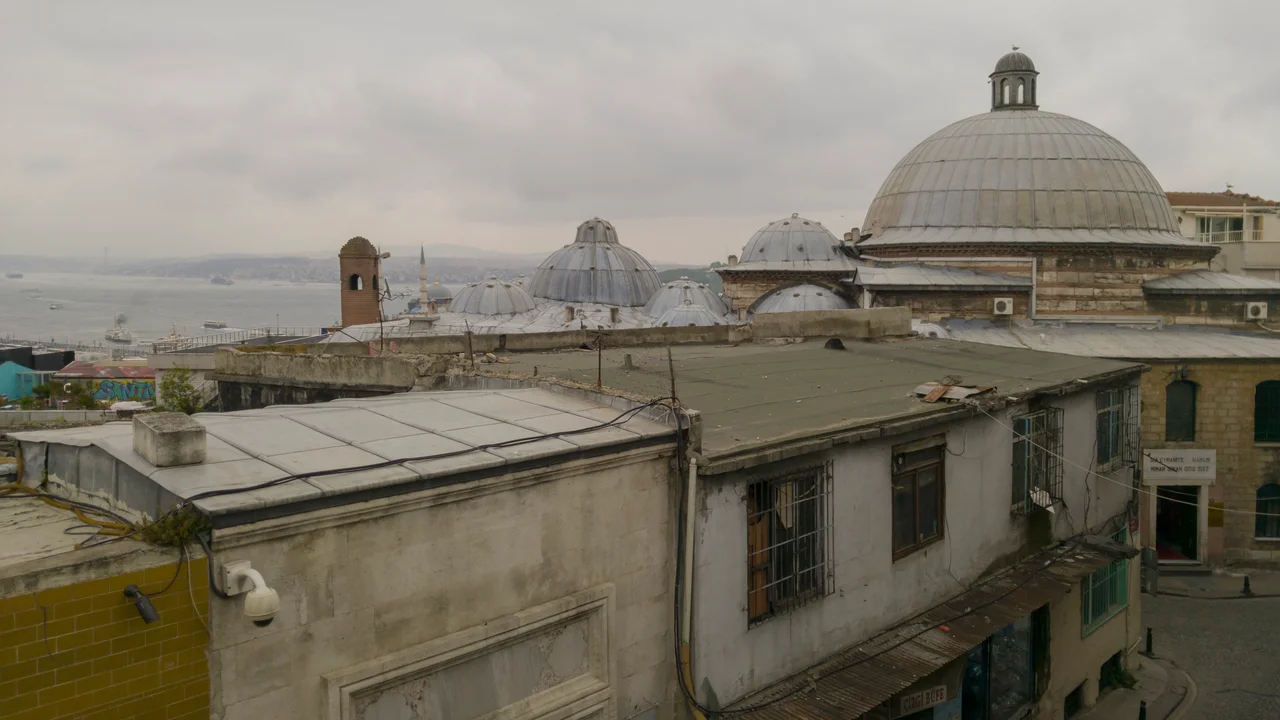

Süleymaniye Hamam
The workers from the nearby foundries called it the metalworkers' bath. They came here with the soot of the forge still on them, filing through the arched entrance of a building that Mimar Sinan — the same architect who designed the great mosque looming above — had built in 1557. The Süleymaniye Hamam was never meant to be a place of contemplation or pilgrimage. It was a place of washing, of the body made clean, of the ritual and the practical fused in the way that Ottoman urban design so often managed. That it still operates today, more than four and a half centuries later, says something about the durability of both the building and the need it serves.
Sinan's Practical Masterpiece
When Sultan Suleiman the Magnificent commissioned Mimar Sinan to build the great mosque complex on Istanbul's third hill, he asked for more than a place of worship. The *külliye* — the complex surrounding the mosque — was to include schools, a hospital, a public kitchen for the poor, a caravanserai, and public baths. The hamam was part of that total vision of an Ottoman city in miniature. Sinan built it on a hill facing the Golden Horn, the arched and domed structure fitting into the slope with the confident geometry that defined his work. The walls are decorated with elaborate marble inlay. The building follows the traditional three-part structure of a Turkish bath: the cold room (*soğukluk*), the warm room (*ılıklık*), and the hot room (*sıcaklık*), each serving a distinct phase of the bathing ritual. In the hot section, temperatures can reach levels that open the pores and ease the muscles in ways that still feel extraordinary after the walk up from the city below.
The Architect Who Bathed Here
Sinan did not just design the hamam and move on. According to tradition, he lived near the mosque complex from 1557 until 1588 — more than three decades — and a private cubicle within the bathhouse is said to have been reserved for his personal use during those years. That cubicle is still preserved. Think about what that means: the greatest architect of the Ottoman classical period, the man who designed more than four hundred structures across the empire, returning to this same bathhouse year after year, watching the steam rise through the domed ceiling he had designed, hearing the water run through channels he had engineered. Another private cubicle in the complex was originally reserved for the sultan himself; in later years it was used by high-ranking theological scholars. The hamam thus held, under the same roof, the architect, the sultan, the scholar, and the metalworker — a democratic quality that the Ottoman bath tradition cultivated.
A Living Tradition
The Süleymaniye Hamam is notable for a practice that would have been unthinkable in its original form: today it is the only hamam in Istanbul where men and women bathe together. In the Ottoman bathhouse tradition, gender separation was absolute — women and men bathed at entirely separate times or in entirely separate sections, and the social codes around the hamam were strictly observed. The present arrangement reflects not just modern attitudes but a shift in the hamam's clientele, which has moved largely toward visitors rather than the neighborhood regulars who once gave the metalworkers' bath its name. Male attendants called *tellak* look after all the clients — another change from the past, when female attendants served women's sections. The hamam's longevity has required accommodation and reinvention, even as the bones of the building remain Sinan's.
Steam, Marble, and the Golden Horn View
There is a particular quality to the light inside a well-designed hamam. It falls from small circular skylights in the domes, filtered and diffused, landing on marble that has absorbed centuries of warmth. The Süleymaniye Hamam's interior is still dressed in that elaborate marble inlay Sinan specified, the patterns worn smooth by generations of hands and water. Outside, the building occupies its hillside position with a kind of quiet authority, the domes echoing in miniature the great dome of the mosque above. The Golden Horn stretches to the north, and on clear days the view from the hill extends across the water to the newer parts of the city. Between the steam of the bath and the scope of that view, the hamam offers what the best Ottoman public buildings always offered: a place that is simultaneously intimate and connected to something much larger.
From the Air: The Third Hill of Istanbul
The Süleymaniye Hamam sits at approximately 41.02°N, 28.97°E, just below and adjacent to the great Süleymaniye Mosque complex on Istanbul's third hill. From the air at 2,000 to 4,000 feet, the mosque's four minarets and central dome make this one of the most distinctive landmarks on the Istanbul skyline — a cascade of domes descending toward the Golden Horn, with the hamam tucked into the complex's lower edge. The hill drops northward to the Golden Horn waterway, visible as a broad inlet cutting west from the Bosphorus. Nearest airport: LTFM (Istanbul Airport) on the European side, approximately 40 kilometers to the northwest. The historic peninsula's cluster of major monuments — Süleymaniye, Hagia Sophia, the Blue Mosque — is visible as a coherent grouping from altitude.
From the Air
The Süleymaniye Hamam is at approximately 41.02°N, 28.97°E, integrated into the Süleymaniye Mosque complex on Istanbul's third hill. The mosque's four minarets are the primary visual reference from the air; the hamam lies at the complex's lower (northern) edge, facing the Golden Horn. Recommended viewing altitude: 2,000–4,000 feet. Nearest airport: LTFM (Istanbul Airport), approximately 40 km northwest.
Nearby Stories
- Kocaeli Peninsula 7.6 km away
- Second Battle of Çatalca 11 km away
- Istanbul's Rural Outskirts 14 km away
- MV Struma 20 km away
- HMAS AE2 36 km away
- Bursa 66 km away
- Sangarius Bridge 71 km away
- Januarius MacGahan 101 km away