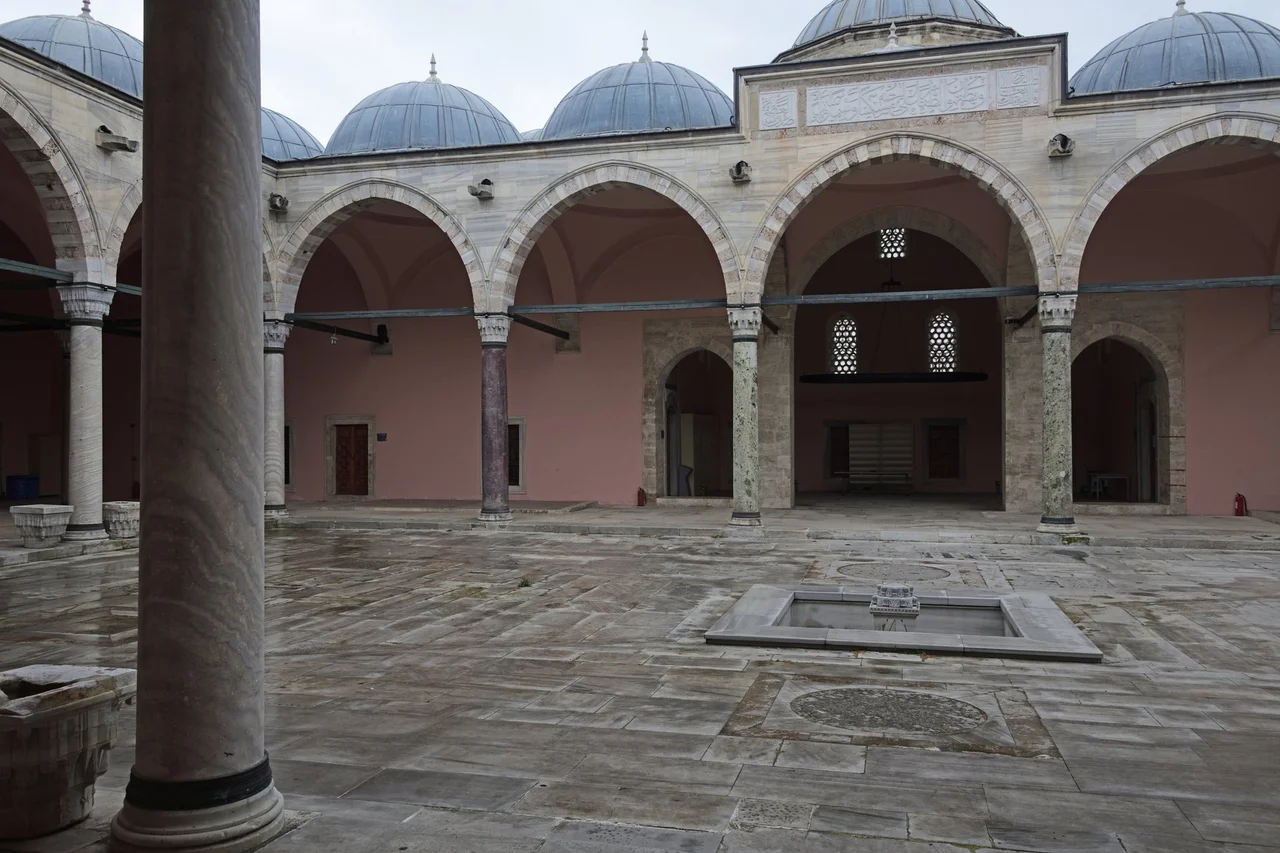

Süleymaniye Mosque
Suleiman the Magnificent is said to have thought of himself as a second Solomon. He commissioned a mosque that would outshine the Hagia Sophia — which itself had been built to outshine the Temple of Solomon. Ambition layered upon ambition, stone upon stone, each civilization trying to exceed the last. And so Mimar Sinan, the greatest architect of the Ottoman classical period, climbed Istanbul's third hill and began. The mosque he completed between 1550 and 1557 did not merely meet the sultan's ambitions. It redefined them. The Süleymaniye Mosque is not the most famous structure in Istanbul — that distinction still belongs to the nearby Hagia Sophia — but many who study Ottoman architecture consider it the more perfect achievement: disciplined where Hagia Sophia sprawls, harmonious where the Byzantine church overwhelms.
The Architect and the Sultan
The relationship between Suleiman the Magnificent and Mimar Sinan is one of the great patron-architect pairings in history. Sinan had already designed the Şehzade Mosque, built in memory of Suleiman's beloved son Crown Prince Mehmed. The sultan was so moved by the result that he asked Sinan to design a mosque for himself — one that would represent the pre-eminence of the Ottoman Empire at its height. Suleiman controlled at the time of the mosque's construction an empire that stretched from Hungary to the Gulf, from the Crimea to the borders of Persia. He had forced the Safavids to make political concessions in the Treaty of Amasya in 1555. He championed orthodox Sunni Islam as the ideological pillar of his rule. The mosque he envisioned was to be all of these things made solid: a theological statement, a political demonstration, and an architectural masterwork. Sinan gave him all three.
Stone from the Hippodrome
Construction began with an act of organized pillage. Marble was gathered from ancient sites across Constantinople and shipped to the building site. A contemporary observer, Petrus Gyllius, watched as one of the four enormous porphyry columns destined for the mosque's interior was cut down to size, and as marble columns were taken from the Hippodrome — that great Roman stadium that had once been the beating heart of Byzantine public life. The foundation date inscribed above the entrance reads 1550; the inauguration date reads 1557. But the final construction expenses were not settled until 1559, and Suleiman's own mausoleum, built behind the mosque after his death in 1566, was completed by his son Selim II between 1566 and 1568. The building that stands today represents nearly two decades of continuous royal effort, assembled from the bones of earlier civilizations and shaped by Sinan's uncompromising vision.
The Logic of the Dome
Standing inside the prayer hall, the mathematics of the space become immediately apparent even to an untrained eye. The central dome rises 53 meters high and spans 26.5 meters — exactly half the height as diameter, a proportion that gives the interior an extraordinary sense of balance. Semi-domes extend before and behind, covering the central space, while smaller domes cascade down the aisles on either side. The arrangement echoes the Hagia Sophia's great covered nave, but Sinan's refinement is decisive: he hid the massive supporting buttresses within the outer walls, so that from inside, the dome appears to float without visible support. Light floods through windows in the tympana between the domes. The effect is one of weightlessness and clarity. Sinan's calligrapher, Hasan Çelebi, inscribed the walls and pillars in monumental thuluth script, and Iznik tiles — mainly blue, turquoise, red, and black on white — ring the mihrab. The deliberate restraint of the decoration was itself a statement: Suleiman championed an austere Sunni orthodoxy, and the mosque's visual character reflects it.
Fire, Earthquake, and the Long Work of Restoration
The mosque has not had an easy five centuries. The great fire of 1660 damaged it and required restoration under Sultan Mehmed IV. The earthquake of 1766 brought part of the dome down. Repairs in the nineteenth century altered what remained of Sinan's original painted decoration — cleaning in the twentieth century revealed that Sinan had initially experimented with blue before settling on red as the dominant dome colour, a detail that had been obliterated by later hands. During World War I, the courtyard was used as a munitions depot; ammunition ignited, causing another fire. The mosque was not fully restored until 1956. More recently, cement-based mortars applied in mid-century repairs were found to be damaging the original stone, requiring painstaking removal and replacement with compatible materials. Each restoration has been an argument about authenticity and survival. Today the mosque is part of the UNESCO World Heritage Site "Historic Areas of Istanbul." Sinan's tomb, placed just outside the complex's north wall, has stood since the architect's death in 1588.
A City Within a City
The Süleymaniye was never just a mosque. Suleiman built it as a *külliye* — a religious and charitable complex that functioned as a complete urban institution. The original ensemble included four madrasas, a primary school, a medical school, a hospital, a public kitchen that fed the poor, a caravanserai for travelers, a bathhouse, a specialized school for the study of hadith, and rows of small shops whose revenues supported the whole. Many of these buildings still stand. The former public kitchen is now a restaurant. What was once the hospital is now a printing factory. The market street created by the shops fronting the madrasas was called the *Tiryaki Çarșısı* — the Antidote Market — because it once housed coffee houses and establishments devoted to the smoking of hashish. Behind the mosque's southeast wall, in an enclosed cemetery, lie the octagonal mausoleums of Suleiman himself and his wife Hürrem Sultan. The mausoleum of Suleiman, completed in 1567, contains the earliest known Iznik tiles decorated with the bright emerald green that would later become a hallmark of that ceramic tradition.
From the Air: Crown of the Third Hill
No landmark on Istanbul's historic skyline is more immediately recognizable from the air than the Süleymaniye. Four minarets rise from the corners of the courtyard — the two taller inner ones with three balconies each, their total of ten balconies said to reflect Suleiman's status as the tenth Ottoman sultan. The central dome, flanked by its cascading semi-domes, creates an almost pyramidal silhouette that dominates the third hill at approximately 41.02°N, 28.96°E. From 5,000 feet, the mosque sits within a coherent cluster of monuments: Hagia Sophia and the Blue Mosque to the southeast on the historic peninsula's tip, the Golden Horn waterway stretching westward below. The tomb of Sinan is just north of the complex walls — an architect buried beside his greatest work. Nearest airport: LTFM (Istanbul Airport), approximately 40 kilometers northwest. On approach from the Marmara or the Bosphorus, the Süleymaniye is the first major dome that announces the old city.
From the Air
The Süleymaniye Mosque occupies Istanbul's third hill at approximately 41.02°N, 28.96°E. Its four minarets and cascading dome profile make it one of the most recognizable landmarks from the air on the entire European shore. Best viewed at 2,000–5,000 feet on approach from the Bosphorus or the Sea of Marmara. Nearest airport: LTFM (Istanbul Airport), approximately 40 km northwest. Hagia Sophia is visible approximately 1.2 km to the southeast.
Nearby Stories
- Kocaeli Peninsula 7.6 km away
- Second Battle of Çatalca 11 km away
- Istanbul's Rural Outskirts 14 km away
- MV Struma 20 km away
- HMAS AE2 36 km away
- Bursa 66 km away
- Sangarius Bridge 71 km away
- Januarius MacGahan 101 km away