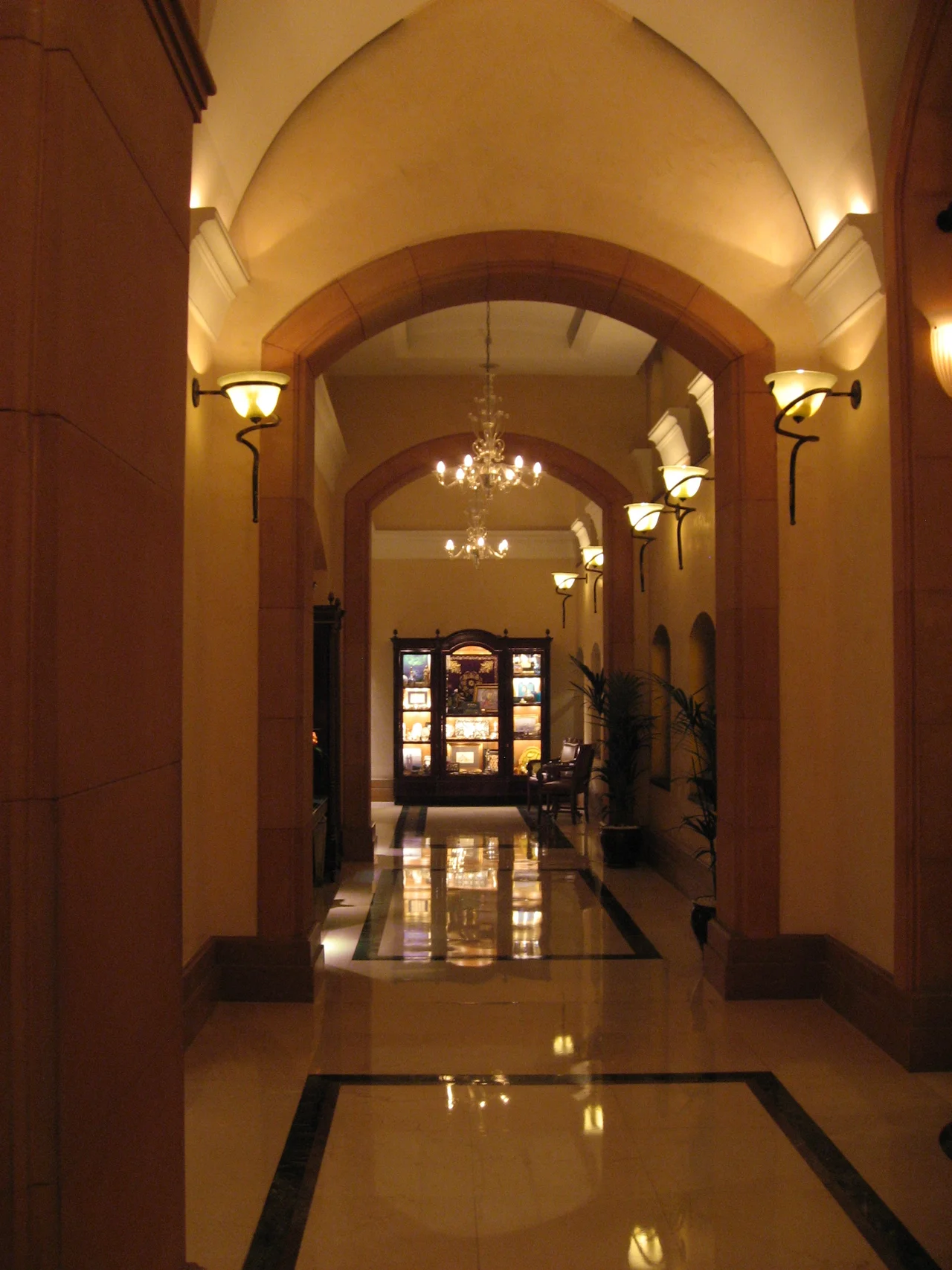

Sultanahmet Jail
In 1938, the poet Nâzım Hikmet was brought to Sultanahmet Jail. He had been sentenced to twenty-eight years in prison — a sentence that was, for all practical purposes, an attempt to silence one of the most powerful literary voices in the Turkish language. He was held here, and then again briefly in 1950. He was not alone. Across the decades of the jail's operation, writers, journalists, humorists, and political figures passed through its four stories and guard towers on the historical peninsula of Istanbul. The building they were held in still stands. Today it is a luxury hotel. That fact is not simple, and it should not be treated as one.
The First Modern Jailhouse of the Capital
Constructed in 1918 and 1919, the Sultanahmet Jail was built as the first modern jailhouse in the capital of the Ottoman Empire, in a period of acute imperial crisis — the empire was fighting on multiple fronts in the final years of World War I, and its social fabric was under extreme strain. The building was designed in the Turkish neoclassical style of a period called the "First National Architecture," a conscious effort to create a distinctively Ottoman-Turkish architectural identity in the waning years of the empire. An inscription in Ottoman Turkish above the main gate named the facility the "Dersaadet Murder Jail" — *Dersaadet* being an Ottoman name for Constantinople. It was built adjacent to a courthouse that had originally been constructed as a university in 1845. Four stories high, with guard towers enclosing a central courtyard, the jail was conceived with a contemporary philosophy: to regulate the daily life of inmates and maintain their connection to the outside world, for those awaiting trial or serving brief sentences. In practice, the people held here included some of the twentieth century's most significant Turkish literary and political figures.
The Writers in the Cells
The Wikipedia article's own phrasing is precise: Sultanahmet Jail "served mostly as a prison reserved for writers, journalists, artists as intellectual dissidents sentenced." Behind that spare sentence lies the accumulated weight of individual lives. Nâzım Hikmet, Turkey's most celebrated modern poet, was held here in 1938/1939 and again in 1950 — imprisoned for his communist beliefs and his refusal to be silent. The novelist Orhan Kemal, the humorist Aziz Nesin, the novelist Kemal Tahir, the writer Rıfat Ilgaz: these were people who had devoted their lives to language, to storytelling, to the work of making meaning. Their confinement in these cells was not incidental to their identities — it was in many cases a direct consequence of what they had written. Juveniles and women were also detained here at various times. The jail closed as an active civilian facility on January 25, 1969, when inmates were transferred to a newer prison; during the subsequent period of military rule it was used as a military jailhouse. Graham Greene mentioned the place in his 1932 thriller *Stamboul Train* — at that point the building's reputation already reached beyond Turkey's borders.
What the Conversion Asks of Us
In 1992, after years of neglect, the building was redeveloped as a luxury hotel. The original plan was to open it as The Regent Istanbul; after Four Seasons Hotels & Resorts acquired the Regent brand in 1992, the project was rebranded and opened in 1996 as the Four Seasons Hotel Istanbul at Sultanahmet. The hotel underwent comprehensive renovation and reopened in December 2021. It is, by all accounts, a beautiful property — the historic architecture preserved, the cells transformed into guest rooms, the courtyard open to the sky. The transformation raises questions that the American poet Myra Shapiro addressed directly in her poem "For Nazim Hikmet in the Old Prison, Now a Four Seasons Hotel," included in *The Best American Poetry 2003*. The poem does not answer those questions, which is appropriate. What does it mean to sleep in comfort where someone suffered for their art? What does it mean that the building survives while the political pressures that filled it with writers have not entirely disappeared? These are not questions that a hotel brochure can resolve.
The Building and Its Memory
The Four Seasons Hotel at Sultanahmet does not feature a pool or spa on the property; guests who want those facilities take a shuttle to the hotel's sister property on the Bosphorus. What the Sultanahmet property has instead is location and architecture — the former jail sits within walking distance of Hagia Sophia, the Blue Mosque, and Topkapı Palace, in the densest concentration of historical monuments anywhere in the city. The building's history is not hidden. The courtyard that was once surrounded by guard towers is now a garden. The four-story structure that once housed the Dersaadet Murder Jail now houses hotel guests. The inscription above the main gate presumably still reads what it always read. The structure of confinement and the structure of hospitality turn out to require not entirely different architectures. What is different is who chooses to be there, and why, and whether they are free to leave.
From the Air: The Historic Peninsula's Southern Edge
Sultanahmet Jail — now the Four Seasons at Sultanahmet — sits at approximately 41.01°N, 28.98°E, in the Sultanahmet neighborhood of the Fatih district, on the historic peninsula that juts into the Sea of Marmara. From the air at 2,000 to 4,000 feet, the building is surrounded by extraordinary context: the domes and minarets of the Blue Mosque are immediately to the west, Hagia Sophia is just to the north, and Topkapı Palace occupies the promontory to the northeast. The Sea of Marmara glitters to the south, the Bosphorus to the east. This is the most historically concentrated square kilometer in Istanbul, and the former jail is embedded in its center. Nearest airport: LTFM (Istanbul Airport), approximately 40 kilometers northwest on the European shore.
From the Air
The former Sultanahmet Jail (now Four Seasons Hotel at Sultanahmet) is at approximately 41.01°N, 28.98°E on Istanbul's historic peninsula, in the Sultanahmet neighborhood. The site is surrounded by major landmarks: the Blue Mosque to the west, Hagia Sophia to the north, Topkapı Palace to the northeast. Recommended viewing altitude: 1,500–3,000 feet to distinguish individual monuments on the peninsula. Nearest airport: LTFM (Istanbul Airport), approximately 40 km northwest.
Nearby Stories
- Kocaeli Peninsula 7.6 km away
- Second Battle of Çatalca 11 km away
- Istanbul's Rural Outskirts 14 km away
- MV Struma 20 km away
- HMAS AE2 36 km away
- Bursa 66 km away
- Sangarius Bridge 71 km away
- Januarius MacGahan 101 km away