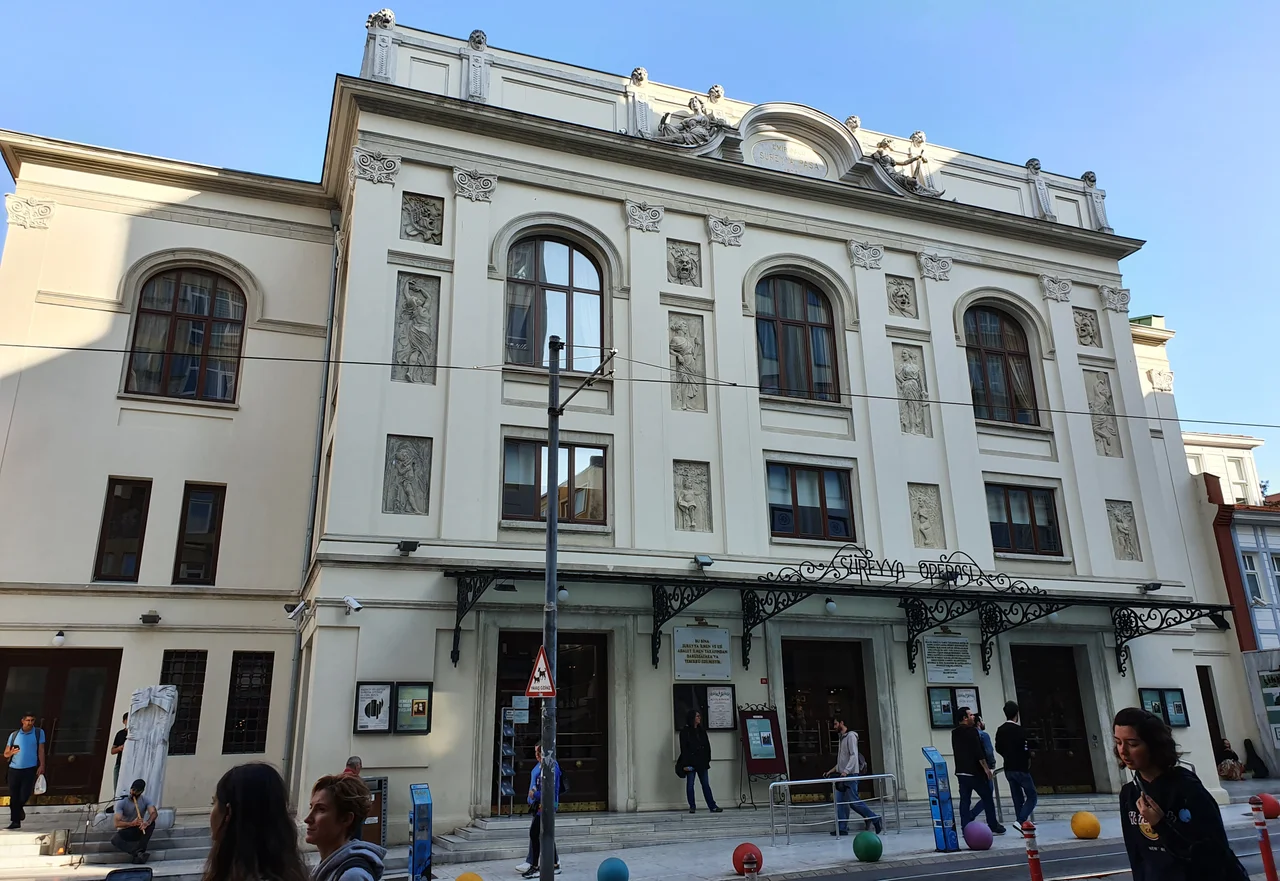

Süreyya Opera House
Süreyya İlmen had a dream that took eighty years to come true. As a deputy representing Istanbul in the early Turkish Republic, he commissioned an opera house for Kadıköy — a grand venue on the Asian side of the Bosphorus that would bring serious musical culture to a district that had none. He hired Ottoman Armenian architect Kegham Kavafyan, who delivered an elegant building in 1927. Then reality intervened: the stage was unfinished, the dressing rooms didn't exist, and no one could stage an operetta there. For the next eight decades, the Süreyya was many things — a theatre for plays, a cinema that screened the talkies when they arrived in 1930, a beloved neighborhood institution with a storied management. The opera it was always meant to be didn't arrive until December 14, 2007, when the oratorio *Yunus Emre* rang out through the restored hall. Süreyya Pasha had been dead for fifty-two years by then. But the building was still standing, still beautiful, still waiting.
A Commission and Its Complications
Süreyya İlmen wanted something that Kadıköy — the busy, cosmopolitan district on Istanbul's Asian shore — had never had: a proper musical theatre. He engaged Kegham Kavafyan, a skilled Ottoman Armenian architect working in the late period of that tradition, and the result was a building of genuine elegance. The facade carried sculpted decoration; inside, the ceilings and walls were painted with frescos in a style that suited the era's taste for ornate cultural spaces. The problem was that by the time the building opened in 1927, the stage remained incomplete and no provision had been made for artists' dressing rooms. The absence of basic theatrical infrastructure meant that the operettas İlmen had envisioned were simply impossible to perform. The venue opened to plays — legitimate theatre, but not what had been planned — while the stage situation quietly remained unresolved.
From Opera House to Cinema
The pivot came in 1930, when technical equipment for screening sound films was installed and the building was renamed Süreyya Sineması — Süreyya Cinema. As a cinema, it thrived. Its first manager was Hikmet Nâzım, father of the poet Nâzım Hikmet, whose own fame would far outlast his father's tenure at the box office. For decades, the Süreyya was one of Kadıköy's defining institutions — the kind of neighborhood cinema that people remember the way they remember specific smells or songs. İlmen himself donated the building in 1950 to the Darüşşafaka Cemiyeti, a charitable organization supporting the education of orphaned children in poverty, with the condition that he and his wife receive its revenues during their lifetimes. He died in 1955; his wife Adalet İlmen in 1966. After that, the building belonged entirely to the foundation — and to the question of what it was actually for.
Restoration and Reopening
The decision to restore the Süreyya and transform it into the opera house it was always meant to be came with the 2000s. Construction lasted nearly two years and cost approximately 14 million YTL, roughly nine million dollars at the time. Workers restored the frescos on the ceilings and walls, repaired the sculpted facade, and — critically — finally completed the stage infrastructure that had been missing since 1927. On December 14, 2007, the restored Süreyya Opera House opened with a performance of Ahmet Adnan Saygun's oratorio *Yunus Emre* (Opus 26). Saygun had composed the work decades earlier; its premiere at Süreyya carried a particular resonance, a sense of long-deferred things finally arriving. The ballroom on the second floor can accommodate 500 guests. The opera house became home to the Istanbul State Opera and Ballet, with opera and ballet performances staged three days a week.
An Asian Shore with European Ambitions
Kadıköy occupies an unusual position in Istanbul's cultural geography. On the Asian side of the Bosphorus, it has long had the feel of a distinct city within a city — denser, more bohemian in character than many European-side neighborhoods, with a strong local identity and a slightly different pace. The Süreyya fits this context precisely: it is not a grand institutional building aimed at international prestige, but a neighborhood opera house, scaled to its surroundings. Walking along Gen. Asım Gündüz Avenue and encountering the facade, visitors often express surprise at finding something so formally handsome in what feels like an ordinary commercial street. That contrast is part of what makes the building work. It belongs to Kadıköy in a way that a more monumental venue never could, and Kadıköy, in turn, has taken genuine ownership of it.
From the Air
The Süreyya Opera House sits at 40.988°N, 29.029°E in the Bahariye quarter of Kadıköy, on Istanbul's Asian shore. Flying into LTFJ (Sabiha Gökçen International Airport, approximately 25 km to the east-southeast), the Kadıköy waterfront is a prominent landmark below — the ferry docks, the busy market streets, and the hillside neighborhoods rising behind them. The opera house is a few blocks inland from the shore, in the dense residential-commercial grid of central Kadıköy. At 2,000 feet on approach from the east, the Bosphorus comes into full view to the west, with the European skyline — including the minarets of the old city — visible across the water. Clear weather provides views of both continents simultaneously.
Nearby Stories
- Kocaeli Peninsula 7.6 km away
- Second Battle of Çatalca 11 km away
- Istanbul's Rural Outskirts 14 km away
- MV Struma 20 km away
- HMAS AE2 36 km away
- Bursa 66 km away
- Sangarius Bridge 71 km away
- Januarius MacGahan 101 km away