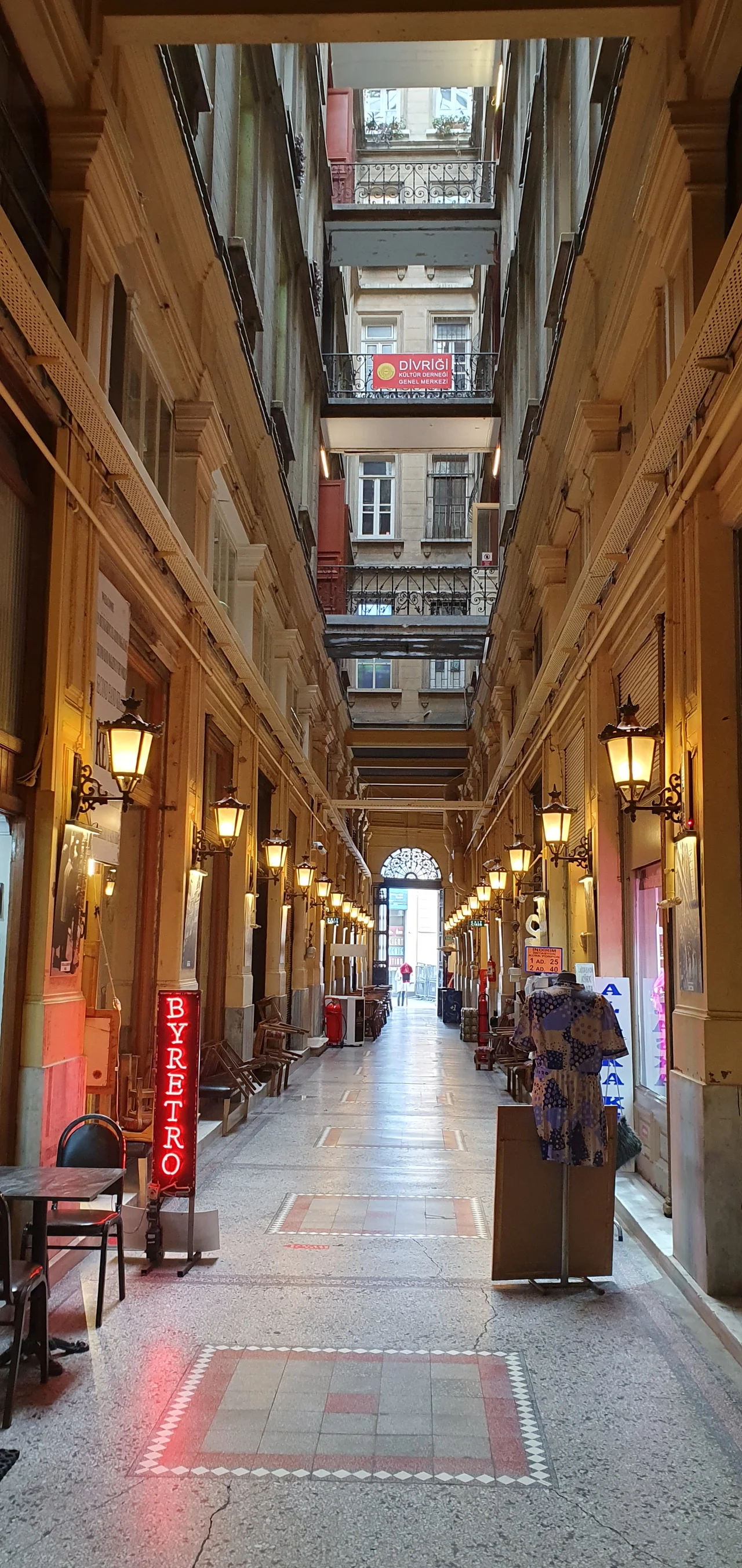

Suriye Pasajı
Step off İstiklal Avenue into the Suriye Pasajı and the noise of the street fades almost immediately. The arcade at number 166 was built in 1908, designed by Greek architect Demetre Th. Bassiladis in the neoclassical style that Beyoğlu's developers favored at the turn of the century, when this part of Istanbul was still called Pera and considered itself as much European as Ottoman. Six storeys of worn stone, dim corridors, and layered history rise above you. Known in French as the Cité de Syrie — the Syria Arcade — the building has housed dozens of lives over its century-plus of existence: newspapers in three languages, a cinema that opened in 1911, leather merchants, antique dealers, families, and offices for communities that Istanbul has largely dispersed or lost. It is not a polished tourist destination. It is something more interesting: a building that has simply continued existing, absorbing whatever the city brought to its doors.
Pera's Multilingual Press
For much of the twentieth century, the Suriye Pasajı was a working address for Istanbul's minority communities. The Stamboul, a French-language newspaper printed continuously from 1875 to 1964, had its headquarters inside the arcade — an institution that lasted nearly ninety years in a city that was changing rapidly around it. The Greek-language daily Apoyevmatini and the Armenian paper Nor Marmara also maintained offices in the building, well into the early 2010s. These newspapers served communities whose presence in Istanbul stretched back centuries but whose numbers had been dramatically reduced by the upheavals of the twentieth century — the population exchanges, the emigrations, the 1955 pogrom. The building that housed their editorial offices was, in a quiet way, a record of who had once been here and who was still, improbably, holding on. The arcade's thick stone walls absorbed a century of those stories without much comment.
The Cinema in the Arcade
In 1911, three years after the building opened, a cinema called Santral Sineması — Cine Central — began operating inside the arcade. Early cinema in Beyoğlu was an institution: the neighborhood's cosmopolitan population took to film culture with enthusiasm, and the pasaj offered a useful address for a venue that wanted to be central without being on the main street. The cinema became part of the Suriye Pasajı's layered character, one more use stacked onto a building that already contained offices, residences, and shops. It didn't last indefinitely — Istanbul's cinema landscape transformed repeatedly across the century — but its existence in 1911 speaks to the ambition the building's designers had for it: this was meant to be a busy, multifunctional place at the heart of a cosmopolitan neighborhood.
A Hundred Years of Mixed Use
What makes the Suriye Pasajı unusual is not any single dramatic moment in its history but the sheer continuity of its use. Individuals, families, businesses, and offices belonging to many different cultures have passed through its doors for more than a century. Today the building holds an antique and second-hand shop in the basement — the kind of place where patient browsing sometimes yields genuine finds — alongside leather and fur shops, coffee and tea houses, a nightclub, and restaurants. Some of those cafes and restaurants have expanded into the arcade's corridors in ways that raise concerns about the building's historic fabric, but the corridor life is also part of what keeps the place breathing. The Suriye Pasajı has never been a museum of itself. It has been too busy being used for that.
Off the Main Street, into the City
İstiklal Avenue, the long pedestrian spine of Beyoğlu, draws enormous crowds daily — a river of people moving between Taksim Square and the Galata Tower neighborhood. The pasajlar that branch off İstiklal are the city's way of creating depth in what might otherwise be a linear experience. Step into the Suriye Pasajı from the bustle of number 166 and you enter a different register of Istanbul: quieter, stranger, older. The neoclassical facade that Bassiladis designed still reads clearly, even worn by time. Inside, the scale shifts — six floors of activity arranged around a central corridor, the sounds of the street replaced by the more particular sounds of people going about their actual lives. That contrast, repeated in different forms across dozens of Beyoğlu arcades, is one of the things that makes this part of Istanbul irreplaceable. The Suriye Pasajı is not the grandest of them, but it may be among the most honestly itself.
From the Air
Suriye Pasajı stands at 41.030°N, 28.975°E in the Asmalımescit subdistrict of Beyoğlu, on Istanbul's European side. It lies a short distance south of Taksim Square, along İstiklal Avenue. Flying into LTFM (Istanbul Airport, approximately 35 km to the northwest), the Beyoğlu ridge is visible as the densely built-up promontory north of the Golden Horn, with the distinctive tower of Galata marking its southern end. At 1,500 feet approaching from the northwest, the straight line of İstiklal Avenue can sometimes be traced through the roofscape. The Bosphorus is visible to the east, and on clear days the Princes' Islands appear in the Sea of Marmara to the south.
Nearby Stories
- Kocaeli Peninsula 7.6 km away
- Second Battle of Çatalca 11 km away
- Istanbul's Rural Outskirts 14 km away
- MV Struma 20 km away
- HMAS AE2 36 km away
- Bursa 66 km away
- Sangarius Bridge 71 km away
- Januarius MacGahan 101 km away