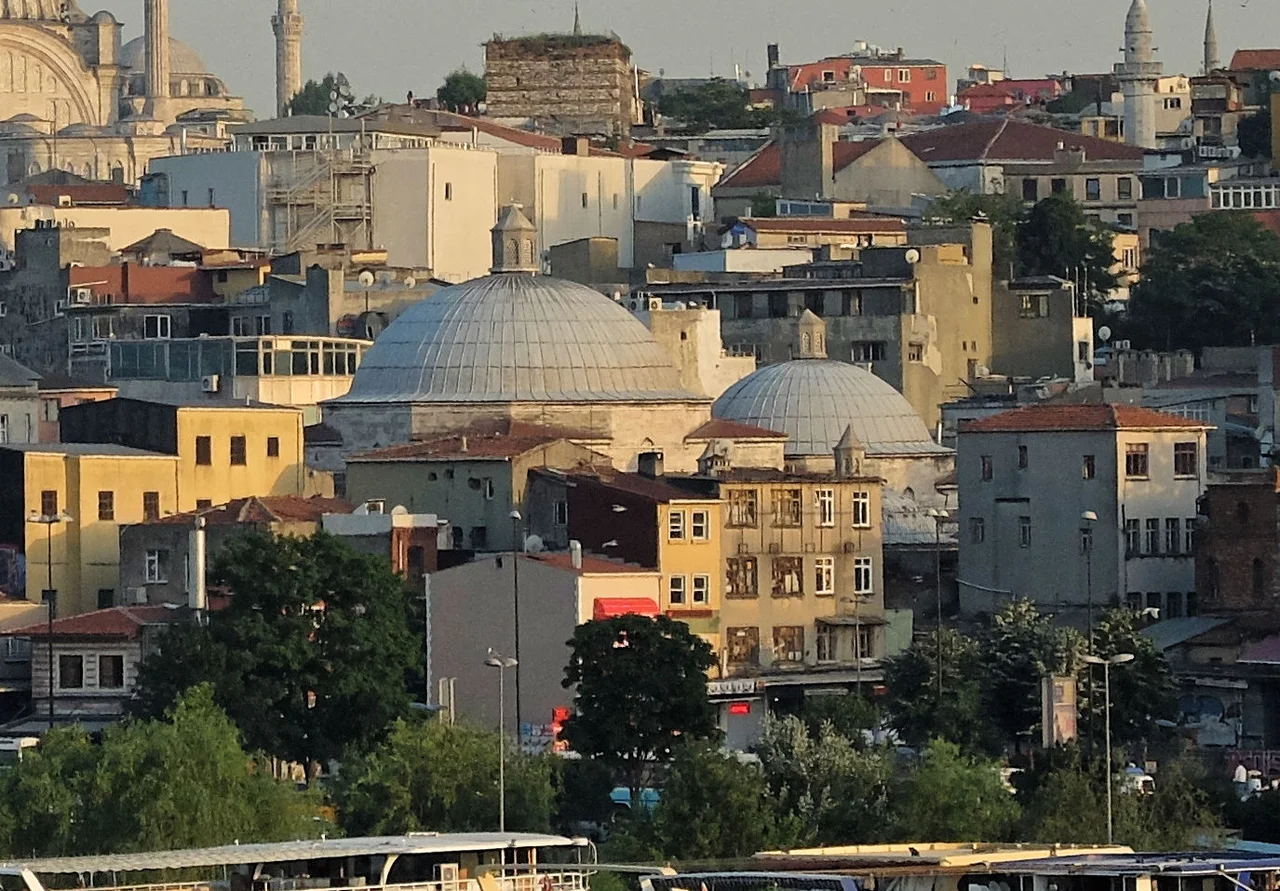

Tahtakale Hamam
The Ottomans moved quickly after the conquest. In 1453, Mehmet II took Constantinople and immediately set about transforming it into an imperial capital — building palaces, mosques, and the infrastructure of a great city. Among the earliest things he built was a hamam: a public bathhouse in the Tahtakale district, between what would become the Grand Bazaar and the busy waterfront of Eminönü. The Tahtakale Hamam appears in the waqf document of the Fatih Mosque dated to 1470-1471, which places its construction sometime between 1453 and that year. Turkish architectural scholar Doğan Kuban argues it was probably built at the same time as the Eski Saray — the Old Palace — just after the conquest, which would make it the oldest surviving hamam structure in Istanbul. It has endured five and a half centuries, an 1894 earthquake, a major neighborhood fire in 1911, and several decades of use as a cold-storage depot for food. It survives.
Designed for the New Capital
The Tahtakale Hamam was built as a double hamam — separate sections for men and women, each with their own sequence of spaces moving from cool to hot. This was standard Ottoman design, but the execution here was unusually refined. The men's hot room features a large central dome flanked by four smaller rooms on either side, nearly all covered with their own domes, plus four halvets: private bathing areas reserved for special guests. Giving a neighborhood bathhouse four private suites was a mark of ambition. The main changing room's dome measures nearly 17 meters in diameter, with muqarnas squinches at the corners — decorative stalactite-like carvings similar to those found in the great hamams of Edirne and Bursa built during the same period. From the rooftops nearby, the building's silhouette is still striking: a cluster of domes punched through with pierced skylights and lanterns, rising above the busy market streets below.
Centuries of Survival
The neighborhood around the Tahtakale Hamam has been one of Istanbul's most commercially active quarters for centuries — a dense zone of traders, merchants, and market life wedged between the Grand Bazaar and the Galata Bridge waterfront. The hamam served this community through the Ottoman period and into the republican era. It survived the 1894 Istanbul earthquake, which caused widespread damage across the city, and a significant fire in 1911 that swept through the area. What it did not survive intact was the twentieth century's indifference to its purpose. At some point the building was repurposed as a cold-storage and cheese depot — its thick stone walls and insulating domes presumably making it practically useful for refrigeration. The consequences were severe. A large section of the interior was destroyed and replaced with concrete floors. Only part of the former men's baths and the cold room of the former women's section remained standing.
Restoration and New Life
The restoration carried out in the late 1980s brought the Tahtakale Hamam back from the edge of structural loss. Workers could not reconstitute what had been destroyed — the concrete interventions had taken too much — but they preserved and reconstructed what remained. The building's floor plan was largely restored, the domed sequence of spaces made legible again, the imposing entrance portal with its muqarnas decoration rebuilt. Today the structure functions as a local shopping centre and cafe, which is not the most romantic possible afterlife for a 15th-century monument, but it is at least a living one. The alternative — continued decay or demolition — was the fate of many comparable buildings across the city. The Tahtakale Hamam is worn and adapted, but it is still there, still visible from the surrounding rooftops by the distinctive crowning of its domes.
Between the Bazaar and the Water
The Tahtakale neighborhood sits at the intersection of Istanbul's oldest commercial energies. Walk east from the Grand Bazaar, past the Kapalı Çarşı's outer walls and the spice vendors of the Mısır Çarşısı — the Egyptian Bazaar — and you arrive in a district where commerce has been continuous for centuries. The Rüstem Pasha Mosque, Sinan's masterpiece of tile-covered interior space, stands nearby, its entrance elevated above street level to accommodate the market stalls that occupy the ground floor. The Tahtakale Hamam is part of this same fabric: a building that has served the people who live and work and trade in this corner of the city since the city was first Ottoman. Its stones carry the layered weight of that history — conquest, commerce, decline, restoration — in a district that has never stopped being busy enough to matter.
From the Air
The Tahtakale Hamam is located at 41.018°N, 28.968°E in the Tahtakale neighbourhood of Fatih, on Istanbul's European peninsula. It sits between the Grand Bazaar to the west and the Eminönü waterfront to the northeast, in the dense historic core of the old city. Flying into LTFM (Istanbul Airport, approximately 40 km northwest), the approach over the city at lower altitudes reveals the historic peninsula as a concentrated mass of domes and minarets — the Süleymaniye Mosque dominates the ridge just to the northwest of the hamam's location. At 1,500 feet, the Golden Horn separates the old city from Beyoğlu to the north. The Galata Bridge is a useful navigational landmark; the hamam sits roughly 500 meters to its west-southwest.
Nearby Stories
- Kocaeli Peninsula 7.6 km away
- Second Battle of Çatalca 11 km away
- Istanbul's Rural Outskirts 14 km away
- MV Struma 20 km away
- HMAS AE2 36 km away
- Bursa 66 km away
- Sangarius Bridge 71 km away
- Januarius MacGahan 101 km away