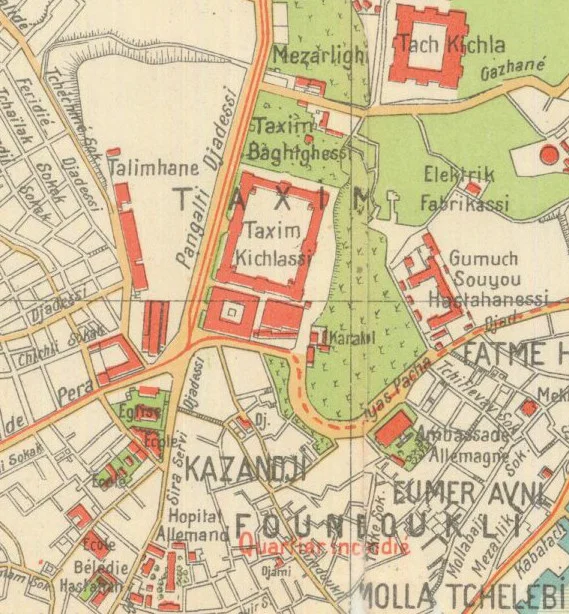

Taksim Military Barracks
The barracks are gone, and have been since 1940. What stands in their place is a small park — Gezi Parkı — a modest patch of green beside the vast concrete expanse of Taksim Square. The Halil Pasha Artillery Barracks, which Ottoman authorities built in 1806, stood on this ground for over a century before being demolished to make room for the park and the reorganized square designed by French architect Henri Prost. The demolition was unremarkable at the time, one among many interventions reshaping Istanbul in the republican era. What no one could have predicted was that in 2013, a proposal to rebuild those long-vanished barracks on the same ground — converting them into a shopping mall with cultural spaces and a mosque — would bring hundreds of thousands of people into the streets of cities across Turkey, and that the police response to those protests would leave people dead and thousands injured.
From Artillery Barracks to Football Pitch
The Halil Pasha Artillery Barracks served their military purpose for a century before other uses began to accumulate within their walls. In 1909, during the political turmoil of the 31 March Incident, the barracks suffered considerable damage. They were not immediately repaired. By 1921, the internal courtyard had been converted into the Taksim Stadium — the first football stadium in Turkey — where Beşiktaş, Galatasaray, and Fenerbahçe all played. For nearly two decades, the most significant clubs in Turkish football competed on a pitch inside a damaged artillery barracks next to the city's central square. The stadium closed in 1939. Demolition of the barracks structure followed in 1940, as part of the broader effort to realize Henri Prost's vision for a modernized Taksim area. Gezi Parkı took shape on the cleared ground: a relatively small green space in a city that was rapidly gaining concrete and losing trees.
The Proposal That Lit the Match
The idea of rebuilding the barracks was not new in 2013. It had circulated in various forms for years, and a reconstruction plan had been formally proposed by Istanbul's municipal authorities. The proposed structure would not be a restoration of a historic military building — none of the original barracks fabric remained. Instead, the rebuilt structure was intended to serve as a shopping center incorporating cultural spaces, an opera house, and a mosque. Critics noted that the plan required overriding green space protection ordinances that applied to Gezi Parkı, and that historic preservation statutes were being invoked to justify a project that would contain no surviving elements of the original barracks. In late May 2013, construction equipment moved into the park. A small group of environmentalists camped there to stop the bulldozers.
The Protests
What began as a small sit-in to protect a few trees escalated rapidly when police moved in with tear gas and water cannons early on the morning of May 31, 2013. Images of protesters being driven out with chemical irritants spread across social media within hours. By that afternoon, Taksim Square was filling with people who had not been there for the park at all — who had come because of what they saw happening to those who were. The protests spread from Istanbul to dozens of Turkish cities. What had started as a dispute about a park became something larger: an expression of accumulated grievances about the direction of Turkish governance, press freedom, and the pace of change in public life. The protests continued through the summer of 2013 and into 2014. According to the Turkish Medical Association, more than 8,000 people were injured in demonstrations across Turkey. At least several people died in circumstances linked to the protests and the police response.
A Park and Its Weight
Gezi Parkı is not a large or particularly distinguished green space. It was made available by the demolition of a building that was itself not architecturally distinguished by the time it came down. The park that replaced the barracks became, through the events of 2013, one of the most politically charged pieces of ground in Turkey — a place whose very ordinariness had made it a canvas for a much larger argument. The reconstruction plan that sparked the protests was not immediately implemented. The park remains. Whether the proposal will resurface is a question that Istanbul continues to live with. What the Gezi Park protests established, beyond the question of any particular building or green space, is that the act of planning a city — deciding what gets built, what gets torn down, and what gets preserved — is never simply a technical or aesthetic matter. It is also a political one, and sometimes a grave one.
From the Air
The former site of the Taksim Military Barracks — now Gezi Parkı — lies at 41.038°N, 28.970°E, immediately adjacent to Taksim Square on Istanbul's European side. Taksim Square is one of the most recognizable landmarks visible from the air over the European city: a large open expanse at the northern end of İstiklal Avenue, identifiable by its relative openness amid the dense surrounding roofscape. The park is the smaller green space to the square's northwest. Flying into LTFM (Istanbul Airport, approximately 40 km to the northwest), the approach over the city at lower altitudes passes over or near the Beyoğlu ridge; Taksim Square is often visible on the right in clear weather. At 2,000 feet, the Bosphorus and the Asian shore are visible to the east. The monument at the center of Taksim Square — the Republic Monument — marks the site precisely.
Nearby Stories
- Kocaeli Peninsula 7.6 km away
- Second Battle of Çatalca 11 km away
- Istanbul's Rural Outskirts 14 km away
- MV Struma 20 km away
- HMAS AE2 36 km away
- Bursa 66 km away
- Sangarius Bridge 71 km away
- Januarius MacGahan 101 km away