.jpg)
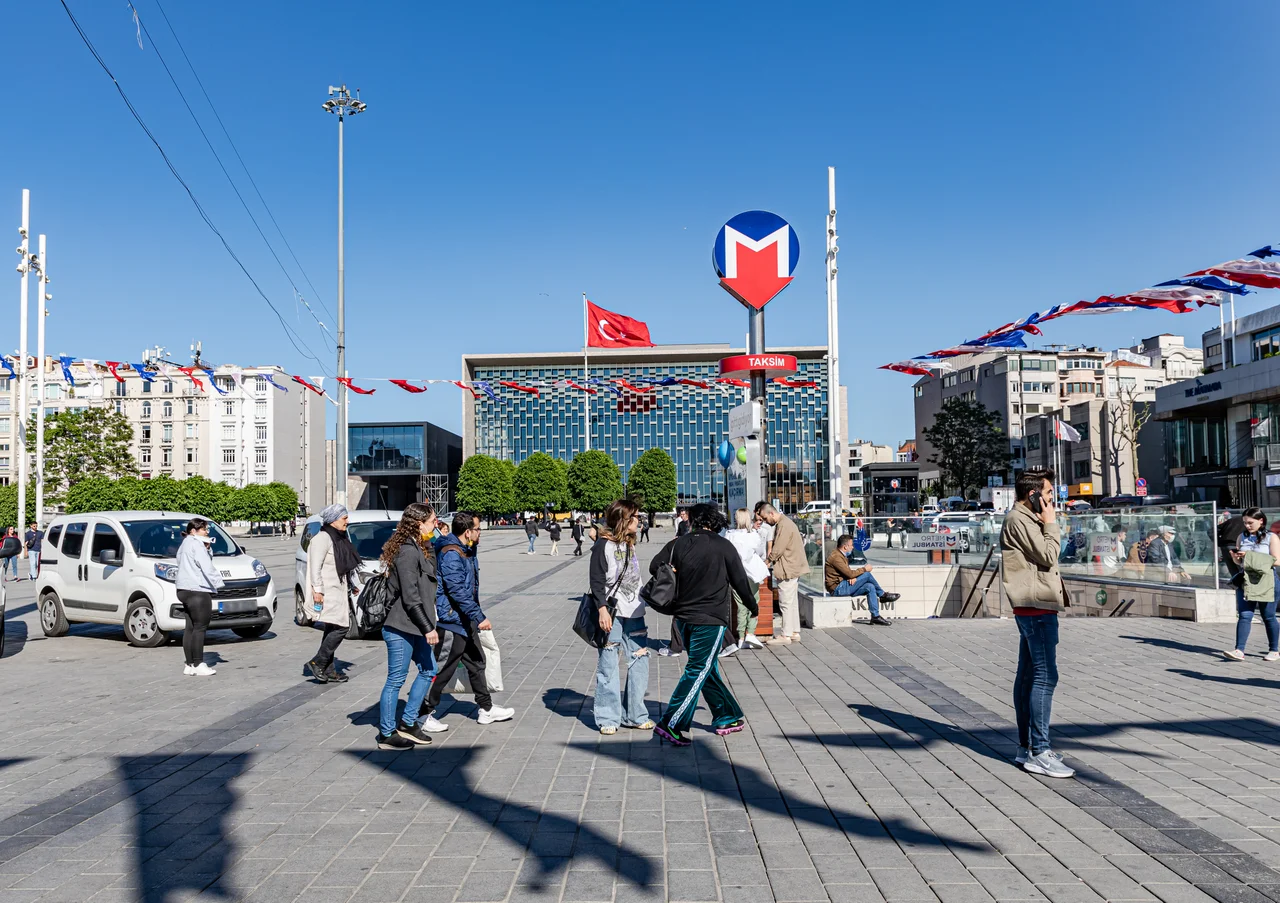
Taksim Square
On May 1, 1977, roughly 500,000 workers gathered in Taksim Square to celebrate International Workers' Day. As a labor leader began to speak, shots rang out from elevated positions — rooftops surrounding the square. What followed was chaos: security vehicles moved in, a police truck blocked the main exit on Kazancı Yokuşu, and the crowd, trapped and panicked, crushed against itself. By the end of the day, between 34 and 36 people were dead, most killed in the stampede. The shooters were never identified. No one was ever convicted. The square had been, for a few hours, one of the most dangerous places on earth — and then the city moved on, as it always has, layering new memories over the old.
A Name That Means Division
The word taksim means "division" or "distribution" in Arabic, and the name is literal: this spot was originally where the main water lines flowing from the forests north of Istanbul were collected and distributed across the city. Sultan Mahmud I established this function in the Ottoman era, and a stone reservoir from that period still stands at the square's edge. The water system is long gone, but the logic of the name persists — Taksim remains the point where Istanbul's European side fans out. Several major arteries converge here: Cumhuriyet Caddesi heading north toward Şişli, İstiklal Caddesi stretching west toward the Bosphorus neighborhoods, Tarlabaşı Bulvarı descending toward Kasımpaşa. At the center of it all stands the Republic Monument, unveiled in 1928 and sculpted by the Italian Pietro Canonica, commemorating the fifth anniversary of the Turkish Republic's founding in 1923. The bronze figures of Atatürk and the commanders of the War of Independence gaze outward with the confidence of a new state that believed it had settled its own future.
The Square as Stage
For much of the 20th century, Taksim was where Istanbul came to mark its occasions. New Year's festivities brought crowds that filled the square from one end to the other. May Day marches arrived here year after year, organized by trade unions who saw Taksim as the proper stage for labor's visibility. Parades of all kinds passed through. The Atatürk Cultural Center — a modernist landmark reopened after major renovation in 2021 — faced the square, hosting opera, theater, and concerts. A nostalgic red tram still runs south along İstiklal Caddesi from the square's edge, ending near Tünel, a funicular station dating to 1875 that is among the world's oldest underground rail lines. This infrastructure of pleasure and gathering made Taksim feel, for decades, like the city's living room. That began to change after repeated political incidents led authorities to restrict large gatherings. Since 2016, permission for May Day celebrations in Taksim has rarely been granted.
1 May 1977: An Unresolved Wound
The massacre of May 1, 1977 remains one of the most contested events in Turkish political memory. The official prosecutor's indictment recorded 34 dead; the DİSK trade union confederation documented 36 names. Autopsies found that most died in the stampede rather than from gunfire — though roughly four deaths were caused by bullets. Over 500 demonstrators were arrested in the aftermath, and 98 were charged, but none of the actual shooters. The case was closed in 1989 when the statute of limitations expired, without anyone being held accountable. Suspicion has consistently centered on Counter-Guerrilla, Turkey's NATO-era stay-behind network, and far-right groups. Opposition leader Bülent Ecevit stated publicly, one week after the massacre, that Counter-Guerrilla "has a finger in the 1 May incident." The European Court of Human Rights later found Turkey in violation of assembly rights in connection with the events. The people who died that day had come to a public square to be counted among those who worked — a right that cost some of them their lives.
The Summer That Changed Everything: Gezi 2013
In late May 2013, a small group of environmental activists camped in Gezi Park — the modest green space immediately north of Taksim Square — to protest municipal plans to demolish it and rebuild the 19th-century Taksim Military Barracks on the site as a shopping venue. Before dawn on May 31, riot police moved in with tear gas, pepper spray, and water cannons. Images of that pre-dawn crackdown spread across social media within hours, and by afternoon, tens of thousands had converged on Taksim in solidarity. What began as a park protest became something far larger: demonstrations spread to dozens of Turkish cities, drawing millions. The Turkish Medical Association documented at least 8,163 injuries by mid-July. Approximately 5 people died in the immediate protest period; the full toll — including those who succumbed later to injuries — rose to around 22 fatalities. Among them was Berkin Elvan, a 14-year-old who had gone out to buy bread, was struck by a tear-gas canister, and died after 269 days in a coma. He became a symbol of the protests' human cost. The park itself survived. The shopping center was never built.
What the Square Holds Now
Today Taksim is both very much itself and subtly altered. The Atatürk Cultural Center reopened in 2021 after years of controversy about its future; beside it stands the new Taksim Mosque, also completed in 2021, the first purpose-built mosque on the square. Police maintain a constant presence, and large public gatherings require permissions that are rarely given. Tourists arrive in numbers, funneling down İstiklal Caddesi or ascending from Kabataş via the F1 funicular — a 110-second ride that opened in 2006 connecting the Bosphorus shore to the hilltop square. The Republic Monument stands where it always has, Pietro Canonica's bronze soldiers frozen in 1928. Around them, the city keeps dividing and distributing itself, as the name always promised it would.
From the Air
Taksim Square sits at 41.0369°N, 28.9858°E, on a plateau in the Beyoğlu district on Istanbul's European side. At low altitude, the square is recognizable by the Republic Monument at its center and the long pedestrian corridor of İstiklal Caddesi extending westward. The Atatürk Cultural Center's distinctive modernist facade faces the square from the east. The nearest major airport is Istanbul Airport (LTFM), approximately 40 km northwest. Approach from the north along the Bosphorus shore provides excellent orientation — the square sits roughly 1.5 km inland from the waterfront at Kabataş. Recommended viewing altitude: 2,000–3,000 feet for the neighborhood context; the square itself is best appreciated on foot.
Nearby Stories
- Kocaeli Peninsula 7.6 km away
- Second Battle of Çatalca 11 km away
- Istanbul's Rural Outskirts 14 km away
- MV Struma 20 km away
- HMAS AE2 36 km away
- Bursa 66 km away
- Sangarius Bridge 71 km away
- Januarius MacGahan 101 km away