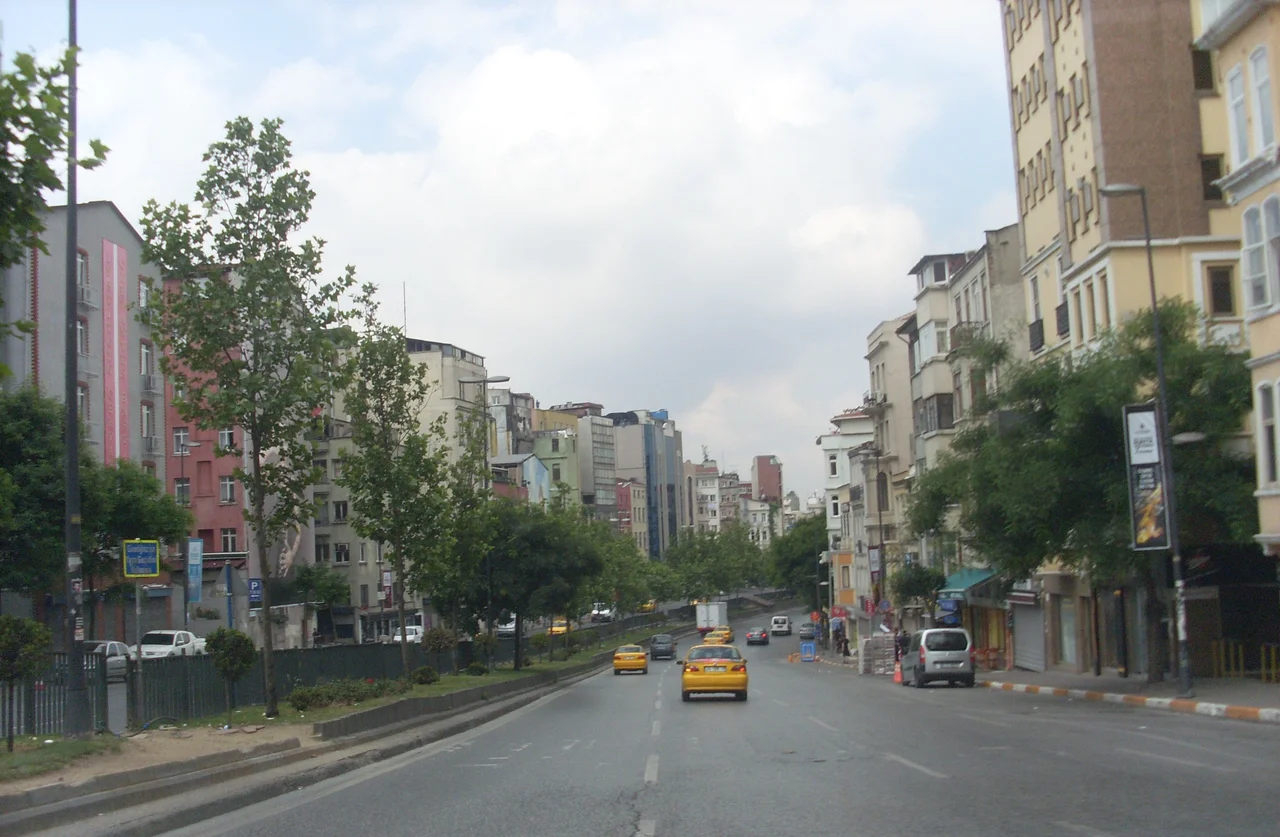

Tarlabaşı
There is a four-lane boulevard in Istanbul called Tarlabaşı Bulvarı that was, in a sense, a declaration of intent. In the 1980s, while Bedrettin Dalan was mayor, the road was sliced straight through the southern edge of the Tarlabaşı neighborhood, severing it from the commercial bustle of İstiklal Caddesi just a few hundred meters away. Dozens of 19th-century buildings were demolished to make way for it. The boulevard ensured that Tarlabaşı — already the city's refuge for the poor, the displaced, and the unwelcome — would become, if anything, more cut off. That isolation shaped the neighborhood that exists today: dense, worn, layered with communities that the rest of Istanbul has at various points preferred not to see.
Layers of Arrival
In the second half of the 19th century, Tarlabaşı became a residential area for people of modest means — and in particular for non-Muslims navigating life in a predominantly Muslim empire. Jews, Armenians, and Greeks settled here, many of them working in the embassies and businesses clustered along nearby İstiklal Caddesi. They built well: the neighborhood still holds fine apartment blocks and townhouses in Art Nouveau and eclectic European styles, many of them beautiful despite decades of neglect. When the Turkish Republic was established in 1923 and the embassies relocated to Ankara, the economic base that had sustained these communities evaporated. Families left. Properties fell into disrepair. The minority populations dwindled through the first half of the 20th century — some driven out by policy, some by poverty, some by the ambient hostility of a state that had grown suspicious of its own pluralism.
The People Who Came Next
From the 1990s onward, Tarlabaşı refilled. Kurdish families from southeastern Turkey arrived in large numbers, drawn by cheap rents and proximity to the city's economic center. They joined the Romani families who had long lived here, and the Syriac Orthodox community that had maintained a small but persistent presence. More recently, migrants from African countries and from Turkey's neighbors have also settled in Tarlabaşı, making it one of Istanbul's most genuinely diverse neighborhoods. A sizeable transgender community has made its home here too, partly because the neighborhood's social margins offered a degree of tolerance — and partly because that margin was the only space available. These are people who found Tarlabaşı not because it was welcoming in any formal sense, but because it was affordable and because other doors were closed. The neighborhood's Sunday market, with its hundreds of vendors, is one place where these communities overlap in ordinary, daily life.
A Poet Died on Sweet Almond Street
Not all of Tarlabaşı's history involves displacement. On Tatlı Badem (Sweet Almond) Street, there is a small museum dedicated to Adam Mickiewicz, the great Polish Romantic poet, who died of cholera here in 1855. Mickiewicz had come to Istanbul to help organize Polish legions in the Crimean War. He died before seeing any of it. In 1861 his body was transported to Montmorency, France; in 1890 it was finally brought to rest in Kraków. The museum is currently closed. The fact that the poet of Polish national longing died in this particular street, in this particular neighborhood of exiles and those who had lost their footing, carries a weight that requires no commentary. Tarlabaşı has always been a place where people arrived hoping for something and found something else.
The Contested Transformation
In February 2006, a large portion of Tarlabaşı was formally designated for urban renewal. The Tarlabaşı 360 project — named for the degree turn that gentrification requires from a neighborhood's existing residents — demolished historic buildings and replaced them with luxury apartments marketed primarily to foreign investors. Longtime residents, many of them renters with no legal standing in the redevelopment process, were displaced without meaningful recourse. What the project offered in return was a version of the neighborhood scrubbed of the people who had shaped it. Researchers studying the area have documented what the official rhetoric of urban renewal tends to obscure: self-organized solidarity networks among refugees and residents, informal community centers, daily acts of mutual support that constitute a social fabric even where institutions have failed. Since the 2010s, hotels and short-term rental properties have spread through Tarlabaşı as well, as investors recognized the value of city-center real estate that had been, for so long, priced for those with nowhere else to go.
What Remains
Three churches still stand in Tarlabaşı, their presence a physical record of communities that are largely gone. Two are Greek Orthodox — Panagia Evangelistria, and the Church of Hagioi Konstantinos and Helene. The third is the Syriac Orthodox Church of the Virgin Mary. Crumbling Art Nouveau facades catch afternoon light on streets that carry the traces of lives lived across centuries of arrival and departure. The neighborhood is not static. It is not finished becoming what it will become. But the people who are here now — the Kurdish families, the Romani residents, the African migrants, the transgender women who have made this margin their home — are not a problem to be solved by the next round of development. They are Tarlabaşı.
From the Air
Tarlabaşı sits at approximately 41.0364°N, 28.9797°E, immediately northwest of Taksim Square in the Beyoğlu district on Istanbul's European side. From the air, the neighborhood is visible as a dense residential grid just behind the landmark Taksim plateau. Tarlabaşı Bulvarı marks the southern boundary, visible as a wide road cutting east-west. The nearest major airport is Istanbul Airport (LTFM), approximately 40 km northwest. Recommended viewing altitude: 1,500–2,500 feet to see the neighborhood's relationship to Taksim and İstiklal Caddesi.
Nearby Stories
- Kocaeli Peninsula 7.6 km away
- Second Battle of Çatalca 11 km away
- Istanbul's Rural Outskirts 14 km away
- MV Struma 20 km away
- HMAS AE2 36 km away
- Bursa 66 km away
- Sangarius Bridge 71 km away
- Januarius MacGahan 101 km away