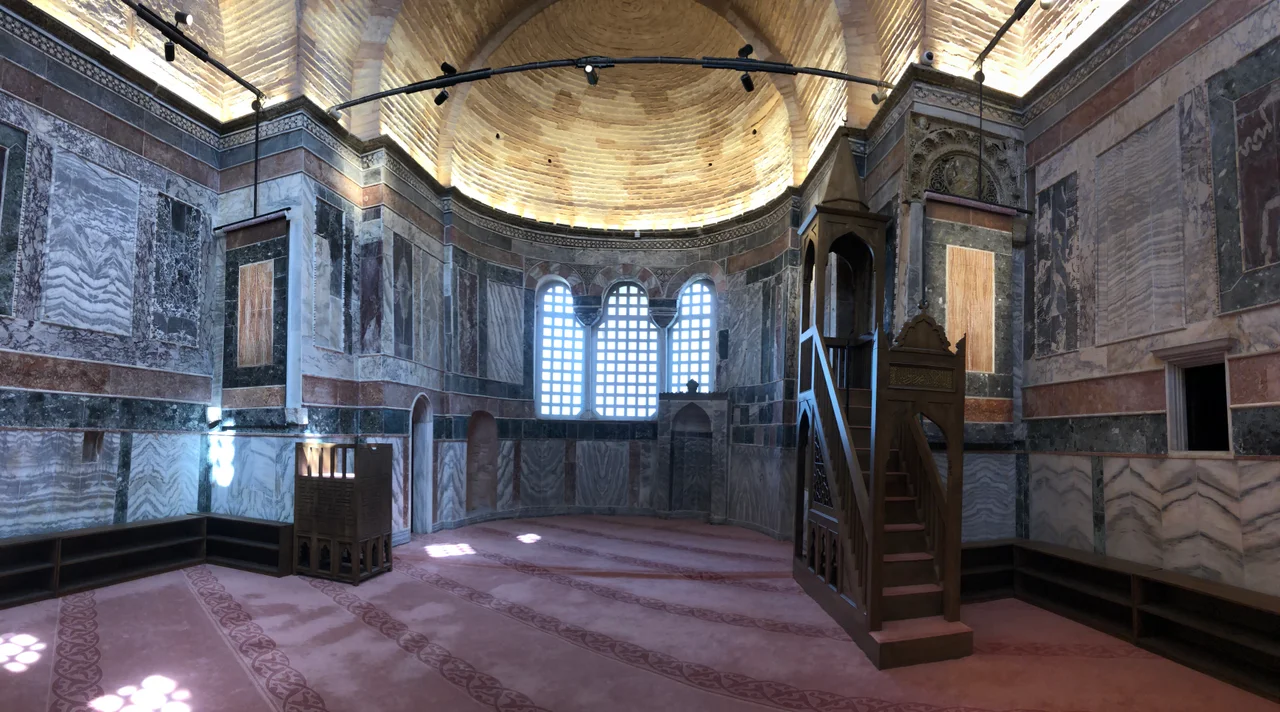

The Chora
The name itself is a riddle. Chora means "the land" or "the country," and the church was originally built outside Constantinople's city walls in the early 4th century — in the fields, beyond the city's edge. When Emperor Theodosius II extended the walls westward in 413–414, the church suddenly found itself inside the defenses, yet kept its name. The mosaics later resolved the paradox with characteristic Byzantine elegance: Christ is labeled the "Land of the Living" and Mary the "Container of the Uncontainable." A building that began as a geographical description became a theological statement. That layering — literal, symbolic, historical — defines everything about the Chora.
Theodore's Grand Wager
Between 1310 and 1317, a single man transformed the Chora from a functional church into one of the supreme artistic achievements of the medieval world. Theodore Metochites was the Grand Logothete — effectively the Byzantine prime minister — a man of enormous wealth, scholarly ambition, and evident aesthetic conviction. He commissioned the decoration of the narthexes and the funerary chapel, funded the mosaics and frescoes, and donated his personal library to the monastery. Then, in 1328, the political tide turned: the usurper Andronicus III Palaeologus sent him into exile. He returned two years later, stripped of power and position, and lived out his final years as a monk in the very church he had built. There is a mosaic of Theodore in the esonarthex, kneeling before Christ and holding a model of the church — the traditional pose of a donor. Knowing what came after, the image is almost unbearable in its dignity.
Gold on the Walls
The mosaics cover the narthexes in a dense narrative program that unfolds like an illuminated manuscript. The outer narthex tells stories from the life of Christ — the journey to Bethlehem, the Nativity, the flight into Egypt, the massacre of the innocents. Mothers mourning their children appear in two separate panels, their grief rendered with a directness that crosses seven centuries without softening. The inner narthex turns to the life of the Virgin: her birth, her first seven steps, her presentation at the Temple, the moment the young Mary awkwardly turns at the well to face the archangel Gabriel. The unknown artists who created these scenes were working at the height of the Palaeologian Renaissance — a late flowering of Byzantine culture — and their command of expression and narrative is astonishing. The Christ Pantokrator gazes from the lunette above the doorway, blessing the viewer with one hand, holding a jeweled Gospel in the other.
The Resurrection in the Chapel
The parecclesion — the side chapel added by Theodore as a mortuary space for his family — contains frescoes rather than mosaics, and their subject matter fits the purpose. The Anastasis, painted on the curved ceiling above the apse, shows Christ having just broken down the gates of Hell, hauling Adam and Eve from their tombs with both hands. He is clothed in vivid white and surrounded by a blazing mandorla; below his feet, the bound figure of Hades lies prostrate in the dark. Behind Adam stand John the Baptist, King David, and Solomon. The image appears in art history textbooks worldwide as the definitive example of Late Byzantine art. Beside it, the Last Judgment unfolds in elaborate detail. Along the chapel walls, arched tomb recesses — arcosolia — were cut for Theodore and his family. Soldier saints painted nearby seem to guard the dead.
Plaster, Politics, and Perseverance
When Hadım Ali Pasha, Grand Vizier of Sultan Bayezid II, converted the church to a mosque in 1511, the modifications were deliberately minimal — a minaret added, a mihrab installed, the mosaics covered with a thin layer of plaster. The Ottomans preserved the spatial organization of the building intact. For roughly four centuries, the images waited in darkness. In 1945, the Turkish government secularized the site and designated it a museum. American scholars Thomas Whittemore and Paul Underwood, working under the auspices of the Byzantine Institute of America and Dumbarton Oaks, led the restoration that uncovered what the plaster had hidden. The building opened to the public in 1958 as Kariye Müzesi. In 2020, a presidential decree reconverted it to a mosque — the mosaics now covered again during prayers, visible at other times. The cycle continues.
A Small Church That Contains the World
At 742.5 square meters, the Chora is not large. Hagia Sophia would swallow it many times over. But the Chora rewards something that Hagia Sophia's scale cannot accommodate: sustained attention. You move through it slowly, from one panel to the next, reading a story told in gold and pigment by artists who died nameless in the 14th century. The name Chora — the land, the country, the dwelling place — recurs in the mosaics as both title and theology. It is a building that has been a monastery, a church, a mosque, a museum, and a mosque again. It sits inside Istanbul's ancient land walls, in the Edirnekapı neighborhood of Fatih, a short walk from one of the gates the Ottomans stormed in 1453. In its final days before the fall, the precious Hodegetria icon was brought here for protection. It did not help the city. The mosaics survived anyway.
From the Air
The Chora sits at 41.0311°N, 28.9392°E in the Fatih district of Istanbul, pressed up against the ancient Theodosian land walls near the Edirnekapı gate. Approaching Istanbul from the northwest on a descent toward LTFM (Istanbul Airport), the Bosphorus comes into view first, then the dense fabric of the old city on the European shore. At 3,000 feet, the line of the land walls becomes visible running north to south — a crenellated shadow through residential streets. The Chora sits just inside the western arc of the walls. The minaret added by the Ottomans in 1511 is modest; the building itself is low and compact. Best viewed in morning light when the sun strikes the western facade. LTFM lies roughly 35 km to the northwest; the airport serves as the primary gateway to Istanbul's European side.
Nearby Stories
- Kocaeli Peninsula 7.6 km away
- Second Battle of Çatalca 11 km away
- Istanbul's Rural Outskirts 14 km away
- MV Struma 20 km away
- HMAS AE2 36 km away
- Bursa 66 km away
- Sangarius Bridge 71 km away
- Januarius MacGahan 101 km away