
The Museum of Innocence (museum)
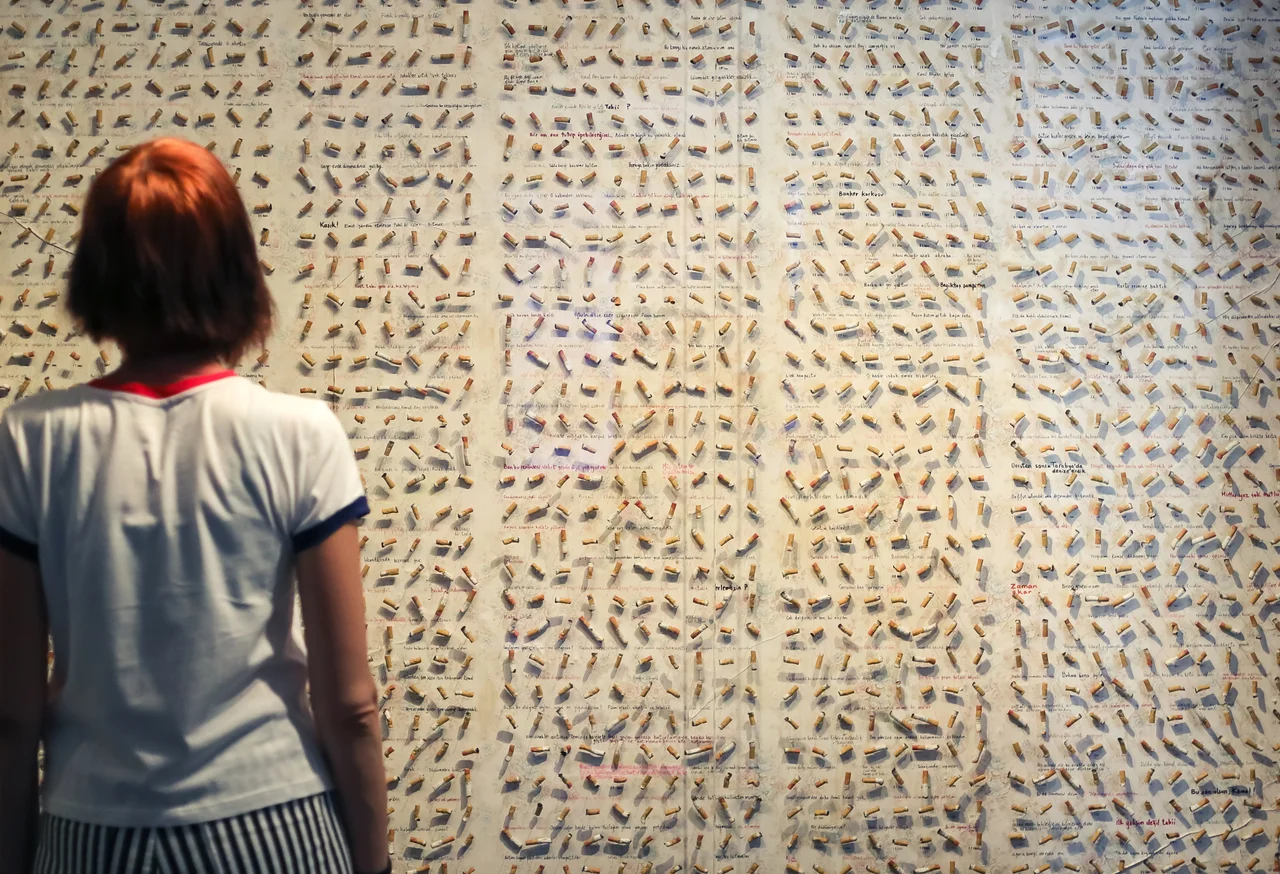
Orhan Pamuk began collecting objects in the mid-1990s without quite knowing what he was building. A cigarette stub. A salt shaker. A barrette. A dog-eared movie ticket. He was accumulating the physical residue of a love story that did not yet exist in any book, for characters he had not yet finished inventing. The novel and the museum grew together, feeding each other: objects suggested scenes, scenes demanded objects. "I wanted to collect and exhibit the 'real' objects of a fictional story in a museum," Pamuk said, "and to write a novel based on these objects." By the time the Museum of Innocence opened in Istanbul's Çukurcuma neighborhood in 2012, it was impossible to say which came first — the story or the stuff that proved it happened.
The Novel Behind the Cases
The Museum of Innocence — both the novel published in 2008 and the physical museum — tells the story of Kemal, a wealthy Istanbulite from a good family, who falls obsessively in love with his poorer distant cousin, Füsun. Their affair, their separation, and the decades Kemal spends collecting objects associated with her form the novel's architecture. The museum displays what the fictional Kemal gathered: more than a thousand objects that the two characters "used, wore, heard, saw, collected and dreamed of," each meticulously arranged in display cases corresponding to one of the novel's 83 chapters. Visitors to the museum move through rooms as if moving through the novel's chapters. Those who have read the book encounter the actual earring Füsun lost, the actual cigarette stubs Kemal saved. Those who have not read it encounter an archaeology of someone else's longing — and often go home to read the book.
A House in Çukurcuma
The museum occupies a 19th-century house in Çukurcuma, a hilly neighborhood in Beyoğlu known for its antique shops, cobblestone streets, and the particular atmosphere that comes from old things being traded among people who care about them. Pamuk chose the location deliberately — Çukurcuma is where Füsun's fictional family lives in the novel. The architect Sunder-Plassmann worked with Pamuk to convert the old house into exhibition space while keeping its domestic scale intact. You move through it as you would move through someone's home: narrow stairs, small rooms, unexpected openings. The intimacy is the point. These are not grand vitrines in a marble hall; they are the accumulated possessions of an inner life, arranged by someone who believed that objects carry memory in the way that memory carries loss.
Objects as Evidence
The collection includes items Pamuk found in Istanbul's antique markets and flea stalls, objects borrowed from friends and family, and things gathered from travels around the world. Some were chosen because they fit the novel's period — the story spans the 1970s through the early 2000s — capturing an Istanbul that was Westernizing, modernizing, anxious about its own identity. A particular bottle of cologne. An old television set. Magazine pages from an era before everything was digital and searchable and therefore, paradoxically, harder to remember. The objects are both props from a fiction and artifacts from a real city's recent past. In 2014, the museum was named winner of the European Museum of the Year Award — recognition that its curatorial ambition had achieved something genuinely new.
The Innocence of Objects
Pamuk published a companion volume to the museum called The Innocence of Objects, part catalogue and part meditation on why we keep things, what objects mean, and what museums are for. His argument, implicit in the museum itself, is that the traditional museum — with its logic of national heritage, its taxonomic ambition, its authority — is one kind of container, but not the only one. A museum built around a fiction, around private feeling rather than public history, can tell truths that official collections cannot reach. The Museum of Innocence asks whether the cigarette stub of someone who loved and lost does not deserve the same care as a sultan's sword. Its answer — 83 chapters long, a thousand objects wide — is yes.
Istanbul Through a Keyhole
What the museum ultimately offers, alongside its meditation on love and objects, is a very particular portrait of Istanbul — upper-class, European-facing, secular, its social rituals detailed with the precision of an anthropologist who happens also to be a novelist. The parties. The apartments. The Bosphorus views from the right addresses. The gap between the wealthy and the merely comfortable, which in Pamuk's Istanbul determines not just where you live but who you are allowed to love. Visitors from Istanbul often report the shock of recognition: yes, that is exactly what a summer evening in Nişantaşı felt like in 1978. For everyone else, it is a window into a world that was already half-gone by the time Pamuk began collecting evidence that it had existed.
From the Air
The Museum of Innocence sits at 41.0309°N, 28.9798°E in the Çukurcuma neighborhood of Beyoğlu, on the European shore of Istanbul. From the air, Beyoğlu occupies the ridge between the Golden Horn to the east and the Bosphorus to the west — its dense 19th-century apartment blocks visible from altitude as a tight urban weave. On approach to LTFM (Istanbul Airport, 35 km northwest), the Galata Tower is a useful visual reference; Çukurcuma lies just uphill and to the south of it, in the narrower streets behind İstiklal Caddesi. The museum building is too small to distinguish from altitude, but the neighborhood is distinctive for its mix of old residential buildings and the glint of antique-shop windows. A viewing altitude of 2,000 feet over the Bosphorus gives a clear sense of Beyoğlu's position between the two bodies of water that define Istanbul's geography.
Nearby Stories
- Kocaeli Peninsula 7.6 km away
- Second Battle of Çatalca 11 km away
- Istanbul's Rural Outskirts 14 km away
- MV Struma 20 km away
- HMAS AE2 36 km away
- Bursa 66 km away
- Sangarius Bridge 71 km away
- Januarius MacGahan 101 km away