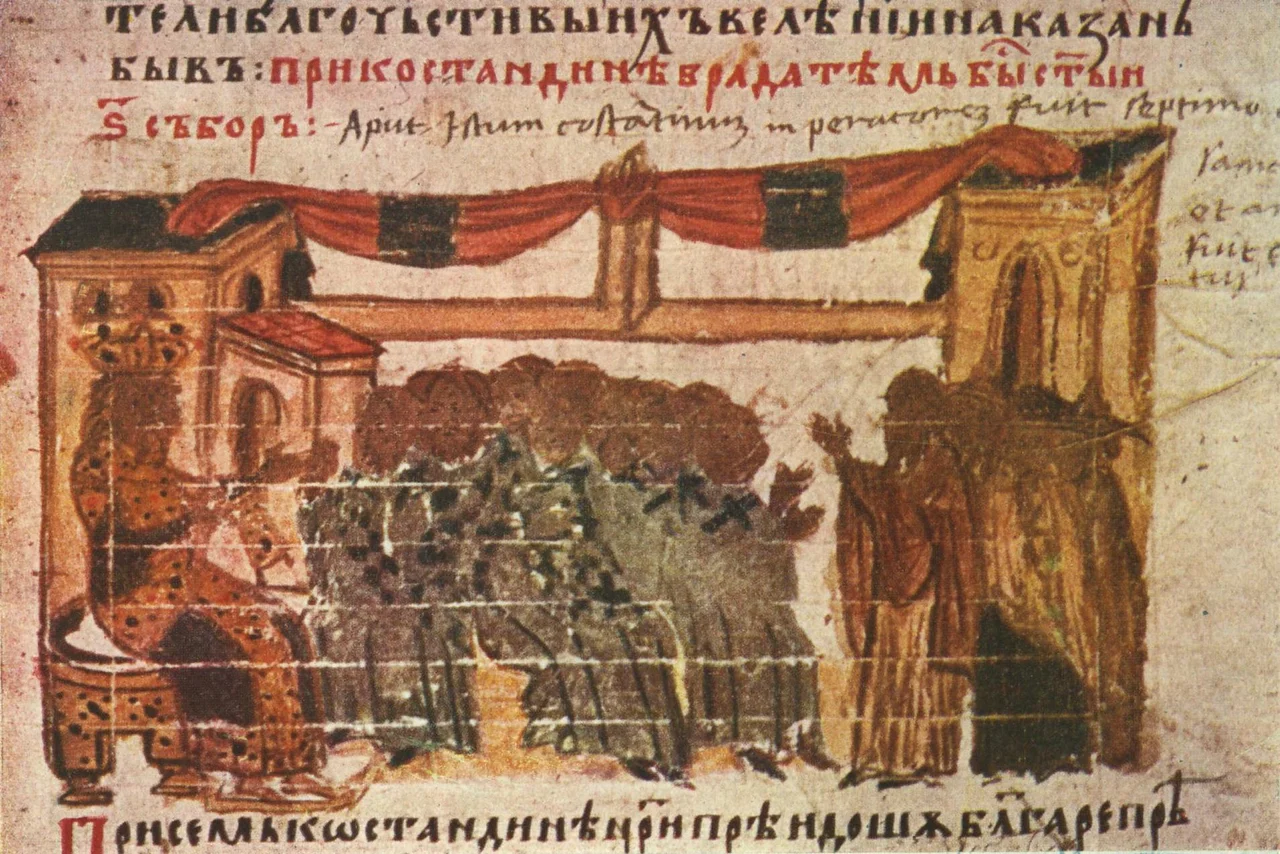

Third Council of Constantinople
The question sounds abstract at a thousand years' distance, but in seventh-century Constantinople it was the kind of dispute that toppled popes and sent emperors scrambling. Does Christ have one will or two? If he is both fully divine and fully human, must he not have both a divine will and a human will — and if those two wills coexist, does that mean Christ ever experienced genuine temptation, genuine struggle, genuine choice? Or was his human nature simply an instrument of the divine, with no independent volition? The answer had implications not just for theology but for how Christians understood salvation, suffering, and what it meant for God to have become a person. The Third Council of Constantinople, meeting in 680–681, was convened to settle the matter once and for all.
A Century of Fracture
The controversy had been building since the reign of the Emperor Heraclius in the early seventh century. Heraclius had recovered large swaths of the empire from the Persians, but Syria and Egypt were full of Monophysites — Christians who believed Christ had only one nature, divine — and reconciling them with Constantinople's orthodoxy was a political as much as a theological problem. His solution was a doctrine called Monothelitism: Christ had two natures but one will. It was a compromise position, and like many compromises it satisfied no one completely. Jerusalem rejected it. Rome rejected it. Pope Martin I and the monk Maximus the Confessor held a synod in Rome in 649 condemning it outright. The Emperor Constans II, Heraclius's grandson, responded by arresting Pope Martin on charges of treason, sending him into exile, where he died. Maximus the Confessor was later tortured and mutilated. The theological dispute had, by now, consumed real lives.
The Council Convenes
It was Constantine IV who finally called the council, and the timing was significant. He had just successfully defended Constantinople against a Muslim siege that had lasted from 674 to 678 — the Umayyad fleet broken, the city relieved. With the external threat receded, internal unity with Rome became possible again. Constantine wrote to the Pope proposing a conference, and after some delays — the Pope he first wrote to had died before the letter arrived — the council was arranged. On 7 November 680, thirty-seven bishops and several priests gathered in a domed hall called the Trullus inside the Great Palace of Constantinople. The Emperor himself attended and presided over the first eleven sessions. The patriarchates of Alexandria and Jerusalem, both under Muslim rule, were represented not by their own patriarchs but by Byzantine appointees — a sign of how drastically the world had changed since the last great council.
The Body That Would Not Rise
The council's proceedings included, by any measure, one of the stranger moments in the history of Christian theology. A Monothelite priest named Polychronius, apparently convinced that God would validate his position through a miracle, claimed he could raise the dead. This was his proof: that his faith was correct, that Christ had only one will, and that the council should believe him. He had a corpse brought forward into the assembly. He knelt and whispered prayers into the dead man's ears. The body did not move. Undeterred by this outcome, Polychronius continued to profess Monothelitism and was formally anathematized by the council — condemned and excluded from the church. The incident is preserved in the records without editorial comment, which somehow makes it more vivid than any amount of theological argument.
The Definition and Its Consequences
The council concluded on 16 September 681, attended by 174 bishops by the final session. Its definition was clear: Christ has two wills and two energies, divine and human, and his human will is not contrary to but subordinate to his divine will. Monothelitism and Monoenergism were condemned as heresies. The Patriarch Macarius of Antioch, who had defended Monothelitism during the proceedings, was deposed. More controversially, the council retroactively condemned Pope Honorius I, who had died nearly fifty years earlier, for failing to clearly oppose the heresy during his pontificate — a condemnation that would resurface in the nineteenth century during debates over papal infallibility, since it showed that a council could judge a pope's doctrine deficient. The Third Council of Constantinople counts as the Sixth Ecumenical Council, recognized by both Eastern Orthodox and Catholic churches.
Constantinople as the World's Hinge
What the council reveals, more than any single theological conclusion, is Constantinople's extraordinary position in the seventh century. The city was under siege from the Arabs. Syria and Egypt had already been lost. The Persians had been pushed back but at enormous cost. And yet bishops still traveled here from the western edges of Christendom — from Milan, from Canterbury, from Rome — to argue about the nature of Christ's will in a domed hall inside the imperial palace. The council's location was not incidental: Constantinople was where these things got decided, where the universal church still had an addressable center, where the emperor and the patriarch and the bishop of Rome could, with effort, speak to each other. The city that housed this argument was also the city that would house its legacy — for another eight centuries, until 1453.
From the Air
The Third Council of Constantinople met inside the Great Palace complex, which occupied the southeastern tip of the historic peninsula now known as Sultanahmet. The coordinates 41.0125°N, 28.98°E place the approximate site near what is today the Blue Mosque and the Hippodrome. On approach to LTFM (Istanbul Airport, approximately 40 km northwest), the historic peninsula juts visibly into the Bosphorus — a triangle of land bounded by the Golden Horn to the north, the Sea of Marmara to the south, and the Bosphorus to the east. At 3,000 feet, Hagia Sophia's dome and the Blue Mosque's six minarets are visible landmarks; the Great Palace foundations lie in the ground between them, excavated in places and built over in others. The Trullus hall where the council met no longer stands, but the geography that made Constantinople the center of the ancient world is unchanged.
Nearby Stories
- Kocaeli Peninsula 7.6 km away
- Second Battle of Çatalca 11 km away
- Istanbul's Rural Outskirts 14 km away
- MV Struma 20 km away
- HMAS AE2 36 km away
- Bursa 66 km away
- Sangarius Bridge 71 km away
- Januarius MacGahan 101 km away