
Tiled Kiosk
Nineteen years after Mehmed II conquered Constantinople, he built himself a pleasure pavilion at the edge of his new palace complex. It was 1472, and the Tiled Kiosk — Çinili Köşk in Turkish — was not a throne room or a mosque or a fortress. It was a place to sit, to look out over the Bosphorus and Gülhane Park, to be cool in summer and sheltered in winter. The name comes from the tiles that cover it: a riot of blue, green, and white ceramic work in geometric patterns that shimmer differently depending on the angle of the light. Mehmed had just folded the Byzantine world into his empire, but the Kiosk is built in an entirely different tradition — Central Asian in its glazed exterior brickwork, Persian in its plasterwork and structural details, with no Byzantine influence at all. It is a statement about where the new empire's cultural roots lay.
A Pavilion on the Edge of Empire
The Tiled Kiosk stands just inside the outermost walls of Topkapı Palace, beside Gülhane Park, at the point where the palace grounds drop toward the Bosphorus. Mehmed II had begun constructing Topkapı in 1459, and the Kiosk was among the first major buildings completed on the site — its tile inscription above the main entrance dates it definitively to 1472. The architect is unknown; sources ascribe the building to a Persian craftsman, pointing to the stone-framed brick construction, the polygonal pillars of the facade, and the white Persian plasterwork inside as evidence. The exterior glazed brickwork shows an influence from Central Asia, specifically from the Bibi-Khanym Mosque in Samarkand — the great Timurid monument that Tamerlane had built roughly seventy years earlier. Mehmed was a man of wide cultural ambitions, and the Kiosk's genealogy reflects them.
Architecture of Cosmic Claim
The building's plan is a Greek cross — two axes crossing at a domed center — spread over two storeys, though from the main entrance only one storey is visible because the building straddles a slope. The square, axial plan was not merely aesthetic: it represented the four corners of the world, symbolizing, in the architectural language of the time, the universal sovereignty of the Sultan. A roofed colonnaded terrace runs above the entrance gate, rebuilt in the eighteenth century. The great central door, framed in a tiled green arch, leads into a vestibule and then into a tall domed court. Behind the court are three royal apartments, each looking out over the park toward the Bosphorus. On either side of the domed court, eyvans — vaulted recesses open on one side — provide sheltered space for sitting, looking, thinking. The blue-and-white tiles covering the walls are arranged in hexagons and triangles in the Bursa manner, some carrying delicate flowers, leaves, clouds, and abstract forms.
Five Centuries of Reinvention
The Tiled Kiosk has never held still for long. Mehmed built it as a pleasure pavilion. Later sultans used it for various purposes. Between 1875 and 1891, it served as the Imperial Museum — the first attempt to create a public repository of antiquities in the Ottoman Empire. When that museum outgrew the space, the collection moved to larger buildings on the same grounds, and the Kiosk stood empty for decades. In 1953, it was reopened as a museum of Turkish and Islamic art, eventually incorporated into the Istanbul Archaeology Museums complex next door. Today it houses the Museum of Islamic Art, displaying examples of İznik tiles and Seljuk pottery — which means the building that was once covered in magnificent tiles now contains other magnificent tiles, each admiring the other across five centuries of craft tradition.
The Genius of İznik
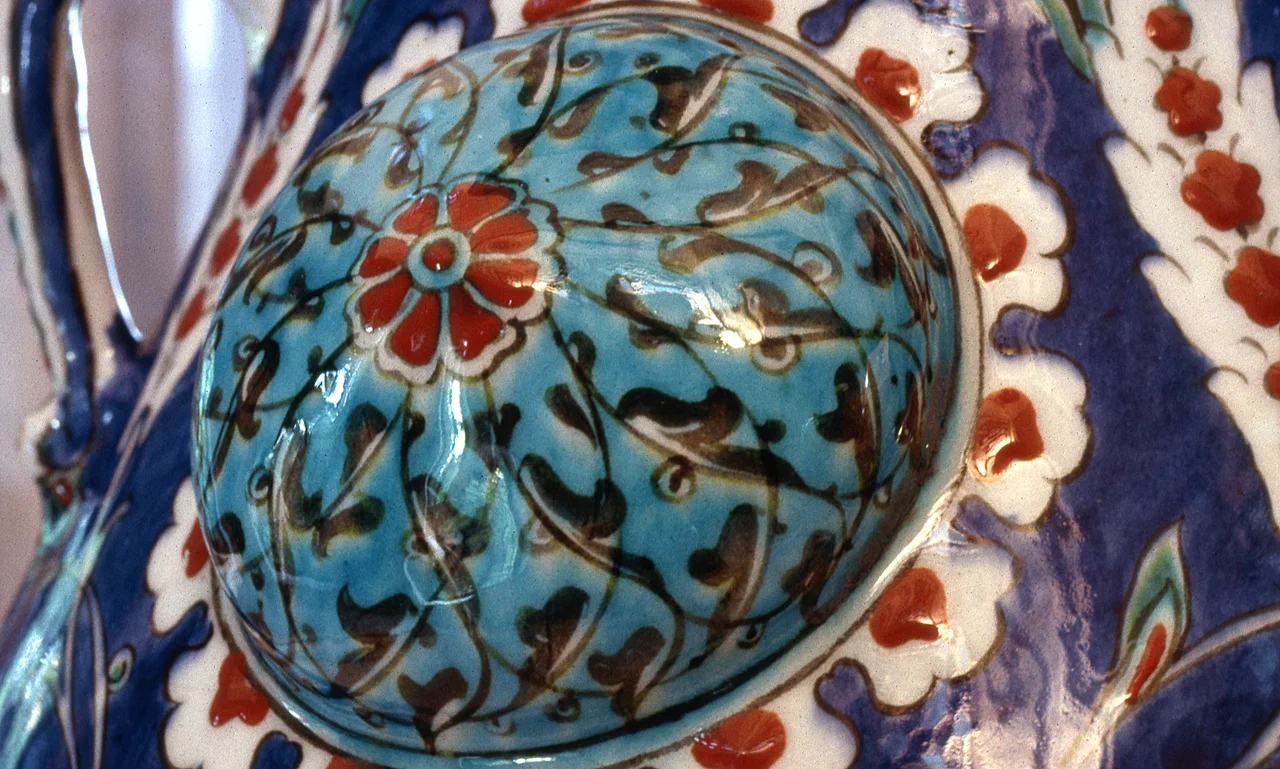
The collection inside the Kiosk focuses on what is arguably the greatest ceramic tradition in Ottoman history: İznik ware, produced in the city of İznik (ancient Nicaea) from the fifteenth through the seventeenth centuries. İznik tiles and vessels developed from Chinese-influenced blue-and-white designs in the early period into a more distinctly Ottoman vocabulary — bold floral patterns in cobalt, turquoise, and the signature tomato red that İznik potters mastered in the sixteenth century. The mosque lamps on display, their forms descended from earlier glass lamps but rendered in glazed ceramic, give some sense of how light would have played through a fully tiled interior. The mihrab niche from the Karamanoglu period, with its intricate colored glaze-work, shows that the tradition extended well beyond Istanbul into Anatolia.
Where the Palace Meets the Park
The Tiled Kiosk sits at the edge of Topkapı's outer world — past the point where the palace becomes public and before the gardens become city. Gülhane Park, which stretches below the Kiosk's terraces toward the Bosphorus shoreline, was once part of the palace grounds and is now a public park, one of the older green spaces in Istanbul. From the Kiosk's apartments, the view that Mehmed II would have seen — water, sky, the Asian shore across the strait — is still substantially there, though the shipping lanes are busier now. The building closed on Mondays and opens at nine. It receives a fraction of the visitors that Topkapı Palace's inner courts attract, which means that on a quiet morning you can stand in a domed room lined with five-hundred-year-old tiles and have it largely to yourself.
From the Air
The Tiled Kiosk sits at 41.0120°N, 28.9812°E, at the outer edge of Topkapı Palace's grounds adjacent to Gülhane Park, on the tip of Istanbul's historic peninsula. From the air, the palace complex is clearly legible — a series of walled courtyards stepping back from the Bosphorus shoreline, with the distinctive roof of Hagia Sophia visible to the southwest. The Tiled Kiosk, relatively small and low, lies at the northern corner of the complex near the archaeological museums. On approach to LTFM (Istanbul Airport, roughly 40 km to the northwest), the historic peninsula is visible well before landing, the Topkapı grounds distinguishable by their green terraces dropping toward the water. A banking turn over the Bosphorus at 2,000 feet provides the best aerial view of the palace ensemble and the parkland surrounding the Kiosk.
Nearby Stories
- Kocaeli Peninsula 7.6 km away
- Second Battle of Çatalca 11 km away
- Istanbul's Rural Outskirts 14 km away
- MV Struma 20 km away
- HMAS AE2 36 km away
- Bursa 66 km away
- Sangarius Bridge 71 km away
- Januarius MacGahan 101 km away