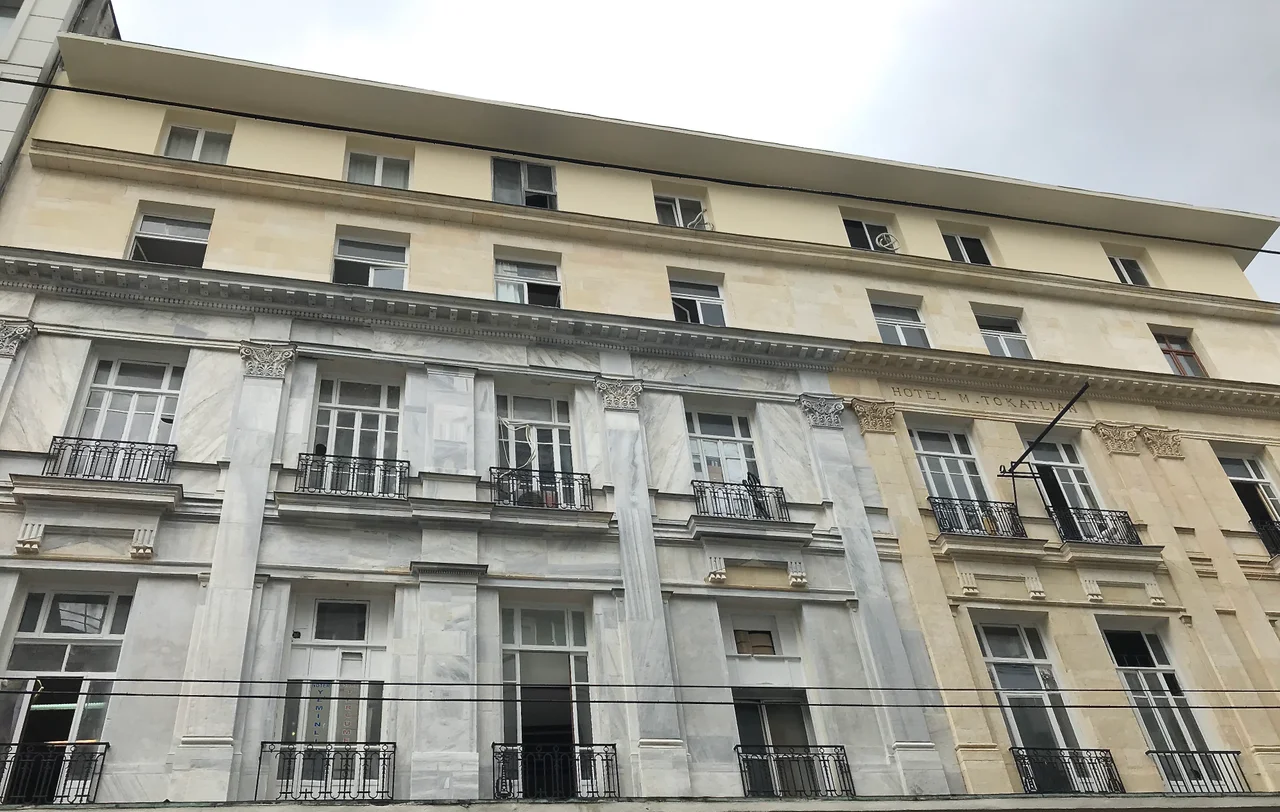

Tokatlıyan Hotels
Meguerditch Tokatliyan arrived in Istanbul from the Anatolian city of Tokat in 1883. He was an Ottoman citizen of Armenian descent, and he took as his surname a word that simply identified where he came from: Tokatlıyan, meaning "from Tokat." Fourteen years after his arrival, in 1897, he opened a hotel on the Rue de Pera — the grand commercial avenue of the European quarter that we now call İstiklal Caddesi — and called it Hotel Splendide. The name did not stick. The hotel became Hotel Tokatlıyan, and then simply the Tokatlıyan, and it became one of the most distinguished addresses in a city full of distinguished addresses. Atatürk considered it his favorite hotel. Trotsky stayed there. Agatha Christie referenced it in her fiction. For decades it was where the world came when it came to Istanbul.
The Grand Hotel on the Rue de Pera
The Beyoğlu branch of the Tokatlıyan opened with 160 rooms, its furnishings imported from Europe. The high-ceilinged halls and corridors were decorated throughout with a silver coat of arms — the hotel's own heraldic device, an unusual touch that gave the establishment the feel of a minor aristocratic residence. Pera was the neighborhood where the embassies and consulates clustered, where the Levantine merchant families lived, where European travelers felt sufficiently at home to conduct business and intrigue over long dinners. The Tokatlıyan occupied a natural place in this world: cosmopolitan, ambitious, attentive to the expectations of guests who had stayed in the best hotels of Paris and Vienna and expected nothing less here.
Famous Guests and a Violent Afternoon
The hotel's guest register would have made for extraordinary reading. Mustafa Kemal Atatürk, the founder of the Turkish Republic, regarded it as his preferred Istanbul address — a personal endorsement that no amount of advertising could replicate. Leon Trotsky, in exile from Soviet Russia, passed through. The novelist Agatha Christie included the Tokatlıyan in her work, as did Orhan Pamuk in his. But the most dramatic moment in the hotel's history was not a literary one. On 4 November 1922 — just weeks after Atatürk's forces had consolidated the Turkish War of Independence — Ali Kemal, a liberal newspaper editor and former Minister of the Interior, was kidnapped from the barber shop inside the hotel. He was transported to İzmit — a city roughly ninety kilometers east of Istanbul — and killed by Republican forces. Ali Kemal was the great-grandfather of Boris Johnson, a fact that gives the event an unexpected resonance across a century.
Changing Hands
Meguerditch Tokatliyan did not stay in Istanbul to see his hotel's full story play out. He eventually settled in Nice, France, and lived there for the remainder of his life. In 1919, ownership of the Beyoğlu hotel passed to the Serbian businessman Nikola Medović. It subsequently came under the ownership of the Turkish businessman İbrahim Gültan, who renamed it the Konak. The building still stands near the Çiçek Pasajı — the famous Flower Passage arcade — on what is now İstiklal Caddesi. Shops occupy the ground floor; most of the upper floors are closed to the public. The physical fabric persists while the name that once adorned it belongs to another era.
The Tarabya Branch on the Bosphorus
The Tokatlıyan name also attached to a second establishment: a hotel on the European shore of the Bosphorus at Tarabya, a well-heeled suburb to the north of the city. This branch had 120 rooms looking out over the water toward the Asian shore. In 1964, it was reconstructed and renamed the Büyük Tarabya — the Grand Tarabya Hotel. The Bosphorus location gave this branch a different character from the urban Pera original: where the Beyoğlu hotel was a place for business and diplomacy in the heart of the city, the Tarabya branch was for summer retreats, Bosphorus breezes, and the slower rhythms of Istanbul's waterfront life. Turkish filmmakers discovered it as a backdrop, and it appeared in numerous films and television productions over the decades.
What the Name Carried
The Tokatlıyan Hotels belong to a particular chapter of Istanbul's Ottoman twilight and early Republican years — the era when the city was still deeply multilingual, when Armenian, Greek, Jewish, and Turkish families ran the great commercial enterprises of Pera side by side, and when the European quarter felt genuinely European in its ambitions and its anxieties. Meguerditch Tokatliyan was one thread in that fabric: an Armenian from the Anatolian interior who built something that became, briefly, synonymous with Istanbul at its most cosmopolitan. The name survived on the building long after it stopped being his, and survives still in historical accounts of a city that has been many things to many people. The hotel's story is, in miniature, the story of who built Istanbul's modern identity — and how complicated the question of ownership has always been.
From the Air
The Beyoğlu branch of the Tokatlıyan Hotel sits at approximately 41.0342°N, 28.9783°E, on İstiklal Caddesi in the Beyoğlu district on Istanbul's European shore. From altitude, Beyoğlu occupies the ridge between the Golden Horn and the Bosphorus — its long spine of 19th-century buildings running northeast toward Taksim Square. The Çiçek Pasajı arcade, near which the hotel building stands, is identifiable at low altitude by the cluster of activity around it. On approach to LTFM (Istanbul Airport, roughly 35 km to the northwest), pilots overfly Beyoğlu in the descent sequence; the Galata Tower, just downhill from İstiklal Caddesi, serves as a reliable visual reference. The Tarabya branch's location on the Bosphorus shore, approximately 15 km north of Taksim, is visible from the approach track as a stretch of dense waterfront development on the European bank.
Nearby Stories
- Kocaeli Peninsula 7.6 km away
- Second Battle of Çatalca 11 km away
- Istanbul's Rural Outskirts 14 km away
- MV Struma 20 km away
- HMAS AE2 36 km away
- Bursa 66 km away
- Sangarius Bridge 71 km away
- Januarius MacGahan 101 km away