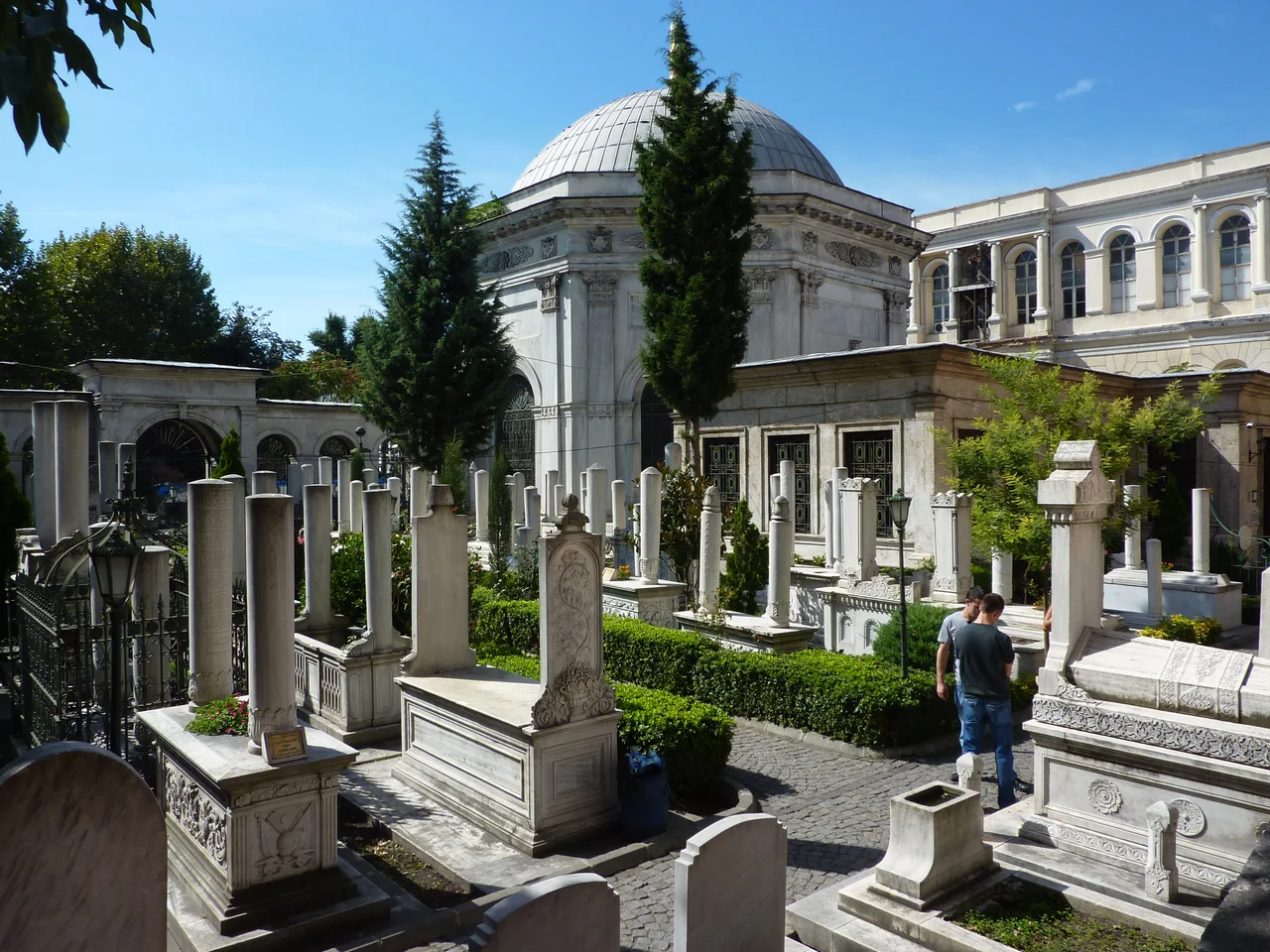

Tomb of Mahmud II
The crystal chandelier hanging from the dome was a gift from Queen Victoria. The gilded wall clocks on either side of the entrance door were sent by Napoleon III of France. These were not souvenirs or diplomatic curiosities — they were gestures of respect from the rulers of Europe's two most powerful nations to an empire they alternately feared, courted, and patronized. They hang inside the Tomb of Mahmud II on Divanyolu, Istanbul's ancient council street, where three Ottoman sultans rest in an Empire-style mausoleum completed in 1840.
The Reformer Who Did Not Live to See It
Mahmud II died in 1839 having spent nearly thirty years dragging the Ottoman Empire toward modernity by force of will and often considerable violence. He abolished the Janissary corps in 1826 in an event known as the Auspicious Incident — a euphemism for a massacre of the old military order that had held sultans hostage for centuries. He introduced Western-style administrative reforms, reorganized the army, and modernized the bureaucracy. He was trying to save an empire that was visibly weakening. He did not survive to know how the project would end. His son Abdülmecid, who succeeded him, immediately commissioned a tomb — an act of both filial devotion and political theater. The land was donated by Mahmud's sister Esma Sultan, who gave up her mansion on Divanyolu for the site.
An Octagon in Marble
The tomb was completed in 1840 in the Empire style — the architectural language of Napoleon's France, adapted here for an Ottoman context. The structure is reached by steps and takes an octagonal form, a shape with deep resonance in Islamic sacred architecture, echoing the geometry of the Dome of the Rock and countless mausoleums across the Islamic world. Its dome is decorated with embossed wreaths and flowers. Inside, the calligrapher Mehmet Haşim wrote the marble inscription. The chandelier sent by Queen Victoria descends from the dome's center. The attribution of the building's design is genuinely disputed — sources variously name Engineer Abdülhalim Efendi, architect Garabed Balyan, or the brothers Ohannes and Boğos Dadyan. No single attribution has achieved consensus, which is itself historically revealing: the tomb of the reforming sultan was built by architects drawn from the empire's Armenian and Greek communities.
Three Sultans, One Courtyard
Mahmud II did not rest alone for long. The tomb also holds Sultan Abdülaziz, who ruled from 1861 to 1876 and was deposed in a coup before dying in circumstances that remain disputed, and Sultan Abdülhamid II, who ruled for thirty-three years — the longest reign of the late Ottoman period — before his own deposition in 1909. Three rulers, three very different fates, all reunited in the octagonal marble building on Divanyolu. The courtyard around the tomb was converted into a hazire — a cemetery attached to the tomb — in 1861, and across the following decades the majority of the empire's senior statesmen, writers, and poets were buried there. The tombstones and sarcophagi in the hazire represent some of the finest examples of Ottoman stonework from the period between 1840 and 1920.
Divanyolu and Its Dead
Divanyolu — literally Council Street — is one of Istanbul's oldest arteries, following the line of the ancient Byzantine Mese, the processional road that once linked the Milion landmark near the Hagia Sophia to the Golden Gate. It passed through the heart of the city then, and it still does. Walking it today, you pass the Column of Constantine, the Sultanahmet tramway stop, and the entrance to the Çemberlitaş neighborhood — and then, almost without announcement, the low gate of the tomb complex. The hazire beyond holds hundreds of graves, including women's tombstones that have been the subject of scholarly study for what they reveal about female commemoration in late Ottoman Istanbul. Inside the mausoleum, the chandelier from London and the clocks from Paris still keep company with the sultans who received them.
From the Air
The tomb is located at approximately 41.009°N, 28.973°E in the Çemberlitaş neighborhood of Fatih district, Istanbul's European side. Divanyolu runs east-west through the heart of the old city, and from around 2,000 feet the layout of the historic peninsula — bounded by the Bosphorus, the Golden Horn, and the Sea of Marmara — is clearly visible. The Hagia Sophia and the Blue Mosque are prominent landmarks approximately 600 meters to the east. Istanbul Airport (LTFM) is approximately 35 km to the northwest.
Nearby Stories
- Kocaeli Peninsula 7.6 km away
- Second Battle of Çatalca 11 km away
- Istanbul's Rural Outskirts 14 km away
- MV Struma 20 km away
- HMAS AE2 36 km away
- Bursa 66 km away
- Sangarius Bridge 71 km away
- Januarius MacGahan 101 km away