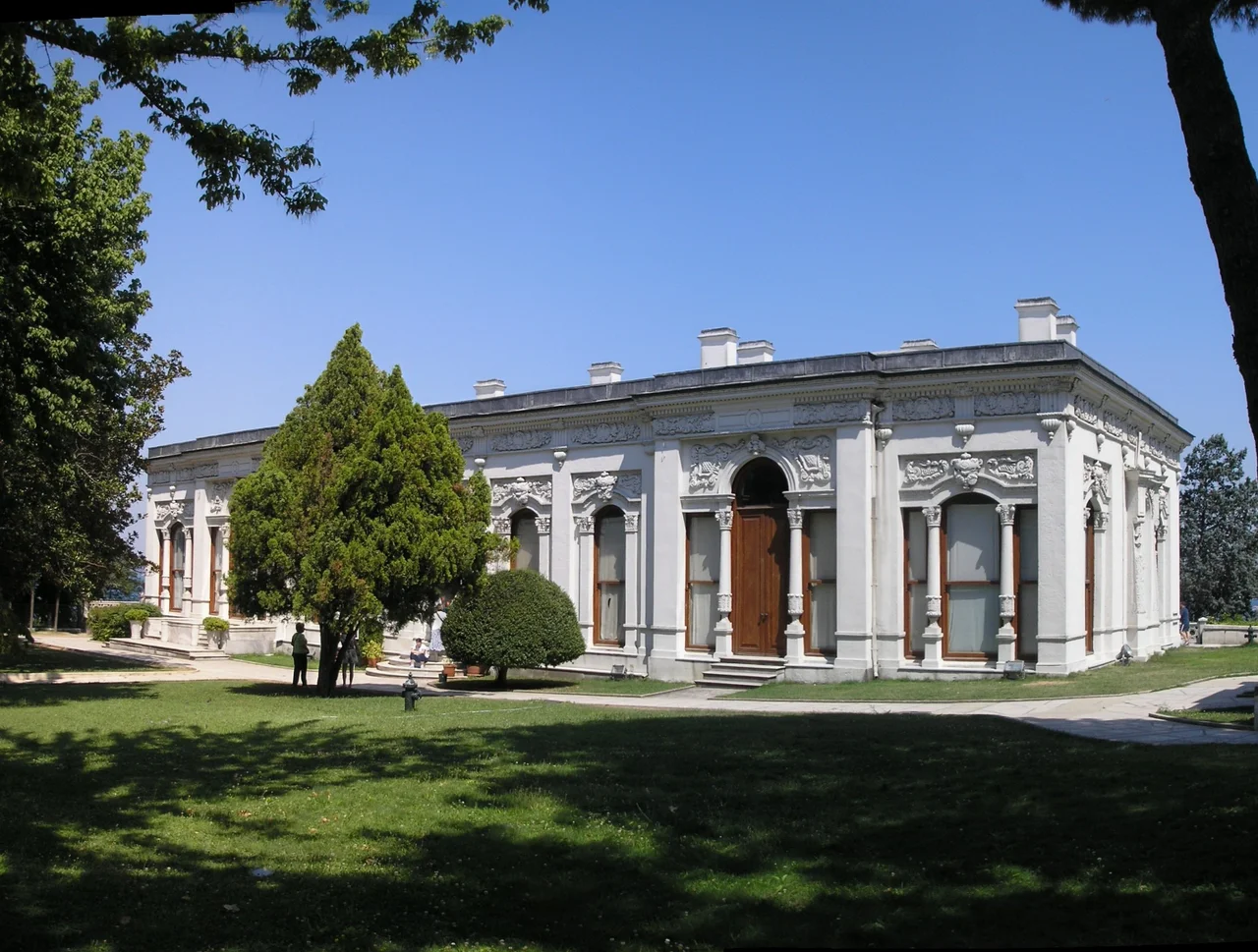

Topkapı Palace
The Ottomans called it the Palace of Felicity. European travellers described it as irregular, asymmetric, non-axial — puzzling to eyes accustomed to the ordered symmetry of Versailles or the Vatican. They were missing the point. Topkapı Palace was not designed for display. It was designed for power: layered, guarded, intentionally opaque, built so that the sultan at the center could observe everything while remaining unseen. From the 1460s until 1856, it was the administrative heart of an empire stretching from Hungary to Yemen, from Algeria to Iraq. Today it is a museum, and its rooms still hold the weight of what happened inside them.
The Promontory and Its Purpose
Sultan Mehmed II ordered construction to begin in 1459, just six years after his conquest of Constantinople. The site was the Seraglio Point — Sarayburnu — a promontory where the Bosphorus Strait meets the Sea of Marmara, with views of the Golden Horn to the north and the Asian shore across the water. The acropolis of ancient Greek Byzantion had stood here. The Great Palace of the Byzantine emperors had stood nearby. Mehmed chose the highest point of the headland for his private quarters and arranged everything else in descending circles of access and intimacy, from the public First Courtyard at the gate to the innermost Third and Fourth Courtyards where only a handful of people were permitted. The historian Critobulus of Imbros wrote that Mehmed summoned the best craftsmen from everywhere: masons, stonecutters, carpenters. Construction of the inner core was completed by the mid-1460s. The palace would grow and change for four more centuries, but its essential logic — concentric courts, maximum seclusion, power expressed through controlled access — was Mehmed's from the beginning.
Courtyards of Protocol and Silence
Walking through Topkapı is walking through a graduated system of permission. The First Courtyard was effectively public — a park where court officials and Janissaries assembled, where the Byzantine church of Hagia Irene stood repurposed as an Ottoman armory, where the Imperial Mint operated. Through the Gate of Salutation — where everyone except the sultan had to dismount — the Second Courtyard opened: the Divan Square, where the sultan held audiences from a gold-plated throne and where foreign ambassadors delivered their credentials. One French ambassador wrote a detailed account of the spectacle: thousands of officials in ranked silence, the sultan elevated and still. Silence in the inner courtyards was not merely custom but law, codified by Mehmed II in 1477 and 1481. The idea was that imperial dignity was too great to be accompanied by noise. Power, in this palace, was enacted through quiet. Through the Gate of Felicity lay the Third Courtyard, the heart of the palace, accessible to only the most senior officials. Beyond that, the Fourth Courtyard and its pavilions — the sultan's most private space, looking out across the water.
The Treasury and What It Holds
The Imperial Treasury occupies a four-room pavilion at the top of the promontory, with views of the Bosphorus and the Sea of Marmara from its porch. The collection it contains is staggering in its breadth. The Topkapı Dagger — its golden hilt set with three large emeralds, its scabbard covered with diamonds — was made in 1746 as a gift for Nader Shah of Persia; the Shah was assassinated on June 20, 1747 while the gift was in transit, and it remained. The Spoonmaker's Diamond, set in silver and surrounded by 49 cut diamonds, has a murky provenance involving a bazaar purchase, a confiscated fortune, and possibly Napoleon Bonaparte's mother — none of the origin stories can be verified, and all of them suit the object's spectacular aura. Two solid gold candleholders, each weighing 48 kilograms and set with 6,666 cut diamonds, were given by Sultan Abdülmecid I to the Kaaba in Mecca and later returned to Istanbul. The Piri Reis world map of 1513, drawn by the Ottoman admiral and cartographer, is held in the Third Courtyard's Enderun Library — showing the coasts of Europe, North Africa, and a recognizable Brazil at a moment when European knowledge of the Americas was barely a decade old.
The Harem: Lives Behind the Gate
The Imperial Harem occupied more than 400 rooms, a vast wing of the palace that was added in its present form at the end of the sixteenth century after a great fire destroyed the Old Palace where the sultan's household had previously lived. Many of its rooms and features were designed by Mimar Sinan. The harem was home to the Valide Sultan — the sultan's mother, who wielded enormous institutional power — as well as to the sultan's wives, concubines, children, servants, and the eunuchs who guarded the gates. The women and children who lived there included women who had been enslaved and brought from across the empire and beyond its borders — from the Caucasus, from the Balkans, from sub-Saharan Africa. They lived under a strict hierarchical system, and the most favored among the concubines could rise to tremendous influence: Hürrem Sultan, wife of Suleiman the Magnificent, was the first consort to move permanently into Topkapı from the Old Palace, a shift that broke with Mehmed II's explicit prohibition on women residing where state business was conducted. Her move changed the power structure of the empire. The privy chambers within the harem reflect centuries of refinement: the Chamber of Murad III, designed by Sinan, is the oldest surviving room and among the finest; Ahmed III's Privy Chamber, known as the Fruit Room for its painted panels of floral designs and bowls of fruit, is among the most colorful. These rooms were the daily reality of lives largely invisible to the historical record — a reality worth holding in mind when walking the tiled corridors.
From Capital to Museum
By the mid-nineteenth century, Topkapı had become an embarrassment — not for its history but for its lack of contemporary comfort. European palaces were grand unified structures with ballrooms and wide staircases; Topkapı was a labyrinth of old pavilions that European visitors found quaint at best, primitive at worst. Sultan Abdülmecid I made the decisive break in 1856, moving the imperial court to the newly built Dolmabahçe Palace on the Bosphorus shore — a European-style building with parquet floors, a crystal chandelier that weighs four and a half tons, and a formal throne room designed to impress foreign visitors. Topkapı kept its treasury, library, and mint. After the Ottoman Empire ended in 1923, a government decree dated April 3, 1924 transformed Topkapı into a museum. UNESCO recognized the Historic Areas of Istanbul — including Topkapı — as a World Heritage Site in 1985. The palace complex receives millions of visitors each year. The rooms are still guarded, as they always were. The silence in the inner courtyards, though of a different kind now, still holds.
From the Air
Topkapı Palace sits at the tip of the historic peninsula at approximately 41.012°N, 28.984°E — the point where the Bosphorus, the Golden Horn, and the Sea of Marmara converge. From the air, Sarayburnu is one of the most recognizable geographical features of Istanbul: the palace's distinctive promontory shape is visible from a wide range of altitudes, with the dome of Hagia Sophia immediately to the west and the Blue Mosque beyond it. At around 2,500 feet, the full historic peninsula layout is clear — the palace occupying its northeastern tip, the old city walls visible running south and west. Istanbul Airport (LTFM) is approximately 35 km to the northwest. Gülhane Park, the large imperial flower garden that borders the palace's western and southern sides, appears as a green wedge from the air.
Nearby Stories
- Kocaeli Peninsula 7.6 km away
- Second Battle of Çatalca 11 km away
- Istanbul's Rural Outskirts 14 km away
- MV Struma 20 km away
- HMAS AE2 36 km away
- Bursa 66 km away
- Sangarius Bridge 71 km away
- Januarius MacGahan 101 km away