
Union Mill, Cranbrook
Mary Dobell went bankrupt in 1819. The mill her son Henry had been working - built only five years earlier, the tallest smock mill in Britain - passed to a union of her creditors, and the name stuck. Union Mill: a quiet monument to commercial failure dressed up as cooperative ambition. The mill rises seventy-two feet above the Kentish skyline at Cranbrook, a three-storey timber smock perched on a four-storey brick base, white-painted and visible from miles away. It is the tallest smock mill in the United Kingdom and one of the few still operating. James Humphrey, the Cranbrook millwright who built it in 1814, would not recognise some of the changes - the patent sails, the fantail, the gas engine that briefly replaced the wind - but he would recognise the silhouette.
The Mary Dobell Years
Mary Dobell commissioned the mill in 1814 at a cost of £3,500, an enormous investment for the time. Her son Henry was meant to run it. James Humphrey, a local Cranbrook millwright, designed and built the structure - a seven-storey building combining the traditional smock mill design with a substantial brick base that gave it unusual height and stability. The smock itself is octagonal, the slanted weatherboarded sides giving the building its characteristic flared profile, like a peasant's smock-frock seen from the side. Five years after completion, Mary Dobell was bankrupt. The mill became the property of her creditors collectively - a union of debts secured against a single building - and the name Union Mill entered Cranbrook's vocabulary.
The Russell Dynasty
John and George Russell bought the mill in 1832, and it remained in the Russell family for five generations. Ebenezer Russell. Hugh Russell. Caleb Russell, who worked it from 1902 to 1918. John Russell, who took over from his father and milled with it until 1957 - a remarkable run of family continuity through the agricultural revolutions of the nineteenth and twentieth centuries. In February 1935, John Russell received the very first certificate ever issued by the Society for the Protection of Ancient Buildings, recognising his zeal in the maintenance of his mill. He had kept the mill running not only as a commercial concern but as a preserved piece of working engineering, repairing rather than replacing, keeping the original mechanisms turning when most British mills had switched to roller mills or shut down entirely.
Steam, Gas, and Wind
Union Mill's history is also a history of competing power sources. In 1863, a 10-horsepower steam-powered beam engine by Middleton of Southwark was added, supplementing the wind sails with consistent mechanical power. An extra pair of millstones came from a steam mill in Smarden to make use of the new capacity. The beam engine was replaced in 1890 by a rotary steam engine from Clarke's of Ashford. That proved unsatisfactory and was swapped within a year or two for a Fowler horizontal steam engine. In 1919, the steam engine gave way to a suction gas engine - cleaner, cheaper, requiring no boiler. The mill kept working with the gas engine into the early 1930s, by which time the four patent sails had effectively become picturesque additions. Wind power had been outcompeted by steam, which had been outcompeted by gas, which would in turn be outcompeted by electric mills no Kentish village could match.
Restoration
John Russell retired in 1957, and Kent County Council bought the mill. He died on 18 June 1958, four months later - the day, in a strange piece of timing, that restoration work began. The restoration cost £6,000, the same sum the mill had been bought for from Russell, and was completed in 1960. The Dutch millwright Christiaan Bremer of Adorp in Groningen was employed to make new stocks - the heavy timber crosspieces that carry the sails - and made them in the Dutch style rather than Kentish practice. The stocks lasted over forty years before being replaced again with proper Kentish stocks in accordance with SPAB guidelines. Rex Wailes, the great mill historian who had documented British windmills for decades, presided over the official reopening. The mill was operational again. The fantail kept it pointing into the wind.
Patent Sails and Working Gears
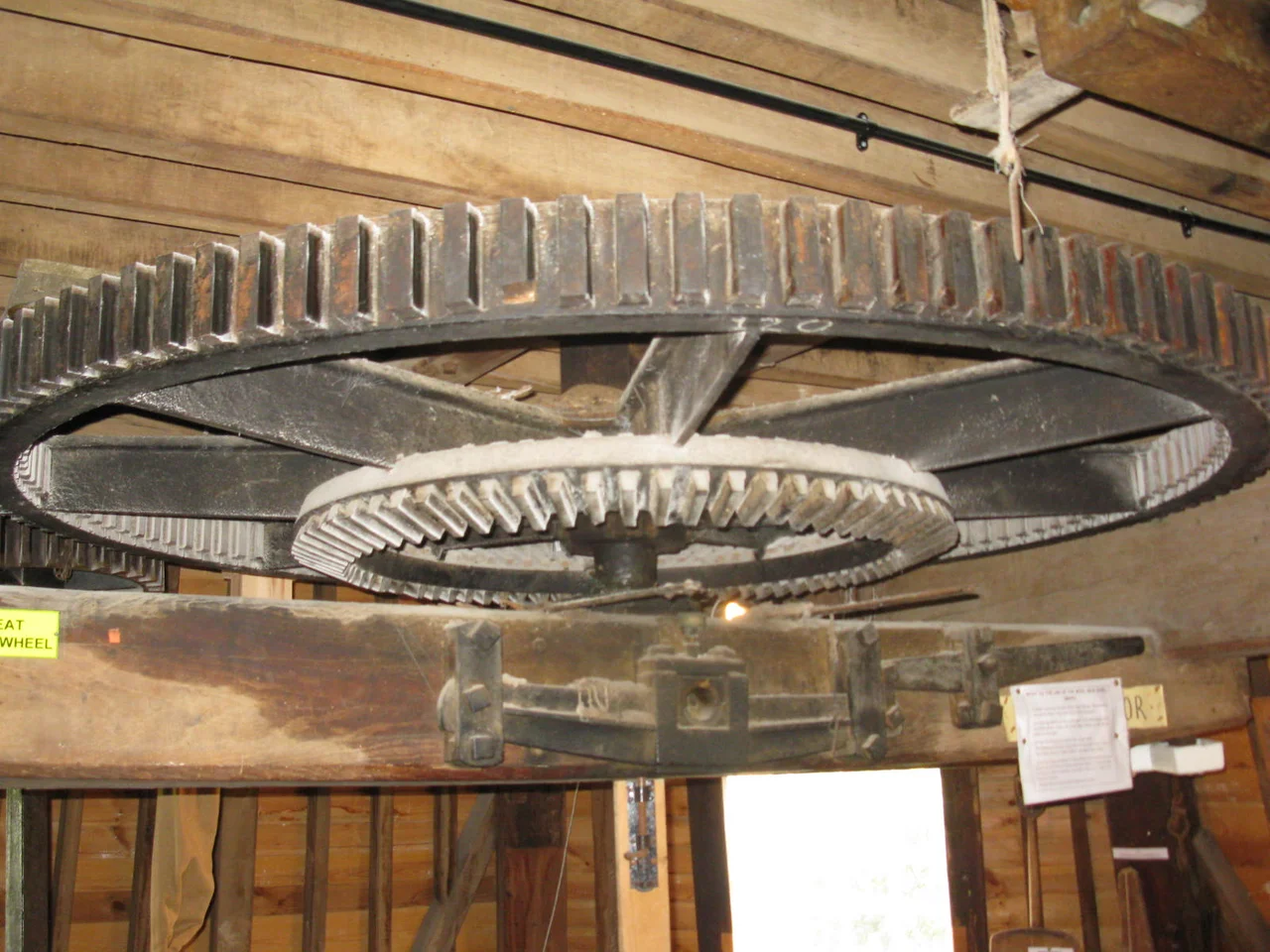
Inside Union Mill, the machinery still works in the way it always has. The patent sails - the kind with adjustable shutters that automatically respond to wind pressure - feed into the canister on the cast-iron windshaft. The windshaft carries the brake wheel, which drives the wallower at the top of the upright shaft and a sack hoist for moving grain to the upper floors. At the bottom of the upright shaft is the great spur wheel, which once drove three pairs of millstones. Two pairs remain. The mill also retains a pair of 4-foot French Burr stones for fine flour, a pair of Peak stones for coarser meal, and the 4-foot stones acquired from Beacon Mill at Benenden in the 1920s. A crown wheel drove auxiliary machinery - the wire machines, the bolters, the bagging mechanisms that turned wheat into flour and flour into the bread of a small Kentish town. The Cranbrook Windmill Association maintains it now. The wind still blows through the Weald.
From the Air
Located at 51.10 degrees N, 0.54 degrees E, at the north end of Cranbrook village in the Weald of Kent. Union Mill is the dominant vertical feature in Cranbrook's skyline - a white-painted smock mill rising seventy-two feet above the surrounding rooftops, visible from miles away. Nearest airports: London Gatwick (EGKK) twenty-six miles west, Lydd (EGMD) eighteen miles southeast. Best viewed at 1,500-3,000 feet on clear days, with the mill clearly distinguishable as a tall white tapered tower among Cranbrook's red-tiled roofs.
Nearby Stories
- Saltwood Castle 2.8 km away
- Jezreel's Tower 5.4 km away
- Bethlem Royal Hospital 6.2 km away
- Herne Bay Pier 6.7 km away
- Royal Sovereign Lighthouse 11 km away
- Plymouth Brethren 15 km away
- Battle of Boulogne 40 km away
- Fratton Park 75 km away