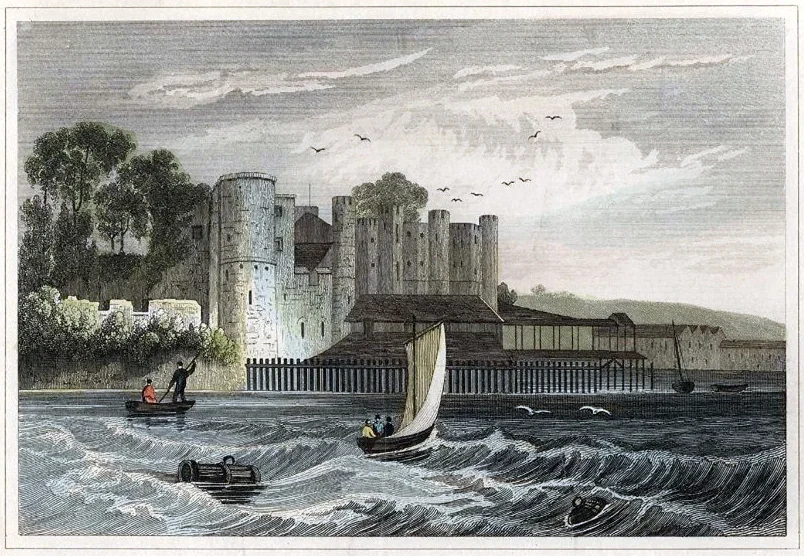

Upnor Castle
On the morning of 12 June 1667, a Dutch fleet under Admiral Michiel de Ruyter sailed up the River Medway, broke the chain stretched across the river, set fire to half a dozen English warships at their moorings, and towed away the Royal Navy's flagship, HMS Royal Charles. It was the worst defeat the Royal Navy has ever suffered on home water. Almost the only thing that worked properly in the English defences that day was Upnor Castle. The Elizabethan brick-and-timber fort on the Medway's west bank had no fresh powder, no resupply, and a garrison that fired until they had 'hardly a gun left upon the carriages, so badly provided they were' - the words are Samuel Pepys's. And yet their fire, combined with a hastily improvised eight-gun battery thrown up beside the castle the previous night, was enough to make the Dutch break off their second attempt to reach the dockyard at Chatham. Upnor Castle was outgunned, outmanned, and unprovisioned, and still made the Dutch retreat.
Why Build It Here
The Medway above Sheerness is a slow, sheltered, mud-banked tidal river that meanders between hills for about ten miles before reaching Rochester Bridge. It has no rocks, no strong currents, and excellent shelter from the south-west wind. For a sailing fleet, it is almost the ideal anchorage. By the time Elizabeth I came to the throne in 1558, most of the Royal Navy spent its winters laid up 'in ordinary' on Chatham and Gillingham Reaches - that is, on this stretch of the Medway. The trouble was that Henry VIII had defended the Thames with five blockhouses but had not defended the Medway with anything. Rochester Castle and Queenborough Castle existed, but both were built to defend land approaches. The fleet was sitting unprotected at anchor in a tidal river without serious river defences. Elizabeth ordered a fort. Construction at Upnor began in 1559.
Lee, Locke, and Watts
The military engineer Sir Richard Lee was given the design assignment, but he was already busy fortifying Berwick-upon-Tweed against the Scots, so the project was largely carried out by his deputies to his designs. Humphrey Locke served as overseer, surveyor, and chief carpenter. Day-to-day management and the accounts fell to Richard Watts, the former mayor of Rochester and victualler to the Royal Navy. The Crown bought the land for twenty-five pounds. The castle, completed in 1567, was a two-storey main building of brick, with a triangular gun bastion - the Water Bastion - projecting into the river. By 1596, with the Anglo-Spanish War on, Lord High Admiral Charles Howard had got the garrison up to eighty men, each paid eightpence a day. A chain was stretched across the Medway below the castle to physically block any attacking fleet. A wooden palisade in front of the Water Bastion blocked landings. A ditch some five and a half metres deep was dug around the landward side, with a gatehouse and drawbridge.
Twenty Guns and Thirty-Four Longbows
A 1603 survey recorded the castle's armament in detail. Twenty guns of various calibres in the castle itself: a demi-cannon, seven culverins, five demi-culverins, a minion, a falconet, a saker, and four fowlers (small breech-loaders) with two chambers each. Another eleven guns split between two outlying sconces called Bay and Warham. The garrison kept thirty-four longbows on the racks - in 1603, archery was still considered to have military value at close range. A royal visit followed in August 1606: King James, Anne of Denmark, her brother Christian IV of Denmark, and Prince Henry came up by barge from Rochester for dinner. The naval engineer Phineas Pett arranged the venue - the Elizabeth Jonas, with a timber bridge connecting it to a second warship, the Bear, and a third hulk serving as a floating kitchen. After dinner the royal party went on by coach to Gravesend, stopping along the way to watch cannon salutes from Windmill Hill.
The Civil War and the Dutch Raid
When the Civil War broke out in 1642, the castle fell to Parliament without a shot fired and was used to intern Royalist officers. A Kentish royalist uprising briefly retook it in May 1648 before being defeated at the Battle of Maidstone on 1 June. Sir Thomas Fairfax inspected the recovered castle and ordered the gun platforms strengthened and the towers built up. The Restoration in 1660 brought peace, neglect, and reduced funding. By 1667, when the Second Anglo-Dutch War turned bad for England, the Medway defences were in a sorry state. On 12 June the Dutch fleet appeared. They broke the river chain. They burned ships at Chatham. They towed the Royal Charles away with them - it remains the only English flagship ever captured by a foreign fleet on home water. But when they attempted to sail past Upnor a second time, the Duke of Albemarle's hastily improvised eight-gun battery at the castle, combined with the castle's own dwindling guns and muskets, made the cost too high. The Dutch broke off and withdrew. Pepys saw clearly what had happened: the castle survived, the garrison fought well, but the larger defeat was about to be politically dressed up as anything but.
From Fort to Powder Magazine
The Dutch raid was a national humiliation. The government's response was twofold: build stronger forts further downriver - which led, eventually, to the great casemated Victorian works at Garrison Point Fort, Hoo, and Darnet - and convert Upnor itself from a fighting fort into a gunpowder magazine. From 1668, the castle's role changed entirely. The second storey was extended over what had been rooftop gun platforms, increasing storage capacity. The ground floor was divided into compartments with a wooden-block floor and copper-sheeted doors to reduce the risk of sparks. A windlass was installed to raise stores from the waterside. Two large Turkey oaks were later planted in the courtyard, said to have been grown from acorns brought back from Crimea after the Crimean War. By 1857 the depot also had a separate 1810 magazine and a new 1857 magazine downstream, with capacity between them for 33,000 barrels of gunpowder.
Guncotton and the Twentieth Century
In 1899 the castle was being used to store dry guncotton, an explosive so volatile that the safer 'wet' form was kept on board hulks moored out in the river. This practice was discontinued soon afterwards as specialist magazines were built at Lodge Hill, connected to Upnor via a narrow-gauge railway. After the First World War the castle became Royal Naval Armaments Depot Upnor, one of a national network of RNADs; for a while the castle was used as a proofyard for testing firearms and explosives. Two German bombs damaged it in 1941. It remained in military use as part of the Magazine Establishment until 1945 - nearly four hundred years of continuous service since Elizabeth I had ordered it built. After the war the castle was decommissioned and opened to the public. It is now an English Heritage property. The barracks block just south-west of the castle, built around 1718 to replace the original troop accommodation when the main building was converted into a magazine, still stands - one of the earliest distinct barracks built anywhere in England.
The Sound of the Guns Falling Silent
Standing today on Upnor's water bastion you look directly across the river at the Chatham Historic Dockyard - the place the castle was built to defend, the place the Dutch came to burn. In the channel between, the river is quiet in a way it has not always been. Charles Howard worked here. Phineas Pett's floating banqueting hall floated here. The chain that the Dutch broke ran from here to the opposite bank. The first sustained naval bombardment of an English fort by an enemy fleet on English soil happened on the water you can see from the wall. The fort is small for its weight in history. The two Turkey oaks in the courtyard - the ones grown from Crimean acorns - have outlived four British dynasties and a navy. The barracks behind the castle look almost exactly as they did when George I was on the throne. And the bricks of the Water Bastion are still arranged in the pattern Humphrey Locke laid down for Elizabeth in 1567.
From the Air
Coordinates 51.4069 N, 0.5269 E, on the west bank of the River Medway in Upnor, Kent, just downriver from Chatham Historic Dockyard on the opposite bank. From the air, identify Upnor Castle by its small rectangular footprint with the triangular Water Bastion projecting into the river, set in a green riverbank just north of the village. The Chatham Historic Dockyard complex is directly across the river to the east. Recommended viewing altitude 1,500-3,000 feet. Nearest airports: Rochester (EGTO) 4 nm south, London City (EGLC) 23 nm west, London Southend (EGMC) 12 nm north across the Thames.
Nearby Stories
- Waltham Abbey Royal Gunpowder Mills 1.6 km away
- Bethlem Royal Hospital 4.4 km away
- Sissinghurst Castle Garden 5.6 km away
- Chelmsford 6.5 km away
- Herne Bay Pier 6.7 km away
- Operation Stack 7.1 km away
- St Osyth's Priory 13 km away
- Plymouth Brethren 24 km away